Blog

Christmas at the Movies: Home Alone and Hilarity

home-alone-boyGUEST POST: Pastoral Intern Carter Whyte

This week we began our “Christmas at the Movies” series – using classic Christmas movies to help shed new light on Jesus’ coming to earth. The enjoyable viewing of Home Alone served two purposes for this first message in the series: it taught us about our forgetfulness, and it forced us to put the message into action by having fun.

Just like Kevin’s parents forgot him at home when they went away for Christmas, oftentimes Christians forget something very important when we enter this holiday season: Joy!

We read in Luke 2 that when an angel announced Jesus’ birth to nearby shepherds, the angel proclaimed, “I bring you good news that will be great joy to all people.”

How often do we celebrate because of Jesus? 

Sometimes Christians become fun-suckers, boring, and somber. We may try to rationalize these attitudes by saying that being serious and focused are important because we have a mission to complete and our days are numbered. But think: If the good news is supposed to bring joy into our lives, can we possibly spread the message of this good news without bringing joy along?

We know that joy is good! Laughter refreshes us! Doing fun things relieves us of the worries we have been carrying around! None of us want to go to work every day when there is absolutely nothing pleasurable about it.

There is a time for sorrow, and mourning, and self-reflection. But there is also a time for joy, and shouting, and self-expression! And Christmas is that kind of time!

Christian maturity should lead to more joy, as a result of a deeper connection with the Spirit that produces joy, and the Jesus that brings joy to the world! So let’s be mature this Christmas and let our lives be filled with joy because of Jesus.

  • With still a few weeks until Christmas, why not consider adding in some extra celebrations with your family and the people around you?
  • Invite people from work over to have a fondue dinner!
  • Do something new and exciting with your spouse!
  • Add something new to a traditional Christmas dinner – invite your family into a sing-along, or invite somebody new along! (Or write a poem!)
  • Join in with your kids when they are silly, or build a gingerbread house with them this Sunday for the competition in Plattsville!

Don’t forget to have joy and spread joy to others this Christmas!

Sermon Notes:

Big Idea: Don’t forget to bring joy with you this Christmas. 

Teaching Points:

  • Sometimes it’s easy to forget the most important things
  • “I bring you good news that will bring great joy to all people”
  • God is about Joy, and the instigator of Joy
  • You don’t win points by being more conservative than God
  • Don’t forget to have fun this Christmas.

Adult Discussion Questions:

What stuck out to you from the sermon? What was challenging to you? What was new? What was funny? When have you forgotten something important? What brings you joy at Christmas? How can you spread joy? How can you have fun? What can you do today to bring joy to your family?

Discussion Questions / Responses for Young Families

Ask your kids what is most fun thing to do at Christmas. Then go do it.

Challenge for the Week: To go have fun!
Christmas at the Movies

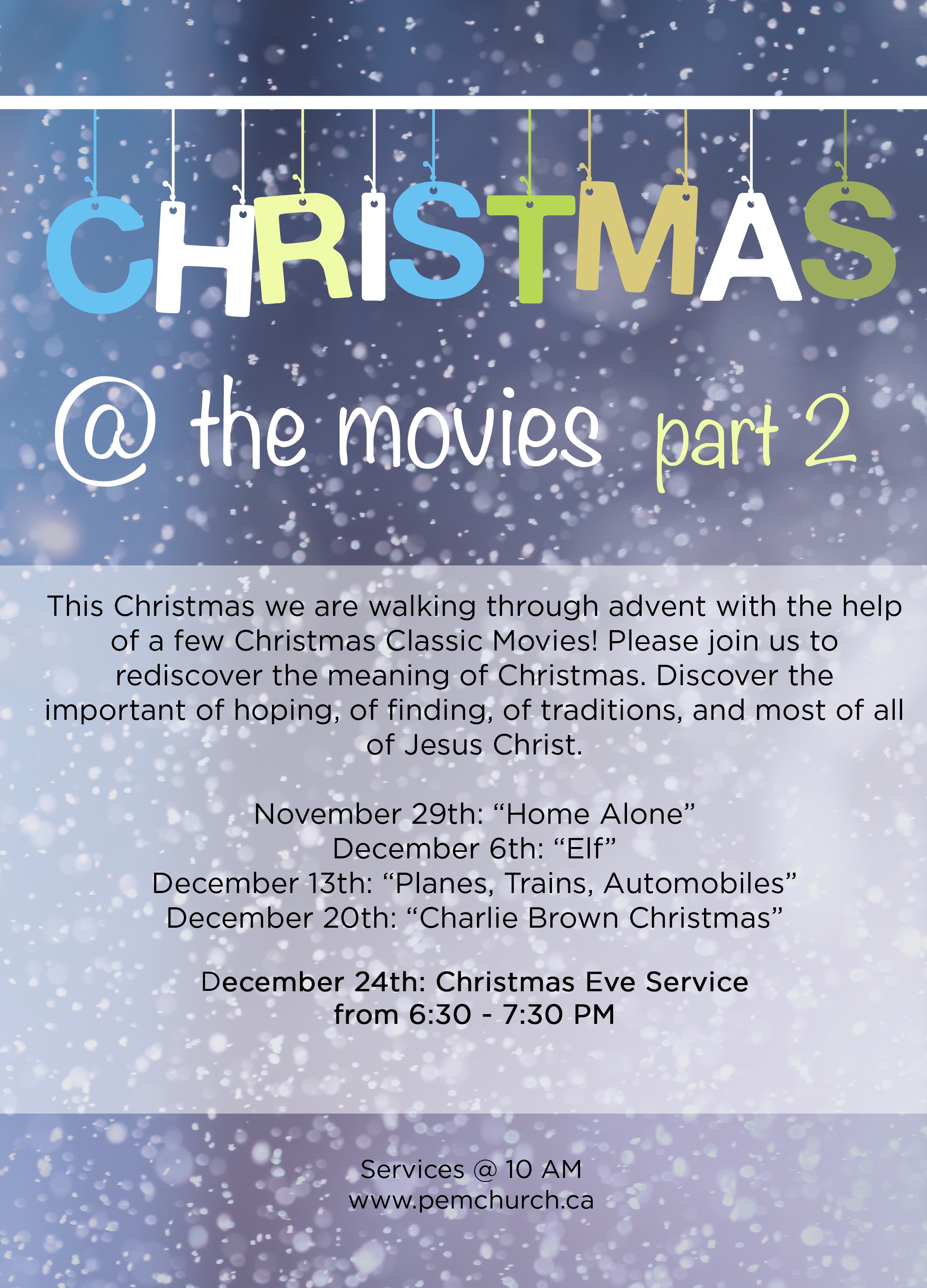
So on Sunday we are opening up a new series for Advent – Christmas at the Movies Round 2! We did this last year and people really liked it so we are going for it again. I’m going to be trying to tie in all sorts of movies to help reveal the truth about Christmas.

Sometimes Christmas becomes so familiar that we forget the key things about it. So join with us as we look at some classic movies to learn some new things about joy, about Elf, about gathering together, and learning to be grateful. Hope you can join us!

Christmas Movies

Leadership Like the Dawn

dawn-2-1504573-1280x960I stumbled across this verse and it just jumped out. Listen to it deeply especially if you are a leader of any kind. Because here is a beautiful description of what power, authority, and leadership should be. It’s poetry but that’s why it’s so inspiring:

When one rules justly over men, ruling in the fear of God, he dawns on them like the morning light. (2 Sam 23:3-4)

I think that’s just a beautiful picture of leadership rightly exercised. That when leadership is done rightly it’s like “he dawns on them like morning light”. That when leaders are full of justice and fear of God, their leadership isn’t heavy and burdensome. It’s soft, it’s light, it’s full of future and promise like an early morning. And just as the dawn creeps up pushing away darkness, this is what it’s like when someone rules justly and in the fear of God.

When I think about my leadership if someone were to describe it like that to me, I would be honored. That’s what I hope for, that my leadership would be like the breaking of the dawn. My guess is if you are a leader you hope that too.

So what can you do today to start to live into that vision of leadership? Because it’s worth chasing after, just like the dawn chases after the night.

The Book that Almost Wasn’t: Prayer, Healing and Revival – James 5

always-there-1314423-1600x1200On Sunday we opened up a favourite passage of mine in James 5. In James 5:13-18 we read this:

Are any of you suffering hardships? You should pray. Are any of you happy? You should sing praises. Are any of you sick? You should call for the elders of the church to come and pray over you, anointing you with oil in the name of the Lord. Such a prayer offered in faith will heal the sick, and the Lord will make you well. And if you have committed any sins, you will be forgiven. Confess your sins to each other and pray for each other so that you may be healed. The earnest prayer of a righteous person has great power and produces wonderful results. Elijah was as human as we are, and yet when he prayed earnestly that no rain would fall, none fell for three and a half years! Then, when he prayed again, the sky sent down rain and the earth began to yield its crops.

And here James shares with us some incredibly practical advice about prayer, healing, and sickness. James calls us all to pray if we are hurting, or in joy, that prayer should be our response (verse 13). And then he gives some incredibly practical advice – if you are sick you should call in the elders.

The truth is that sickness has a tendency to isolate and to separate and James knows that in sickness we need others. So he says invite the elders in to pray, anoint, and support someone who is sick. This is because in sickness it can be so difficult at times to pray, so he says rely on the prayers of others. Be anointed a symbol of the Holy Spirit, and it was also thought to be medicinal. So pray for healing, and don’t shy away from those in the healing profession and medicine for help as well.

James says bring in supports to care, love, pray, and anoint and to find God willing to heal.

We also looked at the importance of confession, of the phrase the “name of the Lord” and a few others things. But most importantly, we landed not on more teaching about prayer, or about how to pray. We landed on whether or not we trust in prayer.

Because the truth is, if we know all about it, and even if I challenge people to practice it – if we don’t trust in prayer and in God, it won’t make a difference. So I asked us all to consider this question, “Do you trust in prayer and God to use prayer”. In spite of all the questions, the suffering we see, all the legitimate doubts and difficulties – do you trust in prayer?

Because I believe that prayer is worth trusting in. I believe that prayer actually changes the world. I believe that even in spite of the doubts I have at times, like anyone, that prayer matters.

So we ended with a challenge to prayer, and then ended the service with the only way that seemed appropriate. We invited people forward for prayer. And today if you are struggling in any way, I think today is the day to invite people in your life to pray. Because prayer matters, and prayer changes lives.

Sermon Notes:

Big Idea: Pray. Pray. Pray.

Teaching Points:

  • No profound theologian, James’ genius lies in his profound moral earnestness; in his powerfully simple call for repentance for action, and for a consistent Christian lifestyle. Douglass Moo
  • Wherever we are at in life prayer is to be part of our life.
  • Sickness has a way of separating us.
  • Oil was medicinal and a symbol of the Holy Spirit and God’s consecrating.
  • To pray in the name of the Lord is to pray and act as his representative and in his authority.
  • Do you trust in prayer?
  • It is God who is the healer.
  • Pray. Pray. Pray.

Adult Discussion Questions:

What stuck out to you from the sermon? What was challenging to you? What was new? What is your view of prayer? When have you seen a prayer answered? What are your questions concerning prayer? Who do you know that needs prayer and support? Who can you confess your sins to? Are you willing to?

Discussion Questions for Young Families

Talk to your kids today about the power of prayer. Ask them what they think prayer is? Ask them who they should be praying for – and then spend time in prayer with them.

Challenge for the Week: To trust in the power of prayer.

Prayer and Revival

just-hands-1550395-1280x960On Sunday we are going to talk about prayer. Prayer is something that is really important and should be part of the regular fabric of our lives. Prayer is something that really releases God to work in the world and in our lives.

So on Sunday I am going to teach on prayer, but more importantly we are going to have a chance to practice prayer. We are going to have a time to actually pray for another. We are going to have a time to anoint people with oil,  because I believe that prayer can heal. Prayer can change lives. So that’s where we are going on Sunday. We are going to be looking at this passage:

Are any of you suffering hardships? You should pray. Are any of you happy? You should sing praises. Are any of you sick? You should call for the elders of the church to come and pray over you, anointing you with oil in the name of the Lord. Such a prayer offered in faith will heal the sick, and the Lord will make you well. And if you have committed any sins, you will be forgiven. Confess your sins to each other and pray for each other so that you may be healed. The earnest prayer of a righteous person has great power and produces wonderful results. Elijah was as human as we are, and yet when he prayed earnestly that no rain would fall, none fell for three and a half years! Then, when he prayed again, the sky sent down rain and the earth began to yield its crops.

Hope you can join us.

The Good and Bad Kind of Authority of a Leader

??????????Leadership is authority. There is no other way around that fact. But in today’s culture we don’t like authority. We don’t’ like being told what to do. We don’t like following authority or obeying authority. We like to become self-made people by each of us rebelling against the same authority (there is irony in that).

But I want to talk about the authority of a leader. Because I still believe that leadership is authority, but the type of authority really matters. Because there are different kinds of authority. There is authority that is based in power, and authority that’s based in gift (people choosing to follow and give you permission to lead).

And this distinction between the kinds of authority is so necessary. And the trouble is that most leaders haven’t consciously decided which type of authority they will rely on. The authority based in power (you have to do what I say) or the authority based in permission (you listen because you choose to).

In my role I’ve decided to never use coercive authority based in power. I could, lots of pastors do, especially when things get sticky and messy. They might say, “I am God’s anointed”, or “I’m the leader”, or even worse “I speak for God”. And the same temptation is for all leaders. That when things get tough, when stress rises, when there is crisis people reach to use power rather than authority based in grace that is given.

Parker Palmer gets at the difference when he writes this,

“The authority such a leader needs is not the same as power. Power comes to anyone who controls the tools of coercion, which ranges from grades to guns. But authority comes only to those who are granted it by others.”

So my question for you is this: what kind of leadership are you using? Is it based in power, or authority, based in grace and gift from others? Do people follow you because they “have to” or because “they want to”. And you might think that in the end the results are the same – as long as the job gets done. But it’s not – why people follow or listen to you is just as important as the outcome it produces.

So in your leadership with your authority is it power based – or people based? Because that small difference makes all the difference.

The Book that Almost Wasn’t: Devils, Distance, and Drawing Close ~ James 4

hand-of-god-1383050-1280x960On Sunday we looked at another pretty challenging teaching of James, but also one filled with hope and promise.

James writes this, ““So humble yourselves before God. Resist the devil, and he will flee from you. Come close to God, and God will come close to you”. (James 4:7-8)

James is sharing that the heart you respond to God with, is how he will respond to you. That if you are open to God, seeking God, humbling yourself to God – he will draw you close. But if you are pushing him away, fighting him, and rejecting him – God honours our freedom but still seeks to care and have compassion for us.

So James reminds us to check our hearts, to see if they are pushing God away, or opening up to him. 

James also reminds us that if we resist the devil he will flee from us. And as I’ve said before, even if you don’t believe in the devil, you’ve experienced him. In the Bible the devil is the source of accusation, fear, and someone who actively seeks to separate ourselves from God. The truth is we have all felt accusation, and fear which separates us from God.

James wants to remind us that this doesn’t need to be so. That if we just were to resist the accusation, the guilt, the fear, the separation, the devil would flee and we would move closer to God. That if we would but draw close to God, he will draw close to us and the devil must flee as we move closer to God.

We ended up with a pretty clear main idea, that we need to repent and rely on God. 

God promises to be there with us, to push away the devil, accusation, guilt, and fear but we need to repent and rely on him. As long as we are going our own way, as long as we assert our independence, as long as we pretend we don’t need him – he can’t help us. He can’t help us when we are resisting and pushing him away.

So on Sunday to make this real, we did something I don’t often do. We did an altar call. We invited people to simply come forward who wanted to physically say to God ~ I need you in some area. And that was it.

But sometimes we need to do something tangible to connect with God. And the truth is we are all broken and need God, so we can all use with doing something tangible. 

So if you are in the place where you need God today – do something tangible. Maybe kneel, maybe write out your needs, maybe ask someone to pray. But do something, because God’s promise is that if you move closer to him, he’ll move closer to you.


Sermon Notes:

Big Idea: We need to repent and rely on God.

Teaching Points:

  • “God gives what he demands” – Augustine
  • God will respond with the heart you have for him.
  • One of the primary roles of Satan is to separate God and people.
  • Draw close to God and he will draw close to you.
  • How often do we try to go it alone and hide our flaws?
  • We live with a lack of light, because we refuse to rely on him.
  • We need to repent and rely on God.

Adult Discussion Questions:

“The reason we struggle isn’t because we can’t overcome our failures, but because we are too proud to ask God to move.”  What do you think of this statement? Have you experienced the truth of these promises: that God WILL come near as we come to Him in true humility, and that Satan WILL flee from us as we resist him? What do you need to repent of? Confess? Get clean from? Admit? (Remember, this is how James says we come closer to God – it is crucial in our relationship with Him) About what things are you too proud to admit the truth? (Our pretending prevents God from working) How can you practically turn from these things and rely on God, beginning today?


Discussion Questions for Young Families

Have you ever needed help with something, but you didn’t want to admit that you couldn’t do it alone? How can we come to God today, letting Him be the one that helps us through our weaknesses and failures?

Challenge for the Week: To repent and rely on God…today.

Humility and the Devil

anybody-listening-1563751-639x852On Sunday we are going to be exploring James 4.

James 4 has lots of wonderful things within it, and also lots of challenging things. The area I want to focus on is this verse:

“So humble yourselves before God. Resist the devil, and he will flee from you. Come close to God, and God will come close to you”. (James 4:7-8)

I want to focus in on how we can draw close to God, on how we can be free from Satan – the source of accusation, fear, and separation. I want to look at how we can find life by moving closer to God.

The trouble is that to do this we need to admit that we need God. And admitting our failures is something most people struggle with, myself included. I don’t like to think that I’m broken, flawed, or in need of much. I don’t like putting myself in places where my lack of knowledge will be revealed – which is why I never go to hardware stores or near tools. But the truth is that we all have flaws, and that there is a beautiful promise of God. That if we would but humble ourselves, admit our need, move away from fear and guilt of the devil, towards God, we will find him drawing closer and closer.

And I’m not sure about you, but this is something that I want in my life.

So why not join with us on Sunday to discover how it can happen in yours.

Love is a dream that enables us both to be our Best

KONICA MINOLTA DIGITAL CAMERA

I read this other day by Joan Chittister as I’m working through one of her books. She writes this,

“Love is not a model that makes two people the same person. Love is the dream that enables both of us to be our own best person – together”

And I wish every single couple I’ve ever done a marriage for, or will do a marriage would sit and think about that.

So often in our world today love is seen as making the same, rather than cherishing differences. We love to make people into carbon copies of ourselves, to find compromises where we become almost indecipherable, where we try to find ourselves in other people, and this is well…it’s not love.

Not love in the way that the Bible talks about it. Love is what binds people together and holds them together, but it doesn’t make them the same. Just go read 1 Corinthians 13 – the well known “love chapter”. This chapter is all about how to love and hold people together, but it’s people who are different. This chapter is set right in the middle of a discussion about how to hold together people with different gifts, ideas, and opinions? Paul’s answer is love can do that. Not love that reduces people to common denominators. Not love that erases all differences. Not love that makes carbon copies. But love that enables both people to be their best.

Love, when it is truly love, doesn’t erase differences; it finds a way to hold onto those differences in harmony. Love actually loves people as they are, without tyring to make them into something else. We have a different word for people who try to change others into their version of perfection. We call that coercion, we call that conquest, we call that wrong when we’ve done that throughout history (see the Crusades, “settling” of the new world, or lots of other examples).

The point is that love doesn’t seek to squish and squash someone into a mold of sameness. Love is a dream that enables people to both be their best. And that’s something worth striving for.

So in your closest relationships today – is there a way that you can help them to reach their dreams? Is there a way that you can both move towards your best? Does it start with a conversation saying – I want you to find the best and be part of that? Does it start with a surprise or a gift? It certainly starts with some effort, so why not give that a shot.

The Book that Almost Wasn’t: Angry Birds, and Angry Words ~ James 3

silence-1225624-639x1314On Sunday we looked at James 3. This is a very famous passage on the power of the tongue. How our words can destroy like fire, or how a little piece of our bodies can control our destiny. James wants us to control our tongues so we can gain control over every other area of our lives. James puts it this way, “We all make mistakes, but those who control their tongues can also control themselves in every other way”. And that’s very true, as we gain self-control in this area of our lives, it spills over into all areas of our lives.

And to help us gain control, James wants us to envision a life without a wasted word. Can you imagine how much better your relationships, your friendships, or your family would be if you never said a word or phrase you regretted. James realizes that learning to control your words will bring a huge benefit to you and to the entire world.

So we landed on a really obvious main idea: Control your tongue. Not a new idea but a necessary and needed idea. All of our lives, careers, and relationships would be better if we could actually learn to control our tongues.

So we spent the majority of our time on some practical ways to gain mastery over this one area that causes so much difficulty.

The first point was to slow or stop our words. So often we speak without thinking, our thoughts simply flow out without any checks or balances. Very rarely have I ever regretted not saying something, often have I regretted saying something. So the first step is to stop or slow our words if we want to control our tongues. The truth is more than likely we can always go back and say things that were left unsaid, but never unsay something that was said. So that was the first step.

The second step was to actually choose our words. So often we don’t’ think through “will this help”, “will this change anything”, “is this the right time to share”. Instead, we respond to our feelings and reactions and rather than choosing our words carefully, regret our words frequently. So the second little step was to choose our words carefully when speaking. We do this in every important interaction in our lives, but forget it in our everyday lives. We choose our words carefully at job interviews, at important meetings, or in presentations – and then forget to choose them carefully with our spouses, friends, and kids. This is what needs to change.

Lastly, we looked at an amazing little video by Pixar called “For the Birds”. This video shows really well the danger of groupthink and how communication is more than words. I reminded us that in groups it is particularly important to be wary of what we say. Because it is so easy to slide into peer pressure and scapegoating others. We also need to be wary that communication is bigger than words, and that we need to watch not only our words but our actions as well.

With all of this we ended with a simple and clear challenge: to review how we spoke once a day. I challenged everyone to put a reminder into their phones to go off once a day for them to review how we are doing with controlling our tongues. As long as we remain unaware we will remain unchanged. So my challenge was this: slow your words, and choose your words. And this will make not only your world better, but the world around you too!


Sermon Notes:

Big Idea: Control your tongue.

Teaching Points:

  • The sixth sick sheikh’s sixth sheep’s sick – Hardest Tongue Twister
  • We love sharing everything about ourselves but have trouble editing what we say.
  • When you gain self-control in one major area It spills over into every other area of your life.
  • Control your tongue.
  • Rarely have a I regretted something not said.
  • Slow or stop your words before speaking.
  • Choose your words before sharing.
  • Groups can bring out our worst, so be wary.

Adult Discussion Questions:

What stuck out to you from the sermon? What was challenging to you? What was new? What did you like about the movie? When have you regretted saying something? Why do you think it’s hard to control your words? What are some good reasons to actually put effort into this? What relationships might be changed quickly if you really worked at this? Who can help you work at this?

Discussion Questions for Young Families

Today simply watch your words with your kids. Did you know that kids on average receive 7 words of criticism for each word of affirmation. Flip that today, and focus on affirming, and see how that changes things!

Challenge for the Week: Slow your words, and choose your words.