
Blog

Science, Relationships, and Spirituality: This is Your Brain in Anger

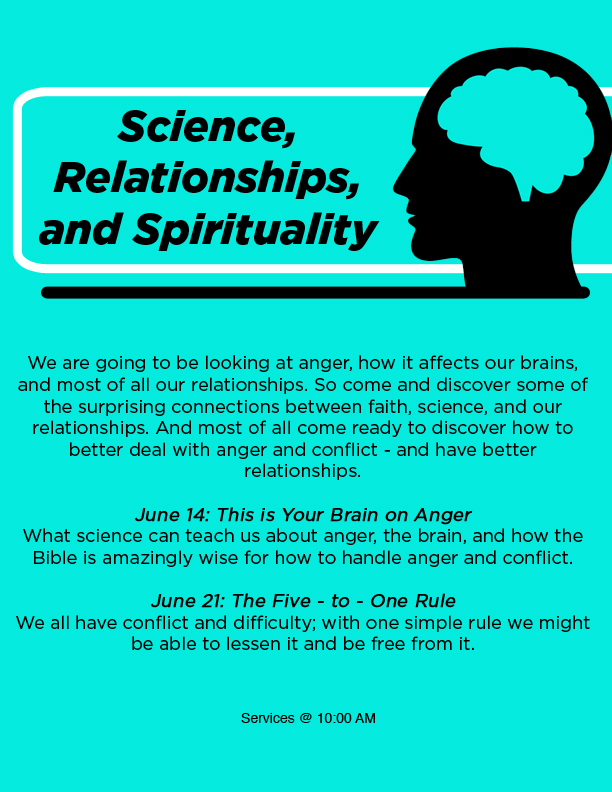
AngerOn Sunday we took a look at the surprising connections between science, the Bible, and our relationships. We looked specifically at what happens when we get angry or enter into conflict and how while our physical systems are amazingly designed to avoid physical danger, they sometimes increase our emotional danger.

Here’s what we learned. That when we encounter or perceive danger we enter into a flight or fight response. This response does a few things: it short-circuits our higher level thinking and shuts it down, it dumps a bunch of chemicals into our system to fight or flight, and it reacts sometimes instantly.

And now this system is amazing for us to respond to physical threats: like a snake that we jump away from, or a falling rock we instantly respond to. This system though is not as amazing when it comes to social threats such as criticism, emotional hurt, or intense arguments.

Our fight or flight response can “hijack” our higher level thinking in these moments and we can end up either shutting down or becoming very aggressive. We talked about the different physiological responses, but asked a very simple question: how do we overcome this? Because we all have probably been in fights and in that state where we’ve said things we regretted (fight), or not said the things we should have (flight). So what do we do?

Well we looked at three concrete biblical steps, that amazingly correspond to science as well. The first is something we can do to help prevent being “hijacked” by our emotional response, and that this: to let heaven fill your thoughts. The truth is what we fill our minds with leave traces and predispositions. So if your mind is filled with negativity, junk, anger, and rehearsing of hurts, we are actually encouraging those very things. So Paul gives some very practical advice, “Let heaven fill your thoughts”. Focus on the things that are good, healthy, true, and life-giving. Focus on the truth of the gospel, and let that fill our minds more than the normal stress, anger, and hurt we carry.

The second thing we noticed is that when we feel that “fight or flight” response coming on, we can shut it down. Sometimes it builds, and it is possible to actually exercise self-control. We talked about how the Holy Spirit can give us self-control and how to pray for it, and practice it.

And last but not least, we talked about what to do when we’ve had a really in-depth hurtful argument. Solomon gives this really wise advice. He says this: Fools vent their anger, but the wise quietly hold it back (Proverbs 29:11). And what he means here is not to deny your anger or your hurt, but not to actually vent it all around.

Venting your anger all around doesn’t actually lessen, but encourages it. When we have difficult conversations our tendency is to share and spread it, rather than dealing with it. And when we do that, we get angry and in the flight or fight response…again. So Solomon gives this wise advice: don’t spread it, deal with it. Don’t put it on Facebook, process it. Don’t keep repeating it, own it.

So those are some of the connections we looked at, and ended with a simple challenge: deal with and prevent anger and conflict. Take these steps and try to put them into practice to not only seek to prevent extra anger and conflict, but to deal with it when it happens.


Sermon Notes:

Big Idea: Our brains and bodies are complex and amazing

Teaching Points:

  • The amygdala perceives and responds to danger around us
  • The amygdala is incredibly fast but it’s actually not all that discerning
  • Two reactions: fight or flight.
  • Hijacking is when our emotional state shuts down our higher reasoning.
  • Let heaven fills your thoughts…
  • Pray for Self-Control and Practice Self-Control
  • Deal with anger, don’t vent it.

Adult Discussion Questions:

What stuck out to you from the sermon? What was challenging to you? How did God speak to you through it? What was new? Which type of response do you most often do – fight or flight? Can you relate to any of the examples shared? Have you ever seen how venting anger can make things worse? When and how? Is there anger that you need to deal with? Who can help you with that?

Discussion Questions for Young Families

Today use our learning to help with your kids. If they get upset remember it can take a while for them to re-centre. Give them space and encourage them even when things get angry and hard.

Challenge for the Week: Deal with and prevent anger.

Science, Relationships, and Spirituality

Well on Sunday we are launching a new little two-week series called: Science, Relationships, and Spirituality.

What we are going to be looking at are some of the surprising connections between current science, the relationships you have, and the ancient wisdom of the Bible. We will be looking at the neurology of anger, and the brain. We’ll be looking at social psychology and how negativity lingers in relationships, and how you can overcome it. We’ll be looking at all sorts of cool little connections.

So I hope you can join us to learn a little about our world, a lot about relationships, and most of all, what the Bible says on how to improve them.

Anger

Testing the Waters with Both Feet

1445490_31979296I want to talk a little bit about launching things. Because we all launch things all the time. You might not think about it that way but you do. For sure some people launch businesses, new enterprises, or new ventures in their careers. But “launching” applies to so much more than just entrepreneurs. You might be launching a small group, a ministry, or what about a new plan for your life. What about a plan to potty train your kids? What about teaching yourself a new skill, or leading in your kids’ sports teams?

These are all simple but real examples of launching something. Whenever we take a new step we are launching something. But I’ve learned a lot from a little African Proverb that helps us when we launch something. It’s this:

Never test the depth of the water with both feet.

And isn’t that true?

What I love about this proverb is that it reminds us of two things.

First, this proverb reminds us to try new things. Change is a part of life, we should be launching things, trying new things, jumping into new waters. Why not try a new business, why not build a new team, why not try something new with your kids? This stuff matters and we shouldn’t let fear tell us to just stay put.

But the second thing this little proverb reminds us of is to be wise. To test the waters with one foot before launching with two feet. All it’s saying is that if you are able to try something, to test it small scale, to get your hands dirty before cutting your safety net – why not test and try? I’m all for audacious crazy big goals. We should be launching, reaching, and trying new things. But all this little proverb reminds us is that there is a difference between being courageous and also well…silly or stupid.

So what are you maybe pondering or dreaming about starting? Is there a way to test the waters, and get going?

Here is the brilliance of the proverb. Most of us don’t actually have problems with jumping in with both feet because we don’t ever jump into new waters at all. But if you test the water a bit, try it out, it might just give you enough courage to jump…

Accusing Voices, Insecurities, and Debates about “Satan”

I had a funny little interaction the other day on twitter. I had posted this comment from a conference we were at:

The antidote to Satan’s deception is truth. Vishal Mangalwadi

And almost immediately someone who I’ve never met, but clearly likes to poke at Christians beliefs responded with this.

Yes. And the truth is that there is no such thing as “Satan”.

Now I don’t expect anyone who isn’t a follower of Jesus to subscribe to or believe in Christian doctrine. But with this one belief, the belief in Satan, I just honestly have no idea how anyone can deny it. And I know there are lots of people out there who might have some strong objections to that. But let me at least clarify what I mean, and why this matters for all of us – whether you follow Jesus or not.

The word “Satan” literally means “the accuser” in Hebrew. And I know lots of people will argue where there is a real being called Satan. And it’s not my intention to wade into that debate right now. My point is whether or not you believe in a personal being called Satan, you have experienced the reality of the Satan – of the accuser.

And here are some examples:

  • Have we all not experienced accusing voices that will not leave us alone?
  • Have we all not experienced thoughts that confuse, conflict, and depress us?
  • Have we all not been able to shake some hurt, pain, or insecurity that just nags at our soul?
  • Have we not heard accusation in our hearts and minds? Voices that say…
    • “You’re not good enough”
    • “You’ll never amount to much”
    • “Things are going to get bad”
    • “People don’t really love you”

When the Bible says that there is an accuser out there, I just believe that’s true because I’ve experienced it and seen it. 

I meet with people who can’t seem to get these accusing voices, thoughts, and beliefs out of their minds. I’ve sat with people whose orientating stories or worldview are all based on what they lack, how they will fail, and they’re unworthy. That is satanic literally: that is accusation that won’t leave you. That is the voice of the accuser. That is what the Bible is talking about. So my point in all of this isn’t to debate the reality of a personal being called Satan; my point is to call to our attention the reality of “the accuser” in all of our lives.

And this brings me back to Vishal Mangalwadis quote above. The only way to combat these voices, this activity of the “accuser” is with the truth. Jesus says “I am the the way, the truth, and the life”. The point is that while the accuser is out there seeking to deceive, to kill, to steal hope, to destroy, and to lie to us, we overcome those accusing voices with the truth. The truth of Jesus Christ. The truth of the gospel. The truth of how God sees us.

The only way you combat lies, and accusation – isn’t with arguing and engaging – but with knowing and trusting in the truth. 

Jesus says the Truth will set you free. And that’s absolutely true. And this is the truth about you no matter what any accusing voices in your life say. No matter what your dad, mother-in-law, insecurities, or accusing voices within tell you. The truth is this:

  • That you matter
  • That God is for you not against you,
  • That no matter what you go through – God will be with you
  • That Jesus thought you were worth dying for
  • That Jesus died to rescue you from all the brokeness and voices that seek to hurt and harm you.
  • That there is nothing in your life that Jesus can’t help you overcome

My point is that whether or not you believe in the reality of Satan, we all struggle with accusing voices from inside us and outside us. And the only way to be free from the hurt, the damage, and evil they cause – is to know the truth. The truth of who you are from Jesus Christ.

So today I wanted to just remind you of one little fact: that you are loved and matter to God. Lots of voices will try to confuse, be divisive, and argue against that truth. But that is the truth that can and will set you free if you start to trust in it, and follow it.

Theology 101: Eschatology ~ Heaven, Hell, and Tough Questions

On Sunday we discussed two controversial topics: heaven and hell. I think around these two topics there has been so much fuzzy thinking, so much conjecture, so much just  silliness sometimes that many people just avoid thinking about them.

Well that’s what we tried to clear up.

1195401_84100834We took a look first at heaven, looking at the picture of life painted without sin prior to the fall in Genesis and revealed in Revelation. What we see so clearly is that we will continue to have deep relationships with others, with creation, with tasks and purposes, and most of all, with God. Heaven is not a place where we float around in the clouds, singing songs on harps to Jesus. Heaven is here on earth – where we move, live, and create with God, others, and creation. Heaven is a beautiful continuance of all that is good and worthy in our lives. And it’s a beautiful thing.

N.T. Wright describes it this way:

The redeemed people of God in the new world will be the agents of his love going out in new ways, to accomplish new creative tasks, to celebrate and extend the glory of his love.

And that sounds anything but boring.

With that we turned to discussing the doctrine of hell. Now this is a confusing, and unclear doctrine for most people at the best of times. Much of their thinking has been more influence by popular culture, Dante, and poor theology than the actual Biblical account. And something we want to at least acknowledge up front is that there isn’t a lot of Biblical material that deals with this directly. And that much of it is metaphorical. That doesn’t mean hell’s not real, but perhaps not every image is meant to be taken literally (i.e. hell is discussed as a place of darkness and fire – which seem to be mutually exclusive).

So with those provisos we dived into the topic by addressing first and foremost: why do we even need this doctrine?

Many people struggle with the idea of hell, and so I discussed why I still believe we need to retain the doctrine. First, is that I do believe that the theme of hell, and judgment are in scripture. Secondly, that God honors free will. And thirdly, that justice requires putting things right.

So I want to expand on the idea that God honors free will. I don’t believe in what’s called “universalism” (that everyone gets to heaven), because I believe in free will. I believe that God, out of love, created us with free will. Which means we are free to reject God, and even reject heaven if we choose. And I don’t believe that God will override that free choice. Robert Farrar Capon writes,

Both heaven and hell are populated entirely and only by forgiven sinners. Hell is just a courtesy for those who insist they want no part of forgiveness.

Also I believe in justice, so I also believe in the necessity of hell. I don’t believe that justice can just pretend that evil doesn’t have consequences. I believe in hell because I believe that ultimately true and deep evil needs to be confronted and made right. Part of that making right is there being justice for the victims and oppressed in the world. And in this then we need to be clear – God does not torture. As Michael Bird shares, “Hell is about justice, not torture”. And I think that Dale Allison gets to the heart of why my view of justice entails some doctrine of hell by writing this:

I do not know what befell Mother Theresa of Calcutta when she died, nor what has become of Joseph Stalin. But the same thing cannot have come upon both. If there is any moral rhyme or reason in the universe, all human beings cannot be equally well off as soon as they breathe their last and wake again.

Or as N. T. Wright comments:

I find it quite impossible, reading the New Testament on the one hand and the newspaper on the other, to suppose that there will be no ultimate condemnation, no final loss, no human beings to whom, as C.S. Lewis put it, God will eventually say, “Thy will be done.” I wish it were otherwise, but one cannot forever whistle, “There’s a wideness in God’s mercy” in the darkness of Hiroshima, of Auschwitz, the murder of children and careless greed that enslaves millions with debts not their own.

And I’ll close my thoughts on hell with this quote from Daniel Migilore:

Hell is not an arbitrary divine punishment at the end of history. It is not the final retaliation of a vindictive deity. Hell is self-destructive resistance to the eternal love of God.

And I think that’s true. You don’t miss heaven by a bit, but by a constant and consistent refusal of the love and person of God.

So that’s what we looked at. It was a tough sermon, but I think one that will for sure spur more thinking and discussing. And certainly there are lots of other views out there. What I think is really important though is to be sure on what you personally believe. I think the hard doctrines and big ideas deserve thought and aren’t to be swept under the rug.

We ended with a reminder that the main point was that in the end all will be made right. That’s the purpose we are heading towards – a world put to right. A world that is finally fixed from evil, sin, and destruction. A world we live on in full communion with God, others, and creation.

We gave three simple little practical points with this to close. To focus on loving and not judging. Focus on sharing Jesus, not figuring out the details. We should be encouraged, it will end right. These are some practical ways that this should actually affect us. We should focus on loving and not judging who is in or out. We should be focused on sharing Jesus, not just debating details to death. And we should be encouraged that no matter what we see in the end God will make it right.

It helps, now and then, to step back and take the long view. The Kingdom is not only beyond our efforts: it is beyond our vision. We accomplish in our lifetime only a tiny fraction of the magnificent enterprise that is the Lord’s work. Nothing we do is complete, which is another way of saying that the Kingdom always lies beyond us. No sermon says that all should be said. No prayer fully expresses our faith. No confession brings perfection. No pastoral visit brings wholeness. No program accomplishes the Church’s mission. No set of goals and objectives includes everything. That is what we are about. We plant the seeds that one day will grow. We water the seeds already planted knowing they hold future promise. We lay foundations that will need further development. We provide yeast that affects far beyond our capabilities. We cannot do everything and there is a sense of liberation in realizing that. This enables us to do something, and to do it very, very well. It may be incomplete, but it is a beginning, a step along the way, an opportunity for the Lord’s grace to enter and dot the rest. We may never see the end results, but that is the difference between the Master builder and the work. We are workers, not master builders; ministers, not messiahs. We are the prophets of a future that is not our own. Archbishop Oscar Romero


Sermon Notes:

Big Idea: That in the end all will be made right

Teaching Points:

  • Heaven isn’t just a heavenly location but the place where God’s reign is full and comprehensive.
  • Heaven is a place where we have this clear, immediate, and personal connection with God.
  • The redeemed people of God in the new world will be the agents of his love going out in new ways, to accomplish new creative tasks, to celebrate and extend the glory of his love. N.T. Wright
  • “There is more to heaven than clouds, angels, and elevator music”. Michael Bird
  • The necessity of hell: free will and justice.
    “Hell is about justice, not torture”. Michael Bird
  • Hell is not an arbitrary divine punishment at the end of history. It is not the final retaliation of a vindictive deity. Hell is self-destructive resistance to the eternal love of God. Daniel Migilore
  • We need to focus on loving not judging.
  • Focus on sharing Jesus, not figuring out the details.
  • We should be encouraged it will end right.

Adult Discussion Questions:

What stuck out to you from the sermon? What was challenging to you? How did God speak to you through it? What was new? What lingering questions do you have about heaven or hell? Who can help you to wrestle through them? What you most looking forward to with heaven?

Discussion Questions for Young Families

Today talk to your kids about heaven and what it’s like. Talk about how we’ll have friendships, relationships, and tasks in heaven. Talk about how best of all we’ll have a relationship with God that is deeper and fuller than anything else.

Challenge for the Week: Keep being faithful to God.

Heaven and Hell – and a Lot of Questions

1157789_38642466So on Sunday we’re talking about hell. I know a topic that is…well…divisive to say the least. Some pastors love talking about – hellfire and brimstone – and all of that. Other pastors avoid it because they don’t know what to do with it.

But I want to deal with it honestly. I want to deal with objections. I want to deal with the Biblical passages. And I want to deal with this doctrine and topic in light of Jesus Christ.

So if you’ve ever had questions about hell, well you’re in good company, because I have lots. And I’m going to do my best to deal with them, talk about them, and hopefully even answer some of them.

And we’ll also talk about heaven, an equally misunderstood topic. And I’m going to do my best to do it all in 30 minutes. So if you’re around, are interested, and have ever wondered about heaven or hell – this is the Sunday to be there 🙂

Why We Need Words and Actions

11136617_10206457512023468_6356891879295745781_nSo as we were driving to church one day, just Hudson and me, I said to him. “Hudson, Daddy loves you”. And Hudson had this funny little response, “He said Daaadddy (in that long drawn out way) you always say that!” And I said, “I know that buddy, I just don’t ever want you to forget that or doubt that.”

And he said, “Don’t worry Daddy, I know you love me because you wrestle with me, read with me, play Lego with me, we sit together and watch TV, you ride my bike with me, and play with me. I know you love me because we do all that together all the time”.

And that just made my day.

But I wanted to share it for a specific reason, what Hudson’s response reminded me of.  And it’s this: Actions confirm words.

And here’s what that means for me. It is important to say I love you, but it is so much more important to say it and show it.

For Hudson, he doesn’t doubt that he is loved, because he hears it and sees it. The consistency of Krista and I saying it and trying to show it as best we can, gives him security and confidence that he is loved.

And this is my larger point in writing this today. Are there people that you need to show love to today? Are there actions that you need to take to confirm what’s in your heart?

Hudson’s response actually made me think about those closest to me. Would Krista be able to rhyme off a list like that right away? What about Asher, or my neighbors, or my mom or whomever?

My point is: are there people that we love, that we need to confirm it with our actions? Because love isn’t love unless it’s acting, moving, and being put into practice. So today put love into practice and confirm at least for someone, that they are loved.

Theology 101: Eschatology, Nicholas Cage, and The End Times

751034_82287592On Sunday we really opened up a pretty deep and difficult topic: eschatology. This is the study of last things, and what will happen at the end. This includes heaven, hell, the second coming of Jesus, who will be saved, and lots more. So we actually have given it two weeks to discuss, and this week I covered why eschatology matters and what’s called corporate eschatology.

But first why does eschatology matter?

Well the simple reason is that it’s practical and crucial for our everyday lives.

At first this seems like…well…a lie. I mean for many of us we don’t think that what happens at the end of the world does affect our lives all that much. But my contention is that it should, and it should shape our lives. And here is why: our view of the future, shapes our present. How the world ends, is how we should be living now.

So practically this really matters. We believe that Jesus is coming again, and when he does he will put the world to rights. He will fix all that is broken with the world. We will live in harmony with one another, with God, and with the earth. So what this means is if this is our destination – we need to start to live it now.

This means the church should be talking about racism. Why? Because in the end all the peoples of the earth will worship together as one. So we need to be challenging racism, sexism, and all that divides us now. We need to practice inclusion.

This means the church should be taking seriously creation care. Why? Because the Bible tells us that the earth will be renewed, not burnt, and we are to steward the earth. So we should be caring for the earth now. Eschatology shapes our present.

Michael Bird puts it this way:

“Eschatology is not just pie in the sky. There is a deeply practical side here, for how we act in the present is deeply impacted by what we think of the future. What we think about evangelism, justice, ecological responsibility, pastoral care, budgets, the church, and ethics is based on what God has done and will yet do for his people through Jesus Christ. If our actions echo into eternity, if we contribute something to God’s coming kingdom, we will be constrained to operate with a kingdom perspective.”

And he is right. So eschatology matters and is practical.

So we gave that big overview, and that what we believe in a nutshell is this: Jesus is coming again to set the world right. That Jesus coming isn’t something to be feared, but longed for. That when Jesus comes it will be a good thing, and he will fix all that is broken. He will come again bodily, imminently, and personally.

This is what orthodox Christians believe. But where orthodox Christians disagree are some of the details and sequence of events of Jesus’ second coming. So we moved from discussing the big picture, to some of the details, specifically found in Revelation 20:1-8. We discussed the three major camps people fall into when thinking about how Jesus will come again: postmillennialism, premillennialism, and amillennialism.

Postmillennialism believes that Jesus will come after a 1000 year reign. This view was popular before WW1 and WW2 but the world wars really killed some of the optimism that we could move into a golden age (millennium) without a dramatic intervention of Jesus Christ.

This leads us to the second camp – premillennialism. This is where people believe Jesus will come before (pre) the millennium. This view is very popular in culture currently, and is probably the default position of most of the evangelical world.

Lastly, there is amillennialism which believes that we are currently living in the millennium rule of Jesus and he will arrive again.

We outlined some of the pros and cons to each view, and which one I personally lean towards. But we ended with discussing the main point: that Jesus is coming again and we need to be ready.

We closed with some wise words from Augustine: Unity in essentials (i.e. Jesus is coming again), liberty in non-essentials (i.e. how that all works out), and love in all things (no matter what we believe). And I think that’s a pretty wise stance.

We challenged ourselves at the end to discuss with a friend what we think the end looks like, and then to reflect about how we need to live now. Because eschatology isn’t just about where we go when we die, but how we live now.


Sermon Notes:

Big Idea: Eschatology sets our focus and direction

Teaching Points:

  • Theology is a pilgrimage. It never stops thinking, questing or questioning. Following Jesus means that every morning begins a new part of the journey. Michael Hardin
  • Eschatology is the study of last things.
  • The end sets our direction and our focus.
  • From first to last, and not merely in the epilogue, Christianity is eschatology is hope, forward looking and forward moving, and therefore also revolutionizing and transforming the present. Jurgen Moltmann
  • Eschatology is about hope.
  • Jesus is coming again and we should be ready.
  • Three Views: postmillennialism, premillennialism, and amillennialism.
  • Eschatology sets our focus and direction

Adult Discussion Questions:

What stuck out to you from the sermon? What was challenging to you? How did God speak to you through it? What was new? What do you think happens at the end? Had you given it much thought before today? What was most interesting to you from the sermon? What did you think of Andrew’s talks on the three different camps? What personally do you need to change now in light of what happens in the end?

Discussion Questions for Young Families

Talk to your kids about how Jesus is coming again. Tell them that when he comes back he will fix the world and put it back right again. Ask them if there is anything that they think Jesus will fix when he gets back. Ask them how they might start to fix that now, and pick one way to do that and do that together.

Challenge for the Week: Have a discussion about what the end is like, and live in light of the end.

The End Times – What Will Happen?

1327662_78432201On Sunday we are going to be learning about eschatology. What’s that you might ask? Well it’s the study of last things. It’s the study of what might happen at the end of the world. And we all have ideas about that. Hollywood certainly does and it mostly involves zombies I think. But I’m not interested in what Hollywood says will happen at the end, I’m interested in what the Bible says.

So that’s what we are looking at on Sunday. We are going to be exploring some difficult passages and asking the question: what will happen at the end?

And here is why this matters and isn’t just idle speculation: because our vision of the end directs our actions now. And this is just true. If we believe in the end the whole world will burn, why bother caring for it? But if we believe the world will be renewed, then we had better steward it.

The point is that our view on what happens in the end will affect how we live now. So that’s what we are looking at on Sunday. And before we get there why not think through a little bit on your own. What do you think will happen at the end? What do you think and why? And on Sunday I’ll tell you what I think, and what I think the Bible teaches.

You Have Something to Offer The World

A gift for youToday I want to talk about a connection between leadership, Jesus, and life.

James Kouzes, and Barry Posner write this in their book The Truth about Leadership.

Everything you will ever do as a leader is based on one audacious assumption. It’s the assumption that you matter. Before you can lead others, you  have to lead yourself and believe that you can have a positive impact on others.

And this is so true. If you want to be a leader, you need to start to learn and believe that you can be. You need to believe that not only do you matter, but that you have something to offer.

And this type of belief in yourself isn’t either arrogance, or shameless self-promotion. It’s not a belief that you’re amazing and everyone should listen to you. Instead, it’s a belief that you have something to offer, something positive to give. And I think Kouzes and Posner are right.

What is interesting to me is that their statement seems a little like Jesus’ statement, “Love your neighbour as you love yourself”. Jesus’ point is that you can’t actually love your neighbour if you don’t love yourself. If you hate yourself, the hate will pour out all over and you wont’ be able to love your neighbour.

And here is the connection between both Jesus and the quote above: that to be able to lead, or love ~ you need to believe in yourself and that you have something to offer. You need to love yourself, and who you are to best love others. To lead others, you need to believe that you have something – big or small – to contribute to the world. This isn’t about listing all the reasons you are amazing, but instead thinking through:

  • What do I have to offer?
  • What has God gifted me with to gift to others?
  • What positive contribution can I give? What do I love about who I am, that I can share with others?

I think those are good questions to not only help us become better leaders, but better followers of God.