Blog

Seven Last Words: “It is Finished” – Jesus ~ Lenten Reflection

sevenlastwords-6On Sunday we looked at three of the most powerful words in Scripture, where Jesus says, “It is finished” (John 19:30).

Here though is the difficulty with these words: what is the “it”?

Because the context isn’t actually all that clear, lots of people have lots of ideas about “what” is finished in Jesus’ last words. People say things like sin, death, evil, Jesus’ mission, pain, and others. And surely all of them have theological warrant, but what we really wanted to get at was what does Jesus mean?

We have a tendency (and have been taught) that Jesus dies primarily for our individual sins. So when we come to a passage like this, we read our ideas into the text. So traditionally many people say that the price of sin has now been paid. That’s what’s finished.

But the text doesn’t mention sin, evil, payment or anything like that. So what is actually “finished”? That’s what we explored on Sunday.

And when the immediate context doesn’t help, you need to widen your scope, so we began in the beginning of John.

John is pretty clear in John 1:1 that he is telling a creation story. John begins with “In the beginning…”; this is a clear echo to Genesis. So John, right off the bat, is saying his story is going to echo, or be a riff, on the Genesis story.

The next thing we noticed was that in John he is counting miracles. He actually says this straight out (this is first miracle, the second miracle, etc). And if you count the miracles there are 7 miracles Jesus does. Seven acts of Jesus, just as in the beginning Genesis story there are seven acts of God.

There is this parallel between what Jesus is doing in John, and what God was doing in Genesis. 

But then comes the twist. Jesus dies and was resurrected. This is miracle number 8. This is the start of a new week, this is new territory, this is a new beginning.

It’s as if John is saying, that Jesus is starting a brand new creation story, that the old is gone. In fact, if you look at end of God creating the world in Genesis, he says “it is finished twice” in close connection. And John has Jesus uttering the same thing in John 19. He says “it is finished” twice in close connection (John 19:28; 30).

John is alluding to the fact that the old creation account is now complete. It is not just “evil, or sin” but the entire old way of living under the burden of sin is complete. That creation account, that world, that way of living is now finished. And with Jesus’ resurrection (miracle number 8) a brand new way of living is founded. A new kingdom, a new way of living, a new creation is starting.

John through hints, allusions, and out right clarity – is insisting that with Jesus’ death and resurrection, it is not just about our personal sin.

It is about a whole cosmos being infected with sin being finished, and a new world being birthed out of Jesus’ resurrection.

And he gives us two giant clues, or “wink, wink, nudge nudges” to see this. Jesus’ side is pierced and out comes water and blood, the classic two symbols of birth. And then when Jesus is first encountered, Mary thinks he is the gardener. You can almost sense John saying, “See? Do you get it? New gardener, new Eden, new creation. Wink wink – nudge nudge”

Jesus’ death and resurrection is the finishing of the old world, and the starting of the new. That’s what is finished, and what is before.

So we ended with asking are there any areas of our lives we are living in the old world. Are we seeking to earn God’s approval? Are we tied to sin? Are we choosing to live in sin – rather than in God’s kingdom? Because Jesus says that whole way of living is finished, there is a new way to live – a new gardener is here.

So our challenge was to live in God’s kingdom this week. And to help that we went old school – giving us a verse to memorize and pray daily this week. It’s from Philippians 1:6 “And I am sure that God, who began the good work within you, will continue his work until it is finally finished on that day when Christ Jesus comes back again”. There is our word again, “finished”.

So this week live in God’s new kingdom of hope, love, and peace. Don’t slide back into the old world of sin that is finished. And when you feel yourself sliding, pray this verse – trusting that God will finish what he has started. Because Jesus is right, the old is finished, and with him the new has come.


Sermon Notes:

Big Idea: The old is gone and finished, and a new world is here.

Teaching Points:

  • Challenge for Lent: 1) Pray Weekly Prayers of Repentance, 2) Pray Daily Corporate Prayers 2 Chronicles 7:14, 3) Fast Something for Lent
  • Whenever something gets familiar we are in dangerous territory.
  • What is familiar is not understood because it is familiar – Hegel
  • Beginnings are crucial to understanding endings
  • John is telling a story about a new Genesis
  • John’s gospel is about a new creation story
  • Jesus’ death and resurrection isn’t just about Jesus dying for our sinsit’s about Jesus creating a brand new world.
  • Finished = Teleo in Greek
  • The old world is finished,  and when Jesus rises again with him is a new world.
  • John is saying with Jesus’ death, the old world is finished, and a new world is being birthed because of Jesus.
  • Is there anything that needs to be finished in our lives today.
  • Some of us might still be living in the old world of earning God’s approval.
  • Some of us are still living under the lie that we are sinners, and unable to break free from sin.
  • Some of you are choosing to live in the old world of sin, evil, and hurt and you know it.
  • And I am sure that God, who began the good work within you, will continue his work until it is finally finished on that day when Christ Jesus comes back again” Phil 1:6

Adult Discussion Questions:

What stuck out to you from the sermon? What was challenging to you? How did God speak to you through it? What was new? Have you practiced Lent before? What can you fast or give up this year? Had you ever noticed some of the connections between John and Genesis before? Which ones were most surprising to you? What does the “old world” way of living look like – in your life? What does living in a new kingdom look like, and feel like? Is there anything that is “old” that you need to let go and say – it is finished too?

Discussion Questions for Young Families

Why not actually act out this with your kids? Get some cardboard, some glue, or paper mache and make a creation story. Make up trees, maybe a volcano for some fun, and talk about how God made the world. Talk about how Jesus re-made the world too, and with it we don’t need to hold onto hurt or hate anymore.

Challenge for the Week: Trust and live in the new world, the old is finished.
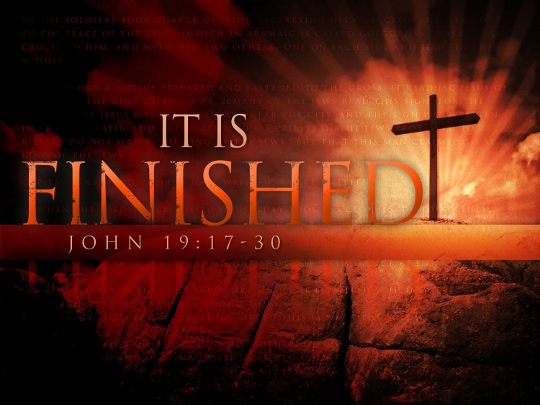
Three Powerful Words: It is Finished

There are three really powerful words when put together. And no it’s not “I love you”, although those are powerful words too.

The three words I’m thinking of are these: “It is finished.”

Those are really wonderful and powerful words to be able to say. Sometimes it feels good  just to say them after remodeling or renovating your house. Sometimes it feels good to say them after a hard day at work, saying “it is finished”.  Sometimes it is really powerful to say them after a huge project, or event.

it-is-finishedBut these words are really more powerful and meaningful when they are shared about soul level stuff.

  • Like when you can finally look back at a brutally dark period of your life and finally say, “It is finished”.
  • When you can look at a hurtful person, and finally because of forgiveness say, “it is finished”.
  • When you can look at some of your addictions (drugs, drinking, pornography, power, importance whatever) and be free from them and say, “It is finished”.

When you can look back on hurtful periods, sinful things, or difficult things and finally say “It is finished”, those are some of the most powerful three words to utter.

And come Sunday we are going to look at how you can say them in your life, over the things that hold you trapped. But first we are going to look at who said those three words first, what they mean, and how they can change your life.

“It is finished” – Jesus (John 19:30)

The Future of the Church Isn’t Our Youth…

1205206_64700205It’s been pretty customary to hear for years this phrase, “The youth are the future of the church”. And I certainly understand and agree with the sentiments behind that statement. But it’s actually a bit misleading on two fronts.

First, the youth aren’t the future of the church…they are the church now. Since when are committed followers of Jesus not fully functional members of the church family? Being part of the church is about a decision to follow Jesus together, not about your age, stage, or whether you are out of high school or not. If you are a follower of Jesus, you are not the future of the church, you are the church. Period.

Secondly, this statement “the youth are the future of the church” is misleading in a much more subtle, and dangerous way. Because the way this phrase functions is to assume that the youth are the guarantee of the future of the church. That if we lose the youth, the church’s future is in danger. So we must pour money, time, and effort into developing the best and most current youth ministries.

But this is wrong for two reasons. First, it distances us from the youth themselves. Rather than being persons to be loved, they become a means to what we want (a church in the future). And secondly, and most dangerously, this idea is actually idolatry.

Let me be clear about why this idea of “youth being the future of the church” is idolatry. Because the future of the church is not guaranteed by getting youth to come to church, it is guaranteed by Jesus Christ. The sustaining and growing of the church is not dependent on wonderful youth ministries, but on the faithfulness of Jesus Christ to his bride. And while in some ways this point can seem like semantics, it’s actually important because it’s about priorities.

If we assume that “youth are the future” of the church, we can mistakenly forget that the most important thing isn’t getting youth to come to church, but for all of us to come to Jesus. If anything supplants Jesus from the centre of our thought and practice, we will go off course. Youth ministry is absolutely important (I was a youth pastor for 8 years), but it is not primary. Jesus is at the centre and primary. And whenever anything good, like youth ministry, being missional, family ministry, or any other new thing, pushes Jesus to periphery and takes centre stage we’ve missed the point.

Bonhoeffer puts it this way.

The future of the church is not youth itself but rather the Lord Jesus Christ. It is the task of youth not to reshape the church, but rather to listen to the Word of God; it is the task of the church not to capture the youth, but to teach and proclaim the Word of God.

This is what I mean by priorities. We need to first be centred first on Jesus, and not anything else. It is so easy for the desire to have a cool youth ministry, a missionally based church, or any other desire to move Jesus from the centre. This is what we must guard against, if we want to see the future of the church come to pass. Of course youth ministry, being missional, and relevant are all good things. All I’m saying is that they shouldn’t push aside the best and most important thing – a person – Jesus Christ.

Creativity, Leadership, and Learning to Launch

1439539_30967932I want to begin by talking a little bit about creativity. Creativity is this weird thing. It’s something that we all have, but something most of us don’t capitalize on. And here is why: creativity always begins with unfinished, unpolished, and imperfect creations.

The truth is if you want to create, the first draft, step, or program will not be great. It will not be perfect, or flawless. Most likely it will be full of holes, and faults, and failures. And we hate that. We don’t like creating something that isn’t perfect, that isn’t a guaranteed success.

But here is the thing then: our fear is more controlling our destiny.

If you resist creating that book, that song, that new idea, that event, whatever it is – because it might not be perfect – you will never end up creating anything.

Tony Bronsink writes,

“Sometimes the first step of creating is the most awkward one. It’s an unfinished product, embarrassingly short of what we dreamed it would be, yet something more than we had before.”

And that is true and that is necessary. The first step in creating something is never perfect, but it is the first step that can lead to something life-giving and successful. If you wait to create that piece of art, that business, that new thing you want – until it’s perfect and guaranteed you’ll be waiting forever.

And here is the tie-in to leadership too. When we lead we love to lead to successes, and that should be the goal. But if the first step is often imperfect, embarrassingly short of what we dreamed, yet necessary, here’s the point: we should be okay with imperfection when we are striving forward. Imperfection shouldn’t stop us from taking the first step, and we shouldn’t just stop with a first step either, but we need to step out and try.

That’s my main point with this post. All of us have these things I think that we’d love to start. Maybe it’s a blog, a book, a neighborhood group, a Bible study, a new business, a piece of art, a new hobby – or whatever. But often what stops is isn’t a lack of ability or creativity – it’s a lack of courage in the face of fear that our first step won’t be perfect or a guaranteed success. Well here is the liberating truth: the first step is never perfect or a guaranteed success…so what’s stopping you from taking it?

Seven Last Words of Jesus: “Father Into Your Hands…” Lenten Reflection

sevenlastwords-7On Sunday we looked at this saying of Jesus on the cross: “Father into your hands I commend my Spirit”.

There is a lot to be said about this statement, but we just focused on a few details. First, that this is a prayer that quotes Psalm 31:1. This is important because on the cross it was virtually impossible near the end to speak. You died of asphyxiation so speaking was not only difficult, but excruciating. So Jesus, for his last words, prays the first line of this Psalm. And here is the rest of the verse:

I entrust my spirit into your hands. Rescue me, Lord for you are a faithful God. Psalm 35:1

When we take Jesus’ words in light of the rest of the verse we see that Jesus’ prayer is both a prayer of trust, and rescue.

The second thing we noticed was that while the translation of the word, “spirit” is correct in English, it is lacking. When we hear “spirit” we think of soul or the opposite of “body” or the material world. But the word in both Greek and Hebrew has earthy roots. Jesus here is not praying to hand over his “soul” but his entire being. This is why Eugene Peterson’ in his translation, translates this verse as, “I’ve put my life in your hands”. And this gets at the heart of what is happening. Jesus is trusting the Father, not just with his soul, but his entire life.

And what is so remarkable about this, is that Jesus at the end of his life turns to faith. We sometimes cheapen this moment by thinking, “Well Jesus…was Jesus he knew he would be resurrected”. But we are saying that on this side of history. Jesus hasn’t lived it yet, and so while he has faith the Father will rescue him, it simply put hasn’t happened yet. So Jesus is starting into death, darkness, and the weight of sin knowing he is about to be abandoned but in his last moments he doesn’t give up on faith, he gives in to faith. He says “Father I trust you even now”, you are all I can hold onto.

What is beautiful is that because Jesus prayed this prayer so can we. We will never know what Jesus experienced, nor will we ever go through the depth of what he experienced. But because of Jesus, even when we are at our worst, in our deepest struggle, because his spirit lives and moves within us – we can pray this prayer like him. When we come up against darkness that doesn’t quit, death that steals our life, we can choose to trust in God. To say, “Father I trust you with my life” which is where we ended on Sunday.

It was a prayer of unquestioning trust…Uncalculating trust. A no-questions-asked readiness to leave everything in the hands of the Father. Eugene Peterson


Sermon Notes:

Big Idea: That if Jesus prayed this prayer, so can we.

Teaching Points:

  • Challenge for Lent: 1) Pray Weekly Prayers of Repentance, 2) Pray Daily Corporate Prayers 2 Chronicles 7:14, 3) Fast Something for Lent
  • There is cosmic significance to what is happening.
  • I entrust my spirit into your hands. Rescue me, Lord for you are a faithful God. Psalm 35:1
  • Jesus’ prayer is both a prayer of trust, and rescue.
  • That if Jesus prayed this prayer, so can we.
  • It was a prayer of unquestioning trust…Uncalculating trust. A no-questions-asked readiness to leave everything in the hands of the Father. Eugene Peterson

Adult Discussion Questions:

What stuck out to you from the sermon? What was challenging to you? How did God speak to you through it? What was new? Have you practiced Lent before? What can you fast or give up this year? Is there any difficulty you are facing right now? What is it? Can you name it? Can you trust God in the midst of it? What might that look like? Can you pray the prayer Jesus prayed?

Discussion Questions for Young Families

Read the story today with your kids. Talk to them about how Jesus, in the most difficult moment, trusted in his Father. Remind them they can always trust in God.

Challenge for the Week: Pray, “Father I trust you with my life”

Where Are You God?

On Sunday we are tackling one of the most difficult texts in the Bible actually. It’s a familiar one so sometimes we don’t push back against it very much. But when you start to think about it – it raises tons of questions.

The text is this, where Jesus cries out, “My God, my God, why have you forsaken me?”

And that’s the question we want to really pursue. Why? Why? Why would the Father abandon his only Son? Why would the Father who is demonstrated and revealed by Jesus to be full of grace and forgiveness – abandon his Son when he needed him the most?

And don’t just give the easy answer of – “well he did this for our sin. “

Years ago when I was a youth pastor, one of my Jr. High’s pointed out, “sometimes the problems’ with the easy answers.” I had just told him that exact answer, and in clarity he raised a new tension for me with this verse.

He said this:

“Well Andrew, when I forgive my sister I don’t have to kill my cat, or abandon my dog. Why does God kill his son, and abandon him. Why doesn’t he just forgive?”

And that gets to the heart of the tension with this text – why God? Why are you doing this? What is going on? WHY?

And we’re in good company raising our voices, shouting, and screaming “why would you do this God”?  Because Jesus does the same thing.

So we are going to try to walk through some of this, examine it, and hope to find some answers. It will be tough, as Martin Luther the great reformer said, “God forsaking God, who can understand it?”

Well on Sunday we are going to give it a shot.

Leadership Limits: The Art of Knowing When You’re Done

877270_52065388 Here is the truth: God created us all with limits.

This is just a simple fact, but one that so many of us don’t realize or accept. In fact, if you read through the creation accounts in early Genesis you’ll start to see that God created Adam and Eve with limits too. Limits remind us of something – that we need each other. We can’t do it alone.

And here is how this relates to leadership.

Leaders are often reluctant to embrace their limits. They push harder, they work longer, and dig deeper. None of this is bad in the short-term, but in the long-term it’s disastrous. To pretend that you can lead and push through and not acknowledge your limits will kill your leadership. It might not today, and it might not tomorrow, but it will happen.

When you refuse to admit you’re tapped out, you are actually denying part of the essence of leadership: relying on and empowering others. Pretending you don’t need anyone or don’t have any limits doesn’t help you, and it certainly doesn’t help your organization, business, or team. Limits are inherent to who we are, and knowing them helps us to lead better and longer.

Of course self-discipline, drive, and a strong work ethic are crucial to leadership. But so too is knowing when you start to run dry.

So here are two questions I ask myself at least once a month. And I think they are good questions for anyone in leadership to ask. It’s this:

  • Have I not asked for help this month when I needed it? 
  • Have I embraced both my limitation and my responsibilities?

These two question help me stay on track and I hope they help you too.

“Today You Will Be With Me in Paradise” ~ Lenten Reflection

sevenlastwords-2On Sunday we looked at the fourth word of Jesus found in Luke 23:43. Jesus says this, “I assure you, today you will be with me in paradise.”

We looked at how Luke introduces us to two thieves who hang next to Jesus. The word “thieves” though probably bring up the wrong connotations for us. We think of common street thugs, when we should be thinking political terrorists. Because that’s what these two thieves were in the eyes of Rome – insurrectionists, revolutionaries, or political terrorists.

They are expecting a Messiah to show up and to overthrow Rome. The Messiah would “save” them from Rome. The Messiah would, through strength, power, and violence if needed, toss out the Romans and inaugurate God’s reign (or Kingdom) in Israel. This is what they were waiting for. This is what they were looking for.

So when these two men look at Jesus, all they see is a failed Messiah. Real Messiahs don’t get nailed to cross. Real Messiahs don’t get crushed by Rome, they overthrow Rome.

So one of the thieves hurls abuse at Jesus. The Greek word is a strong word, and it demonstrates that this thief continues to hurl abuse and blasphemy at Jesus constantly. It’s not once or twice, it’s a constant barrage of abuse.

But we get a completely different reaction from the second thief. He seems to have had a change of heart. He isn’t hurling abuse; Jesus seems to have somehow convinced him that he is who he says he is.

What is interesting is two men experience the same thing, but have different responses. One hurls abuse at Jesus, the other accepts Jesus.

I think it has to do with seeing Jesus offer forgiveness to those who killed him. For the one thief this is a betrayal of his most deeply held beliefs. You do not forgive your oppressors; you kill them and overthrow them. Yet for the other thief, he sees a different thing. He sees not weakness in forgiveness but strength, and it causes him to believe that even as Jesus is dying – he is somehow coming into his kingdom.

So he says essentially two words: Remember me. Remember me. Remember me.

He doesn’t confess his sins, he doesn’t offer a prayer of repentance, he just says “remember me”. And it’s enough. And it’s always been enough. So Jesus says something remarkable – “today you will be with me in paradise.”

And from this we asked a very personal but poignant question: what type of prisoner are you?

  • Are you like the first – hurling insults at Jesus and seeing nothing but weaknesses and irrelevance?
  • Or are you like the second – who sees something more amidst the hell he was going through?

Because it is the second that received a promise, in the midst of his own personal hell, for paradise to enter his life. This is a promise that is worth finding. This is a promise worth hearing  – but it only comes when we choose to trust in Jesus.

So we ended with that question, and invited a response. That if today you want to find paradise and Jesus, to simply say two words: “remember me.” The thief didn’t know how paradise would enter his world, and I don’t know how it might enter yours if you trust in Jesus. What I do know though is that it is always through Jesus, and begins by saying “Remember me”.

Sermon Notes:

Big Idea: What type of prisoner are you?

Teaching Points:

  • Challenge for Lent: 1) Pray Weekly Prayers of Repentance, 2) Pray Daily Corporate Prayers 2 Chronicles 7:14, 3) Fast Something for Lent
  • Crucifixion was a punishment that the Romans used almost exclusively for the crime of sedition. Reza Aslan
  • Jesus is not dying because of his religious ideas, but because of his political ideas.
  • The people were expecting a messiah who would save them, not die for them.
  • What kind of prisoner are you?

Adult Discussion Questions:

What stuck out to you from the sermon? What was challenging to you? How did God speak to you through it? What was new? Have you practiced Lent before? What can you fast or give up this year? Had you thought of Jesus dying before because of politics and power more than religion? What do you think about that? What thief can you relate to more and why? Have you ever been like the first thief hurling abuse? What brought you there? Have you ever been like the second thief trusting? What brought you there? Where are you today – trusting – or distrusting?

Discussion Questions for Young Families

Today read the story and talk to your kids about Jesus’ words. Help them to see that if we choose to trust in him, he will promise us paradise in our lives. Ask them if any of them might want to trust in him.

Challenge for the Week: Pray – Remember me

Finding Paradise

screen-shot-2011-04-22-at-9-04-38-amOn Sunday we are looking at the 4th word Jesus says, before he dies, where he says, “I assure you, today you will be with me in paradise”.  Luke 23:43.

This is truly a beautiful statement and promise Jesus gives to a thief that hangs next to him.

What I find interesting is that both thieves mock Jesus. Both thieves seem to disbelieve in Jesus. Both thieves seem to think Jesus is a joke. But then both thieves have the same experience with Jesus. They both hear his words, they both see how he is nailed to the cross, they both see the look on his face as people mock him. And yet one thief continues to hurl abuse at Jesus, where the other has a change of heart.

And this change of heart prompts him to hear, “Today you will be with me in paradise”. On Sunday I want to look at this phrase, and what led the one thief to the place where he could hear that phrase. Because if there is something I think we all need, it’s to be with Jesus. This is the promise the thief receives, because of how his heart changed. So we will look at how that happens, and how it might happen in us as well.

Being Missional Isn’t Just About Acting, but About Seeing

1395871_19682756A lot of discussion about being “missional” focuses on doing. Being missional means partnering in what God is doing all over the world, and in your neighbourhood. Being missional is about remembering that Christians are geared for mission – to serve, love, and change lives. And being missional matters.

Many of the seminars and speakers I’ve heard focus on some great actions to get us out into the community and caring. Things like throwing BBQ’s, being a real-life blessing to those around us, and caring for those who are hurting in our communities. Great stuff.

But I think the real art to being missional isn’t about doing, but about seeing.

The truth is God is already active all around us. God is doing things in our neighbourhoods, families, and communities right now. We follow an active, and dynamic God. A God on the move.

And so while certainly it is important to move and “do mission” with God – the most important practice is to first learn to see where God is moving. We, as Christians, need to become experts at spotting the initial moves of God’s Spirit in our lives, communities, and neighbourhoods. We need to become so in-tune with God’s Spirit that we catch his harmonies in conversations, that we sense his movements in the lives around us.

It’s important to act, but first it’s important to have “eyes to see” where God is already moving.

So how do you do that? Well sometimes the best answer is the simple answer. Start to pray. Pray as you walk around your street. Pray as you talk with neighbours and families. Pray that God will give you eyes to see how he is already moving around you, and how you can join him.

And trust me – this is a prayer God not only will answer, but I think one he wants to answer.