Blog

Following Jesus is Hard ~ Goodbye Violence, Revenge, and Retaliation

old-bible-1178354-mOn Sunday we explored the teaching of Jesus where he says to turn the other cheek. Jesus is incredibly clear, even if we wish he wasn’t, we are not called to resist an evil doer. Before we look at how, we wanted to explore why. Why are we called to live this way? Why are we called to practice non-resistance, non-retaliation, and love?

The easy answer isn’t actually the right answer. The easy answer is that violence, and an eye for an eye leaves the whole world blind as Ghandi said. And that’s true but that isn’t actually why we are called to practice non-violence, non-retaliation, and turning the other cheek. We are called to live this way, not because an “eye for an eye” doesn’t work. We are called to live this way because this is who God is.

Jesus, as the perfect representation and revelation of God, practices what he preaches. On the cross he doesn’t resist the evil people, he turns the other cheek, and he practices what he preaches. This is who God is – one who turns the other cheek. So if this is who God is, this is who we are called to be. If this is the way of Jesus it needs to be the way of his followers.

So we don’t practice “turning the other cheek” because it is pragmatic or effective. We practice it because it is the way of Jesus Christ. Hauerwas says, “Jesus does not promise that if we turn the other check we will avoid being hit again. Non-retaliation is not a strategy to get what we want by other means. Rather, Jesus calls us to the practice of non-retaliation because that is the form that God’s care of us took on his cross…In a like manner, Christians are to give more than we are asked to give, we are to give to those who beg, because this the character of God”.

This is our calling, and so on Sunday we heard Jesus’ challenge: to turn the other cheek this week. How this will work its way out in our lives will be different in each situation. Jesus himself recognizes this with the different responses he gives in the passage. The point is that Kingdom people – turn the other cheek – because their king did, does, and will continue to.

“We are concerned not with evil in the abstract, but with the evil person. Jesus bluntly calls the evil person evil. If I am assaulted, I am not to condone or justify aggression. Patient endurance does not mean a recognition of its right…the shameful assault, the deed of violence and the act of exploitation are still evil. The disciple must realize this, and witness to it as Jesus did. Because this is the only way evil can be met and overcome. The very fact that the evil that assaults him is unjustifiable makes it imperative that he should n to resist it, but play it out and overcome it by patiently enduring the evil person. Suffering willingly endured is stronger than evil, it spells death to evil.” Dietrich Bonhoffer

Sermon Notes:

Big Idea: Do not resist and evil person

Take Aways…

  • What if we actually did what Jesus said?
  • God’s blessing allows us to live differently
  • “The only proper response to this word which Jesus brings with him from eternity is simply to do it” Dietrich Bonhoeffer
  • Our calling is to not resist and evil doer
  • Jesus teaching shows us that that in God’s kingdom we will have enemies, encounter evil people, and we are not to resist
  • Jesus here is not teaching an ethic based on pragmatism, but on who he is
  • We are called to this life of non-resistance because we are called to follow Jesus
  • Jesus doesn’t let someone else’s violence dictate or determine his response.
  • Not-resisting evil doesn’t mean accepting evil either
  • “Jesus does not promise that if we turn the other check we will avoid being hit again. Non-retaliation is not a strategy to get what we want by other means. Rather, Jesus calls us to the practice of Non-retaliation because that is the form that God’s care of us took in his cross…In a like manner Christians are to give more than we are asked to give, we are to give to those who beg, because that this the character of God” Hauerwas
  • We are called to live this way of non-aggression, of peace, reconciliation, and grace – because that is who God is
  • Yes we are stand against evil but we are to do it in Jesus’ way
  • Can you commit today to trying this week – To practice turning the other cheek
  • “Cheek-turning is not advocated as what works (it usually does not) but advocated because that is the way God is – God is kind to the ungrateful and the selfish. This is not a stratagem for getting what we want but the only manner of life available now, that in Jesus we have seen what God wants”. Hauerwas.

Adult / Group Discussion Questions: What stuck out to you from the sermon? What was challenging to you? How did God speak to you through it? What was new?What did you find hardest about this teaching? What did you find compelling? When has someone ‘turned the other cheek’ and really changed you? Who might you be called to turn the other cheek towards this week?

Discussion Questions for Young Families: Talk to your kids about today’s teaching. Teach them about how we are called not to retaliate, but turn the other cheek. Make it practical and real and share with them how Jesus did that for us so on the playground, at school, or even at home if someone hits us, or hurts us we don’t hit or hurt back.

Challenge for this Week: Commit to turning the other cheek

Turning the Other Cheek

323963_9429On Sunday we are looking at one of the most radical and deeply practical teaching of Jesus Christ. We are going to be looking at turning the other cheek.

Jesus says do not resist an evil doer, instead, if you are hit to turn the other cheek.

This is a radical and explosive teaching.

But here is the thing, this isn’t something we are just called to think about, or to meditate on. We are called to actually practice it.

Stanley Hauerwas and Will Willimon write this:

What impresses about the Sermon is its attention to the nitty-gritty details of everyday life. Jesus appears to be giving very practical, very explicit directions for what to do when someone has done you wrong, when someone attacks you, when you are married, etc.

And this is true – Jesus is interested in the nitty-gritty practical details of everyday life. That when we come up against an enemy, someone who hurts and harms us, we are called to turn the other cheek. But what does that actually mean? And does that actually even work – or isn’t that a naïve view of the world? That’s what we are going to really dive deeply into Sunday. The question I have for all of us is pretty simple: has anyone you know ever “turned the cheek” in a difficult situation? What happened? How did it change them? Did it change the other person?

And if you get stuck not coming up with anyone…you could always try looking at Jesus.

…then the church is dying

My youth pastor sent me this picture and quote. He thought I would like it, and he was right.

1544379_653093764732643_1808453389_n

The reason I like it is it challenges our priorities. It asks us what matters most, our personal preference or passion for Jesus; is our comfort more important than others coming to know Jesus; what is the centre for us – ourselves or our calling?

These are really important questions to look at and ask. Because I believe the world needs the church. The world needs Christians. The world needs you and me. But it only needs us if our priorities are right. It needs followers of Jesus that are willing to die to themselves, that are willing to put others first, to be last in line, and serve. These are the type of people that change the world, because these are the type of people who courageously follow Jesus.

So I guess this little quote simply is asking me: what’s front and centre in my life ~ God’s calling or my personal preferences. That’s a really good question. A good question to think about, but an even better question to shape and change my actions.

Speaking Truth and Getting Rid of Promises

1195548_76079122On Sunday we looked at Jesus’ teaching on oaths, vows, and promises in Matthew 5:33-37.  In this teaching Jesus teaches people not to swear oaths by anything earth, God, Jerusalem, or heaven. He summarizes his teaching with saying, just let your yes be yes and your no be no.

And here is why I think if you have to add an oath, a vow, a provision, or an extra promise to something, it points to the fact that trust is low. Dallas Willard puts it this way, “The essence of swearing or making oaths is to try to use something that, though impressive, is irrelevant to the issues at hand to together to believe you and let you have your way. This is wrong. It is unlike God”. And he is so right. The NLT translates the last few sentences of Jesus’ teaching this way, “Just say a simple Yes I will, or No I won’t. Your word is enough. To strengthen our promise with a vow shows that something is  wrong”

I think Jesus’ teaching comes down to the point that we need to be people of truth. That as his followers we need to be committed to truth – getting rid of all lies, oaths, vows, and half-truths. Just let every word you speak be truthful.

So we ended with the challenge to be people who speak truth this week. And to help that happen I gave three suggestions.

First, we need to confess to God our sin. This seems a bit counterintuitive but the point is that unless we are truthful with God we will not be able to be truthful with others. Bonhoeffer puts it this way, “Complete truthfulness is only possible where sin has be uncovered and forgiven by Jesus. Only those who are in a state of truthfulness through the confession for their sin to Jesus are not ashamed to tell the truth wherever it must be told”.

Secondly, we talked about needing to speak truth all the time. What this means is that everything I say needs to be true, but I don’t have to say everything that is true. I don’t need to reveal everything I think is true, in every situation. I can have tact, and discernment, but everything I do say or reveal needs to be true. This is our calling as Christians.

And lastly, that we need to speak truth softly. Whenever we use our words as a weapon to hurt, injure, or wound we’ve missed the point. Jesus previously in this chapter has already taught us to rid ourselves of anger. So any words that are spoken without compassion, is just veiled aggression and isn’t to be part of the kingdom. Stanley  Hauerwas puts it this way: “Christians are thereby, committed to plain speech. We seek to say no more or no less than what needs to be said. Speech so disciplined is not easily attained. Too often we want to use the gift of speech as a weapon, often a very subtle weapon, to establish our superiority” .

So we ended with a challenge to be people of truth. To confess to God, to speak truth to others, and to speak it softly. This is so important because if we want to have churches, marriages, and communities that are stable, healthy and whole, they need to be built on truth and trust. So go be a person of truth today…

“There is not truth toward Jesus without truth towards other people. Lying destroys community. But truth rends false community and founds genuine fellowship”.  Dietrich Bonhoeffer

Sermon Notes:

Big Idea: Be a person of Integrity

Take Aways…

  • What if we actually did what Jesus said?
  • “The only proper response to this word which Jesus brings with him from eternity is simply to do it” Dietrich Bonhoeffer
  • Old Testament verses point to being people of truth
  • People swear oaths because of a lack of trust
  • The essence of swearing or making oaths is to try to use something that, though impressive, is irrelevant to the issues at hand to together to believe you and let you have your way. This is wrong. It is unlike God. Dallas Willard
  • “Just say a simple Yes I will, or No I won’t. You’re word is enough. To strength our promise with a vow shows that something is wrong” – Jesus
  • Thus disciples of Jesus should not swear, because there is no such thing as speech not spoken before God. All of their words should be nothing but truth, so that nothing requires verification by oath. An oath consigns all other statements to the darkness of doubt. That is why it is from the evil one. Bonhoeffer
  • Speak with truth
  • Confess your sin, to be able to speak with truth
  • Complete truthfulness is only possible where sin has be uncovered and forgiven by Jesus. Only those who are in a state of truthfulness through the confession for their sin to Jesus are not ashamed to tell the truth wherever it must be told”.
  • Everything I say needs to be true But I don’t have to say everything that is true
  • “Christians are thereby, committed to plain speech. We seek to say no more or no less than what needs to be said. Speech so disciplined is not easily attained. Too often we want to use the gift of speech as a weapon, often a very subtle weapon, to establish our superiority” Hauerwas
  • “There is not truth toward Jesus without truth towards other people. Lying destroys community. But truth rends false community and founds genuine fellowship” Bonhoeffer

Adult / Group Discussion Questions: What stuck out to you from the sermon? What was challenging to you? How did God speak to you through it? What was new?

How do you use your words? Would you say you use them to build up or tear down? How thoughtfully or intentionally do you use your words? How can you this week start to become a person of deeper integrity? Who can help to support you and keep you accountable in being truthful and honest.

Discussion Questions for Young Families: Talk to your kids about being a person of truth. Tell them why it matters in your own words. Maybe take a moment and promise to them that you will always speak to them with truth, and ask if they would do the same with you.

Challenge for this Week: Speak with truth

Followers of the Truth, and Speaking Truth

592557_62660582On Sunday we are looking at an incredibly important piece of Scripture found in Matthew 5:33-37. The whole focus is on oaths, vows, and promises. And even though this might seem a little removed from our day to day life in our day and age – I think it does matter for us. I know that many of us probably don’t make large vows everyday to clients, friends, or our spouses by swearing on god, our mother’s graves, or other things. But I do think Jesus’ teaching matters for us, because its about telling the truth.

Jesus is asking his followers to be people of the truth. To be trustworthy, and to be people of integrity. The honest truth is this: we cannot be the church God has called us to be if our lives are founded and function in deceit, half-truths, and compromised integrity.

To be a true follower of Jesus, means that we would be committed to telling the truth. So on Sunday we are going to work out how that happens, what that means, and what’s going on. But for now I have one question to ask you that I think matters. Are you a person of integrity?

And here is a second but an even better one. How can you today, this weekend, and this week become a deeper person of integrity? And come Sunday that’s what we’re looking at.

“Jesus Didn’t Ring the Doorbell”

1546071_10153722534615643_359237485_nEarlier this week at breakfast Hudson was sitting at our counter and we were talking. He looked so very sad and he said to me, “Daddy, Jesus didn’t come”. I asked him what he meant.

He said this, “Daddy, Jesus didn’t come and ring the doorbell. He didn’t come for his birthday. He missed his birthday.”

He had been thinking about this because his birthday is coming up, and he’s been talking about it all the time (he wants an Angry Birds, Cars, and Tree-Rex themed party). And I guess from all this thinking he was actually watching and waiting for Jesus to show up on Christmas day.

I sat down and talked to him about how Jesus was here over Christmas and how he is here with us now. I tried to explain to him how Jesus is a part of our lives. And he just kept coming back to – “But Daddy, I want him to ring the doorbell and come in”.

And to be honest I was a little stuck. How do you help a 3 year old become aware of God’s presence all around? How do you help him enter into the awe and wonder of encountering Jesus? How do you explain to them that Jesus is real, and present but probably won’t ring the doorbell for his birthday?

And if I’m honest with you – I don’t have a lot of great answers. I tried talking some things through but they all fell flat. I guess that’s the joy of parenting, you get to figure it out as you go, and I’m sure I’ll get another shot at explaining it.

So if you’ve maybe walked through with your kids, nieces, or grandchildren I’d love your thoughts. How do you help children experience and develop an awareness of the presence of God? I think that’s an important question to ask, think about, and try to figure out because I want Hudson to grow up knowing the full presence of God in all he does.

So I’m still working that out, and I have a lot of ways to grow as a parent. But one thing made me extremely happy even while I struggle to explain and try to help Hudson encounter Jesus. And it’s this: he was waiting and looking for Jesus and that’s a great start.

Anger, Murder, and Following Jesus

1391171_98402089On Sunday we looked at the teaching of Jesus where he calls his Kingdom followers to root anger out of their hearts. This is where Jesus says, “You’ve heard it said that murder is wrong, but I tell you anger is also wrong”.

And as we explored this topic we realized why anger is so destructive. It is destructive because anger stops reconciliation. Anger fuels grudges, bitterness, and a prison of our own making. The point is that as followers of God it is not enough to simply refrain from committing homicide, while harbouring seething rage in our hearts. To do that is to miss the point.

Christians are to be a different community, called to live differently than those around us. But how can we live differently if we harbor anger, let it direct our actions, drag others into courts, refuse to reconcile, and hold onto our own self-righteous anger. And yes, all anger is self-righteous in a way. Because anger arises when our will is opposed, blocked, or stopped. We get angry because we don’t get what we want. The point isn’t that anger is wrong in and of itself. Anger simply points to the fact that something we want (which may be very good) is being stopped. The point is that if we harbor anger in our hearts, no longer is anger alerting us to a situation, it starts to direct our actions and attention.

The point is we cannot be the church God calls us to be, if inside of us our hearts are brimming with anger and resentment. We need to learn to deal with it, to root it out, and to not harbor anger against another.

Stanley Hauerwas writes: “Jesus’ life makes possible our reconciliation with the Father and with one another. That reconciliation creates a community of reconciliation, a  community of peace. So we should not be surprised that Jesus admonishes us not to harbor our anger at our brothers and sisters, but rather we are to seek reconciliation with them. He does not say that we are not to be angry, but rather that we are not to come to the alter of sacrifice unreconciled to one with whom we are angry.”

The point is that if we are following Jesus, we are following someone who practices reconciliation, and then so must we. We cannot hold onto our anger, to stoke our rage, or to let contempt take hold of our hearts. We need to be people who root it out, and pursue reconciliation. This was the main point on Sunday – root out anger, and pursue reconciliation.

We left ourselves with this challenge on Sunday to rid ourselves of anger, and work at reconciliation. We want to take this teaching of Jesus seriously. To examine the places where anger has taken root, to ask Jesus whom do we need to pursue reconciliation with, and how can we live as people of peace in the world. This is indeed a practical everyday challenge, but one that could truly change how we live and how we are seen in the world.

I want to close with a rather lengthy but a very poignant quote from Dietrich Bonhoeffer who summarizes the idea and makes it personal:

Anger is always an attack on [another’s] life, for it refuses to let him live and aims at his destruction…Every idle word which we think so little of betrays our lack of respect for our neighbor, and shows that we place ourselves on a pinnacle above him and value our own lives higher than his. The angry word is a blow struck at our brother, a stab at his heart: it seeks to hit, to hurt and to destroy.

So long as we refuse to love and serve our brother and make him an object of contempt and let him harbor a grudge against me or the congregation, our worship and sacrifice will be unacceptable to God…Let us therefore, as a church, examine ourselves ….There is only one way of following Jesus and of worshipping God, and that is to be reconciled

Sermon Notes: 

Big Idea: Root out anger and pursue reconciliation

Take Aways…

  • What if we actually did what Jesus said?
  • “The only proper response to this word which Jesus brings with him from eternity is simply to do it” Dietrich Bonhoeffer
  • “The whole sermon is not about how to be better individual Christians, it is a picture of the way the church is to look” Stanley Hauerwas, Will Willimon
  • Now the point is that we can follow the rules and still entirely miss the point of the rules
  • The root of murder is anger, and anger is murderous in principle. One has not conformed to the better righteousness of the kingdom simply by refraining from homicide. D.A. Carson
  • Anger stops reconciliation
  • This teaching is about overcoming the anger, that leads to murder, and learning to be people who reconcile
  • We cannot be the church God calls us to be, if inside of us our hearts are brimming with anger and resentment
  • Jesus followers are not to insult each other. Reconciliation must be a first priority in the family of God’s people, or else the worshipping community will be no different from the world at large where festering pride and resentment lead people to drag each other into court and throw each others into prison – Dallas Willard
  • Root out anger and pursue reconciliation
  • Rid yourself of anger, and work at reconciliation

Adult / Group Discussion Questions: What stuck out to you from the sermon? What was challenging to you? How did God speak to you through it? What was new?

Would you say you ever struggle with anger? Had you ever thought of anger in this way before? How has anger stopped you from reconciling before? Whom do you need to reconcile with this week? How might you go about trying? Who can help you and support you as you pursue reconciliation?

Discussion Questions for Young Families: Talk to your kids about anger, and how about in God’s kingdom it isn’t to be there. Ask someone being angry has ever hurt their feelings. Ask if when they were angry they ever hurt someone’s feelings. Ask them if there is anyone they need to reconcile

Challenge for this Week Rid yourself of anger, and work at reconciliation

What If We Just Did What Jesus Said?

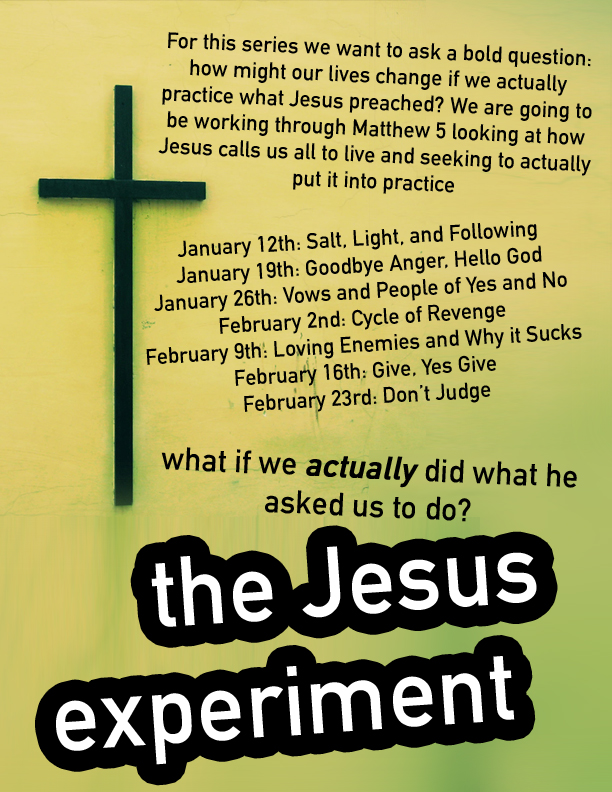
walking-away-1418812-mOn Sunday we are really exploring a radical question. What if we just followed Jesus in what he said?

We are beginning to explore his teaching on the Sermon of the Mount and will be seeking to actually practice it. Because here is what I believe: the teachings of Jesus aren’t primarily to be debated, to be forgotten, reworked, or skipped over. They are to be practiced.

Our guiding quote for this whole series is from Dietrich Bonhoeffer. Commenting on the sermon of the mount, with his usual succinctness and challenge he says:

“The only proper response to this word which Jesus brings with him from eternity is simply to do it”

And I think he is right. What if we just did what Jesus said? Dream with me a moment how might your life be different? How might your family’s life be different? How might your community be different? How might this world be different if we all got serious about following what Jesus said?

That’s why I’m excited for Sunday because I think it will start something in our lives so meaningful.

So before we get there why not take a moment and simply sit and read over Matthew 5 a few times. See what stands out, see what Jesus asks you to do, and then don’t forget to put it into practice.

Following

“Daddy I’m Not Special Because You Love Me”

1470072_10153676442255643_402969151_nA few days ago I was talking with my three-year old. And sometimes I think three-year olds should be in charge because in their simplicity and understanding they are brilliant. But, of course, if they were in charge we’d probably have to watch more Dora than we’d want to but that’s a side point.

As I was talking with Hudson I told him he is so special and loved by mommy and daddy. And he got mad. Down right angry. And he told me, “No daddy I’m not special because you love me”. And I started to get a little frustrated that it kind of felt like he was rejecting a bit of my care and love for him. So I told him, “No you are special because daddy and mommy love you and will always love you no matter what.” And he said again “No daddy I’m not special beause you love me” And he started stomping his feet.

Just as I was feeling a little inwardly unsure about what to do, Hudson said this. “Daddy I’m special because God loves me, mommy told  me that. God loves me, made me, so I’m special”.

See three year olds can be brilliant – right?

And Hudson is right. That is the foundation for why we are all special, unique, and valued. And I pray to God that he will never ever forget that foundation. I pray that he holds onto that truth for every day of his entire life. I pray that he will never seek to find his validation in love from anyone else, from anything else, or from any other substitute. I pray that he will know he is special, matters, and has value because God loves him.

If you think about how might our lives be different if we would have just held onto that truth?

How might decisions in high school have been different, if we knew with such conviction, like Hudson, that we matter because of God? How might our decisions in our marriage, in our jobs, and in our families be different if we were so secure in God’s love for us?

So on that day Hudson taught me something important. He is special because God loves him, and so am I, and so are you.

Beatitudes, Blessing, and The Best Sermon Ever

1336079_98421028On Sunday we looked at the most beautiful sermon ever given…and of course it was given by Jesus. We looked at the Beatitudes found in Matthew. These are beautiful promises, pronouncements, and announcements that blessing is being given by God. That in God’s Kingdom blessing flows. The beautiful thing about the Beatitudes are that they aren’t extra to-dos. The Beatitudes aren’t telling us what more we need to do to be blessed. The Beatitudes are telling us that God is about blessing, and he is giving it free of charge. Are you poor in spirit – burn out and broken? Blessing is for you. Are you mourning – experiencing loss and hurt? Blessing is for you. Are you trying to show mercy in chaos? Blessing is for you. This is the radical nature of the Beatitudes and of our God. That he gives blessing regardless of whether we deserve it, can earn it, or even appreciate it. God is about blessing and life.

And so on Sunday we really tried to rest in this reality. To help to do this we read and listened to the Beatitudes. We simply sat and asked God to speak to us through his promises in the Beatitudes. To help with this I read a targum (an expanded and interpretation added version) of Matthew 5:3-10. I simply invited the church to ask God to speak to them through it. And I’m going to invite you to do the same. Why not sit, read, and ask God to speak to you through it. And of course, my hope is that you  might experience some of the blessing God wants to give.

God blesses those who realize their need for him, Because with less of you there is more room for God.  When you’re are at the end of your rope, and your strength is failing, that’s when he shows up in a furious torrent of love and strength. When you’re lost and wandering in the desert, His love will chase and capture your heart leading you to his rest, presence, and purpose

God blesses those who mourn, who weep, who have lost, and feel broken. He will not let you break, he will not let your heart run empty of hope. When your heart is broken, healing is on the way – hope on the horizon. When your spirit is lost and low, God sends his Holy Spirit that mends the tears and wipes away the tears.

God blesses those who are gentle and lowly. When you’re simply content with just who  you are – no more, no less, the world belongs to you – because you belong to God. Those who place trust in God – and not others, will know great peace and victory over all things, and all evil.

God blesses those who are hungry and thirsty for Justice. Who see the world as God sees it. For you will know righteous living flowing from you like a river, changing the tide of history. When you desire justice – You will be filled. When righteousness is your hunger, God will fill your soul – and loose the Spirit in your life.

God blesses those who are merciful because mercy will be abundantly theirs. When kindness becomes a habit, God’s presence becomes a never-ending reality. When you find yourself full of caring, you will find yourself cared for by the lover of your soul.

God blesses those who have a pure heart, for they will see God. For those who know Jesus, God’s presence is never far away but always right before your eyes ready to be seen.

God blesses those who work for peace, who stand up for reconciliation in the midst of chaos. You are invited into God’s family. Your peace and grace-filled actions mark you as God’s and God’s alone – You are his firstborn.

God blesses those who are persecuted, because the kingdom is yours – here today. When you are slandered, taken to town, and thrown to the dogs because of your love of Jesus, know that you do not stand alone – Jesus stands with you and stands up for you. When you are hurt -and you respond in grace, then the kingdom is fully alive in your life – bursting out sending light to dark places.