On Sunday we looked at what’s called the 5-1 Rule. How our brains are wired for negativity, and we need at least 5 positive interactions to cancel out 1 negative interaction. The interesting thing is that’s actually what we see in Paul’s letter to the Ephesians.
Prior to Paul giving some pretty specific instructions in chapters 4, 5, and 6 (don’t steal, treat your spouse well, etc) Paul affirms the good in the Ephesians first. Paul begins building them up and reminding them who they are, before turning to what they need to do differently.
And that one difference, can make all the difference.
We tend to jump to the negative, but that’s not the example of Paul in Ephesians. Paul starts with the good in people, not the bad. Paul reminds them of who they are before telling them what to do. Paul in essence follows the 5-1 ratio or rule. He certainly addresses concerns, but not before affirming and caring for who they are.
And I think that one little insight can help so many of our relationships.
What if before nagging – we stopped to do some caring? What if before confronting – we did some affirming? What if before judging – we actually did some loving?
I think if we focused on following Paul in this, not only would our lives be different, but our relationships healthier, whole, and better.
Big Idea: Practice the 5-1 Rule
Teaching Notes:
Every relationship has expectation gaps
Before bringing up the negative, Paul shares the positive.
Paul starts with the good in people, not the bad
Before Paul tells them what to do, he tells them who they are.
Science has taught us what is called “The Brain’s Negativity Bias
The mind is like Velcro for negative experiences and Teflon for positive ones.” Rick Hanson
affirm the good, before bringing up the bad
Questions for Discussion:
What was funny or new? How did God speak to you through the sermon? Have you ever thought about an idea like the 5-1 rule before? Are you prone to start with good or bad? How can you put this rule into practice this week?
Questions for Young Families:
Rather than talking about the today, show it. Do something for your kids to affirm their goodness.
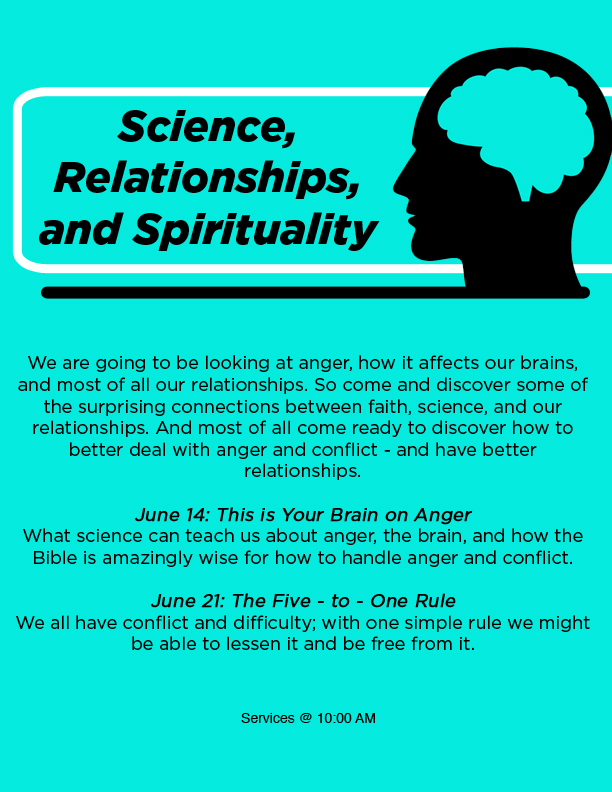
On Sunday we took a look at the surprising connections between science, the Bible, and our relationships. We looked specifically at what happens when we get angry or enter into conflict and how while our physical systems are amazingly designed to avoid physical danger, they sometimes increase our emotional danger.
Here’s what we learned. That when we encounter or perceive danger we enter into a flight or fight response. This response does a few things: it short-circuits our higher level thinking and shuts it down, it dumps a bunch of chemicals into our system to fight or flight, and it reacts sometimes instantly.
And now this system is amazing for us to respond to physical threats: like a snake that we jump away from, or a falling rock we instantly respond to. This system though is not as amazing when it comes to social threats such as criticism, emotional hurt, or intense arguments.
Our fight or flight response can “hijack” our higher level thinking in these moments and we can end up either shutting down or becoming very aggressive. We talked about the different physiological responses, but asked a very simple question: how do we overcome this? Because we all have probably been in fights and in that state where we’ve said things we regretted (fight), or not said the things we should have (flight). So what do we do?
Well we looked at three concrete biblical steps, that amazingly correspond to science as well. The first is something we can do to help prevent being “hijacked” by our emotional response, and that this: to let heaven fill your thoughts. The truth is what we fill our minds with leave traces and predispositions. So if your mind is filled with negativity, junk, anger, and rehearsing of hurts, we are actually encouraging those very things. So Paul gives some very practical advice, “Let heaven fill your thoughts”. Focus on the things that are good, healthy, true, and life-giving. Focus on the truth of the gospel, and let that fill our minds more than the normal stress, anger, and hurt we carry.
The second thing we noticed is that when we feel that “fight or flight” response coming on, we can shut it down. Sometimes it builds, and it is possible to actually exercise self-control. We talked about how the Holy Spirit can give us self-control and how to pray for it, and practice it.
And last but not least, we talked about what to do when we’ve had a really in-depth hurtful argument. Solomon gives this really wise advice. He says this: Fools vent their anger, but the wise quietly hold it back (Proverbs 29:11). And what he means here is not to deny your anger or your hurt, but not to actually vent it all around.
Venting your anger all around doesn’t actually lessen, but encourages it. When we have difficult conversations our tendency is to share and spread it, rather than dealing with it. And when we do that, we get angry and in the flight or fight response…again. So Solomon gives this wise advice: don’t spread it, deal with it. Don’t put it on Facebook, process it. Don’t keep repeating it, own it.
So those are some of the connections we looked at, and ended with a simple challenge: deal with and prevent anger and conflict. Take these steps and try to put them into practice to not only seek to prevent extra anger and conflict, but to deal with it when it happens.
Sermon Notes:
Big Idea: Our brains and bodies are complex and amazing
Teaching Points:
The amygdala perceives and responds to danger around us
The amygdala is incredibly fast but it’s actually not all that discerning
Two reactions: fight or flight.
Hijacking is when our emotional state shuts down our higher reasoning.
Let heaven fills your thoughts…
Pray for Self-Control and Practice Self-Control
Deal with anger, don’t vent it.
Adult Discussion Questions:
What stuck out to you from the sermon? What was challenging to you? How did God speak to you through it? What was new? Which type of response do you most often do – fight or flight? Can you relate to any of the examples shared? Have you ever seen how venting anger can make things worse? When and how? Is there anger that you need to deal with? Who can help you with that?
Discussion Questions for Young Families
Today use our learning to help with your kids. If they get upset remember it can take a while for them to re-centre. Give them space and encourage them even when things get angry and hard.
Challenge for the Week: Deal with and prevent anger.
On Sunday we discussed two controversial topics: heaven and hell. I think around these two topics there has been so much fuzzy thinking, so much conjecture, so much just silliness sometimes that many people just avoid thinking about them.
Well that’s what we tried to clear up.
We took a look first at heaven, looking at the picture of life painted without sin prior to the fall in Genesis and revealed in Revelation. What we see so clearly is that we will continue to have deep relationships with others, with creation, with tasks and purposes, and most of all, with God. Heaven is not a place where we float around in the clouds, singing songs on harps to Jesus. Heaven is here on earth – where we move, live, and create with God, others, and creation. Heaven is a beautiful continuance of all that is good and worthy in our lives. And it’s a beautiful thing.
N.T. Wright describes it this way:
The redeemed people of God in the new world will be the agents of his love going out in new ways, to accomplish new creative tasks, to celebrate and extend the glory of his love.
And that sounds anything but boring.
With that we turned to discussing the doctrine of hell. Now this is a confusing, and unclear doctrine for most people at the best of times. Much of their thinking has been more influence by popular culture, Dante, and poor theology than the actual Biblical account. And something we want to at least acknowledge up front is that there isn’t a lot of Biblical material that deals with this directly. And that much of it is metaphorical. That doesn’t mean hell’s not real, but perhaps not every image is meant to be taken literally (i.e. hell is discussed as a place of darkness and fire – which seem to be mutually exclusive).
So with those provisos we dived into the topic by addressing first and foremost: why do we even need this doctrine?
Many people struggle with the idea of hell, and so I discussed why I still believe we need to retain the doctrine. First, is that I do believe that the theme of hell, and judgment are in scripture. Secondly, that God honors free will. And thirdly, that justice requires putting things right.
So I want to expand on the idea that God honors free will. I don’t believe in what’s called “universalism” (that everyone gets to heaven), because I believe in free will. I believe that God, out of love, created us with free will. Which means we are free to reject God, and even reject heaven if we choose. And I don’t believe that God will override that free choice. Robert Farrar Capon writes,
Both heaven and hell are populated entirely and only by forgiven sinners. Hell is just a courtesy for those who insist they want no part of forgiveness.
Also I believe in justice, so I also believe in the necessity of hell. I don’t believe that justice can just pretend that evil doesn’t have consequences. I believe in hell because I believe that ultimately true and deep evil needs to be confronted and made right. Part of that making right is there being justice for the victims and oppressed in the world. And in this then we need to be clear – God does not torture. As Michael Bird shares, “Hell is about justice, not torture”. And I think that Dale Allison gets to the heart of why my view of justice entails some doctrine of hell by writing this:
I do not know what befell Mother Theresa of Calcutta when she died, nor what has become of Joseph Stalin. But the same thing cannot have come upon both. If there is any moral rhyme or reason in the universe, all human beings cannot be equally well off as soon as they breathe their last and wake again.
Or as N. T. Wright comments:
I find it quite impossible, reading the New Testament on the one hand and the newspaper on the other, to suppose that there will be no ultimate condemnation, no final loss, no human beings to whom, as C.S. Lewis put it, God will eventually say, “Thy will be done.” I wish it were otherwise, but one cannot forever whistle, “There’s a wideness in God’s mercy” in the darkness of Hiroshima, of Auschwitz, the murder of children and careless greed that enslaves millions with debts not their own.
And I’ll close my thoughts on hell with this quote from Daniel Migilore:
Hell is not an arbitrary divine punishment at the end of history. It is not the final retaliation of a vindictive deity. Hell is self-destructive resistance to the eternal love of God.
And I think that’s true. You don’t miss heaven by a bit, but by a constant and consistent refusal of the love and person of God.
So that’s what we looked at. It was a tough sermon, but I think one that will for sure spur more thinking and discussing. And certainly there are lots of other views out there. What I think is really important though is to be sure on what you personally believe. I think the hard doctrines and big ideas deserve thought and aren’t to be swept under the rug.
We ended with a reminder that the main point was that in the end all will be made right. That’s the purpose we are heading towards – a world put to right. A world that is finally fixed from evil, sin, and destruction. A world we live on in full communion with God, others, and creation.
We gave three simple little practical points with this to close. To focus on loving and not judging. Focus on sharing Jesus, not figuring out the details. We should be encouraged, it will end right. These are some practical ways that this should actually affect us. We should focus on loving and not judging who is in or out. We should be focused on sharing Jesus, not just debating details to death. And we should be encouraged that no matter what we see in the end God will make it right.
It helps, now and then, to step back and take the long view. The Kingdom is not only beyond our efforts: it is beyond our vision. We accomplish in our lifetime only a tiny fraction of the magnificent enterprise that is the Lord’s work. Nothing we do is complete, which is another way of saying that the Kingdom always lies beyond us. No sermon says that all should be said. No prayer fully expresses our faith. No confession brings perfection. No pastoral visit brings wholeness. No program accomplishes the Church’s mission. No set of goals and objectives includes everything. That is what we are about. We plant the seeds that one day will grow. We water the seeds already planted knowing they hold future promise. We lay foundations that will need further development. We provide yeast that affects far beyond our capabilities. We cannot do everything and there is a sense of liberation in realizing that. This enables us to do something, and to do it very, very well. It may be incomplete, but it is a beginning, a step along the way, an opportunity for the Lord’s grace to enter and dot the rest. We may never see the end results, but that is the difference between the Master builder and the work. We are workers, not master builders; ministers, not messiahs. We are the prophets of a future that is not our own. Archbishop Oscar Romero
Sermon Notes:
Big Idea: That in the end all will be made right
Teaching Points:
Heaven isn’t just a heavenly location but the place where God’s reign is full and comprehensive.
Heaven is a place where we have this clear, immediate, and personal connection with God.
The redeemed people of God in the new world will be the agents of his love going out in new ways, to accomplish new creative tasks, to celebrate and extend the glory of his love. N.T. Wright
“There is more to heaven than clouds, angels, and elevator music”. Michael Bird
The necessity of hell: free will and justice.
“Hell is about justice, not torture”. Michael Bird
Hell is not an arbitrary divine punishment at the end of history. It is not the final retaliation of a vindictive deity. Hell is self-destructive resistance to the eternal love of God. Daniel Migilore
We need to focus on loving not judging.
Focus on sharing Jesus, not figuring out the details.
We should be encouraged it will end right.
Adult Discussion Questions:
What stuck out to you from the sermon? What was challenging to you? How did God speak to you through it? What was new? What lingering questions do you have about heaven or hell? Who can help you to wrestle through them? What you most looking forward to with heaven?
Discussion Questions for Young Families
Today talk to your kids about heaven and what it’s like. Talk about how we’ll have friendships, relationships, and tasks in heaven. Talk about how best of all we’ll have a relationship with God that is deeper and fuller than anything else.
Challenge for the Week: Keep being faithful to God.
On Sunday we really opened up a pretty deep and difficult topic: eschatology. This is the study of last things, and what will happen at the end. This includes heaven, hell, the second coming of Jesus, who will be saved, and lots more. So we actually have given it two weeks to discuss, and this week I covered why eschatology matters and what’s called corporate eschatology.
But first why does eschatology matter?
Well the simple reason is that it’s practical and crucial for our everyday lives.
At first this seems like…well…a lie. I mean for many of us we don’t think that what happens at the end of the world does affect our lives all that much. But my contention is that it should, and it should shape our lives. And here is why: our view of the future, shapes our present. How the world ends, is how we should be living now.
So practically this really matters. We believe that Jesus is coming again, and when he does he will put the world to rights. He will fix all that is broken with the world. We will live in harmony with one another, with God, and with the earth. So what this means is if this is our destination – we need to start to live it now.
This means the church should be talking about racism. Why? Because in the end all the peoples of the earth will worship together as one. So we need to be challenging racism, sexism, and all that divides us now. We need to practice inclusion.
This means the church should be taking seriously creation care. Why? Because the Bible tells us that the earth will be renewed, not burnt, and we are to steward the earth. So we should be caring for the earth now. Eschatology shapes our present.
Michael Bird puts it this way:
“Eschatology is not just pie in the sky. There is a deeply practical side here, for how we act in the present is deeply impacted by what we think of the future. What we think about evangelism, justice, ecological responsibility, pastoral care, budgets, the church, and ethics is based on what God has done and will yet do for his people through Jesus Christ. If our actions echo into eternity, if we contribute something to God’s coming kingdom, we will be constrained to operate with a kingdom perspective.”
And he is right. So eschatology matters and is practical.
So we gave that big overview, and that what we believe in a nutshell is this: Jesus is coming again to set the world right. That Jesus coming isn’t something to be feared, but longed for. That when Jesus comes it will be a good thing, and he will fix all that is broken. He will come again bodily, imminently, and personally.
This is what orthodox Christians believe. But where orthodox Christians disagree are some of the details and sequence of events of Jesus’ second coming. So we moved from discussing the big picture, to some of the details, specifically found in Revelation 20:1-8. We discussed the three major camps people fall into when thinking about how Jesus will come again: postmillennialism, premillennialism, and amillennialism.
Postmillennialism believes that Jesus will come after a 1000 year reign. This view was popular before WW1 and WW2 but the world wars really killed some of the optimism that we could move into a golden age (millennium) without a dramatic intervention of Jesus Christ.
This leads us to the second camp – premillennialism. This is where people believe Jesus will come before (pre) the millennium. This view is very popular in culture currently, and is probably the default position of most of the evangelical world.
Lastly, there is amillennialism which believes that we are currently living in the millennium rule of Jesus and he will arrive again.
We outlined some of the pros and cons to each view, and which one I personally lean towards. But we ended with discussing the main point: that Jesus is coming again and we need to be ready.
We closed with some wise words from Augustine: Unity in essentials (i.e. Jesus is coming again), liberty in non-essentials (i.e. how that all works out), and love in all things (no matter what we believe). And I think that’s a pretty wise stance.
We challenged ourselves at the end to discuss with a friend what we think the end looks like, and then to reflect about how we need to live now. Because eschatology isn’t just about where we go when we die, but how we live now.
Sermon Notes:
Big Idea: Eschatology sets our focus and direction
Teaching Points:
Theology is a pilgrimage. It never stops thinking, questing or questioning. Following Jesus means that every morning begins a new part of the journey. Michael Hardin
Eschatology is the study of last things.
The end sets our direction and our focus.
From first to last, and not merely in the epilogue, Christianity is eschatology is hope, forward looking and forward moving, and therefore also revolutionizing and transforming the present. Jurgen Moltmann
Eschatology is about hope.
Jesus is coming again and we should be ready.
Three Views: postmillennialism, premillennialism, and amillennialism.
Eschatology sets our focus and direction
Adult Discussion Questions:
What stuck out to you from the sermon? What was challenging to you? How did God speak to you through it? What was new? What do you think happens at the end? Had you given it much thought before today? What was most interesting to you from the sermon? What did you think of Andrew’s talks on the three different camps? What personally do you need to change now in light of what happens in the end?
Discussion Questions for Young Families
Talk to your kids about how Jesus is coming again. Tell them that when he comes back he will fix the world and put it back right again. Ask them if there is anything that they think Jesus will fix when he gets back. Ask them how they might start to fix that now, and pick one way to do that and do that together.
Challenge for the Week: Have a discussion about what the end is like, and live in light of the end.
On Sunday we looked at Bibleology, the study of the Bible. Specifically we looked at two things: how the Bible came to be, and how to read the Bible.
We talked about how the Bible came to be over a period of years, and how there were different criteria for books to be included in the Bible. These criteria were: Apostolicity, Orthodoxy, Antiquity and Catholicity or Usage.
Apostolicity is that the writings needed to be connected to an apostle. Orthodoxy meaning that it conformed to the overall emerging tradition. Antiquity meaning that it was written early and close to the time of first-hand and eye witness accounts. And lastly, Catholicity or usage meaning that it was used by the majority of the early church, and attested to its usefulness.
From there we moved on to discuss three poor ways to the read the Bible, and three helpful ways to read the bible.
The first poor way to read the Bible was what I called foundationalism. This is where the Bible is the foundation of our faith. Where we build up a historical, reasonable, and irrefutable arguments for the validity of the Bible and of faith itself. And while I believe in apologetics and using reason and history to demonstrate the reliability of the Bible, this view has one major flaw for me. And it’s this: the Bible is not the foundation of our faith. I know that sounds controversial but it shouldn’t be. The foundation of our faith is Jesus Christ. And yes, the Bible attests to that fact, but it is still not the foundation of our faith.
For me foundationalism misses the point because it raises the Bible above Jesus. So to put it clearly I don’t believe in Jesus because of the Bible, I believe in the Bible because of Jesus. That’s the correct order of priorities of things. And yes, of course, we get to know Jesus through the Bible, but the Bible should never become more important or foundational than Jesus. The Bible actually has a word for that, and it’s idolotary and leads to poor readings of Scripture.
Secondly, we talked about how a poor way to read the Bible is to read it flat. We read it as if each part is equally authoritative for our lives right now. All of the Bible is God-breathed, absolutely!, but we do prioritize or privilege certain parts – specifically Jesus. When we read the Bible we need to take into account the overall arc or trajectory of Scripture, and interpret in light of that. So what this means to give a practical example, we no longer practice “eye for an eye” because Jesus says not to do that. To read the Bible flat though makes these two teaching authoritative even though they contradict. Instead, we need to read the bible through the light and revelation of Jesus Christ, the full revelation of God. So reading it flat is taking each part equally without placing the commands of God, in the history, context, and overall scope in which they are given.
The third issue is that we read the Bible plainly or naively. Sometimes people say, “The Bible says it, I believe it, and that settles it”. But that is a really naïve way of reading, because we interpret all of the Bible even the clear parts. Because what is clear to you, might not be clear to others. Most of us in the West who are very wealthy do not take Jesus clear words “Go and sell everything” as his clear command. We take them metaphorically, even though they are clear. My point is that we need to learn to read the Bible not naively or plainly but deeply. And ask some key questions is this text just describing a time, or prescribing how we should relate for all time? What is the context here? How does this relate to other parts of the Bible? I think that to approach the Bible with just a forced naivety without a willingness to study is problematic.
And lastly, I gave three other quick ways to read it correctly. First, was to read it through the lens of Jesus. If Jesus is the complete revelation of God, we need to read the Bible through that revelation. Jesus is the standard, so we need to start there.
Secondly, we need to start reading the Bible through not only the lens of Jesus, but also the lens of love. This is because this is what Jesus explicitly says. When he summarizes all of the Old Testament he says its summary is to love God and love others. That this is the trajectory or goal of the Old Testament to teach how to love. So we need to read the Bible in light of that. And St. Augustine agrees, saying this: “Whoever, then, thinks that he understands the Holy Scriptures, or any part of them, but puts such an interpretation upon them as does not tend to build up this twofold love of God and our neighbor, does not yet understand them as he ought”
And lastly, I argued that we need to read it looking for things to practice. The classic verse that is used to argue for the inspiration of Scripture actually points us to the meaning or purpose of Scripture. Paul in 2 Timothy 3:16 says:
All Scripture is inspired by God and is useful to teach us what is true and to make us realize what is wrong in our lives. It corrects us when we are wrong and teaches us to do what is right.
The purpose of Scripture is to teach us how to live. That’s the point of it, “teaches to do what is right”
So when I come to read the Bible this is what I try to do:
To not place the Bible above Jesus, but to help me discover Jesus
To not read the Bible flat, but to look for how to act
To not read the Bible plain, but through the lens of love
We ended with this main point: The Bible matters, but what matters most is following Jesus. And when we keep that priority and relationship right, it helps everything. So the challenge was simple this week. To go home and read your Bibles, to really dive deeply into them, to wrestle with them, and read them through the lens of love, through the lens of Jesus, and looking for things to place into action.
The truth is reading the Bible flat, plainly, or as the main priority are just immature ways of reading it. They are great starting places, but we need to grow deeper than that. And that happens through practice. So read, study, and let God guide you in that.
Sermon Notes:
Big Idea: The Bible matters, but what matters most is following Jesus
Teaching Points:
Criteria for the Bible: Apostolicity, Orthodoxy, Antiquity, Catholicity or Usage
The Bible isn’t the foundation of our faith, Jesus is.
I don’t believe in Jesus because of the Bible, I believe in the Bible because of Jesus.
Scripture has a trajectory and a goal to it.
Don’t read it flat, but in light of Jesus.
Reading the Bible “plainly” or “naively” rather than deeply isn’t helpful.
Read the Bible through the Lens of Jesus
Read the Bible through the Lens of Love.
Whoever, then, thinks that he understands the Holy Scriptures, or any part of them, but puts such an interpretation upon them as does not tend to build up this twofold love of God and our neighbour, does not yet understand them as he ought. St. Augustine
Read the Bible for action and praxis.
Adult Discussion Questions:
What stuck out to you from the sermon? What was challenging to you? How did God speak to you through it? What was new? How can reading the Bible without context lead to difficulty? Which way of reading the Bible (lens of love, Jesus, or action) do you really need to focus most on? How often do you read the Bible? What are your struggles with reading the Bible? Who can help you?
Discussion Questions for Young Families
Today rather than asking questions, why not do something together. If you’re not already in the habit of reading the Bible with your kids daily – why not start? There are some great Story Bibles even for little kids like Whirl Story Bible. Pick one up and start reading.
Challenge for the Week: Read the Bible everyday this week.
On Sunday we looked at Soteriology, or the study of how Jesus saves us. We looked at different Atonement Theories. These are theories that seek to explain how Jesus’ death and resurrection actually saves us.
So we began by looking at what’s called Ransom Theory. This is the idea that Jesus pays the price, to buy our freedom from Satan. That we are held by Satan, and Jesus is exchanged for us. This view might be familiar if you’ve ever seen or read the Lion, the Witch, and the Wardobe which is used there.
The next we looked at recapitulation. This is the view that the “Son of God became man so that we might become God” (Irenaeus). The basic idea is this; that Jesus fully participates in God, so that we might fully participate in God. And like Ransom theory this theory too has biblical support, particularly Romans 5:17-19.
And there are lots of other views including Moral Influence Theory, Governmental Theory, Satisfaction Theory, and even more. Yet we finished by focusing on the two most current or prominent views, Penal Substitutionary Atonement, and Christus Victor.
Penal Substitutionary Atonement states that Jesus took our place (substitutionary) and took on our punishment (penal). Jesus died to pay the price of our sin and disobedience to God. And since God is just and holy he abhors sin and its need to be punished. So Jesus takes on the punishment rightly deserved for us. John Calvin puts it this way, “This is our acquittal: the guilt that held us liable for punishment has been transferred to the heart of the Son of God”.
And while this view is probably the default view of evangelicalism, and quite popular, it has some issues inherent within it. For example, God, as an act of justice, punishes an innocent person, which raises questions about God’s justice. This view also traditionally sees sin in a very individualistic manner rather than systemic. This view can also lead people to fear the Father (who pours out his wrath on Jesus) rather than embrace the Father.
So while this view is very popular, and has been incredibly helpful in leading people to Jesus (myself included!) – there are some complications or questions with it. So with that understanding we then dove deeply into my preferred, or privileged atonement theory: Christus Victor.
Christus Victor in short is: A picture of God in Christ liberating humanity out of bondage from sin, death, and the devil (Derek Flood). Jesus dies, not simply as payment for sin, but to destroy death, evil, and sin. Jesus enters into the dungeon of death, and breaks its chains and leads us to resurrection.
Derek Flood continues writing,
“Christus Victor understands our salvation within the larger picture of a cosmic victory over evil. It is about our healing, and the healing of our world. This is tremendously significant because it means salvation is not simply a private religious affair, but entails putting all of life under Christ – our social, political, economic, nation and legal systems all need to reflect Christ’s way. Christus Victor captures the full scope of the redemption of both us and our world”.
And so while I personally lean toward Christus Victor, none of these atonement theories are necessarily in competition with one another. You don’t need to believe one to the exclusion of another. Michael Bird, an evangelical systematic theologian, writes this: The doctrines of penal substitution and Christus Victor do not compete against each other. And he personally holds Christus Victor as primary, yet also believes that Penal Substitutionary Atonement explains the specifics of God’s salvation.
So the main point though is that regardless of how you believe that Jesus saves us, that you believe that Jesus is the one who saves us. This is the centre.
And we ended with the main idea that Jesus’ death and resurrection has secured our freedom. Our freedom from sin, evil, injustice, death, and all that is anti-God. So we can have hope. Even if we don’t fully understand how Jesus saves us, that doesn’t stop us from experiencing his salvation!
Derek Flood writes, “What happened to Jesus was horribly unjust, and yet it was how God brought about justice. It was wrong, but God entered into that wrongness and turned it around to make things right. This is the great reversal of the cross. God enters into our darkness and makes justice come about despite injustice. God chose to make something good out of something bad. This does not mean that God condones evil and pain, but that God overcomes evil with good. It means that God can enter into all of our ugliness, evil, and hurt, and turn it around.”
And that’s he beauty of the cross. That Jesus can enter into all our ugliness, evil, and hurt and turn it around. That was our challenge on Sunday; to let God into all our evil and turn it around. That whether for the first or hundredth time to let God in, to save us, and transform us.
The essence of salvation is not to obtain something but to live with God…Salvation is not a possession but a relationship. Andrew Sung Park
Sermon Notes:
Big Idea: Jesus’ death and resurrection has secured our freedom
Teaching Points:
Soteriology ~ Study of Salvation
Atonement means “at-one-ment”
We want to be unified in our belief that Jesus saves us, and allow diversity for how we believe that happens.
Ransom theory: Jesus died to ransom us back from Satan.
Recapitulation Theory: For the Son of God became man so that we might become God – Irenaeus
This is our acquittal: the guilt that held us liable for punishment has been transferred to the heart of the Son of God. John Calvin
“The justice of God is not primarily or normatively as retributive justice or a distributive justice but a restorative or reconstructive justice, a saving action by God that recreates shalom and makes things right”. Chris Marshall
Christus Victor is a picture of God in Christ liberating humanity out of bondage from sin, death, and the devil. Derek Flood
What we see Jesus doing specifically in his life (healing, freeing, forgiving); Jesus is doing universally on the cross.
What happened to Jesus was horribly unjust, and yet it was how God brought about justice. It was wrong, but God entered into that wrongness and turned it around to make things right. This is the great reversal of the cross. God enters into our darkness and makes justice come about despite injustice. God chose to make something good out of something bad. This does not mean that God condones evil and pain, but that God overcomes evil with good. It means that God can enter into all of our ugliness, evil, and hurt, and turn it around. Derek Flood
God can enter into all of our ugliness, evil, and hurt, and turn it around. Derek Flood
Adult Discussion Questions:
What stuck out to you from the sermon? What was challenging to you? How did God speak to you through it? What was new? Had you ever heard any of the theories before? Which one resonated most with you? How would you explain why and how Jesus saves us? Do you have any questions that still need answering?
Discussion Questions for Young Families
Talk to your kids about Jesus’ death and resurrection. Talk about how Jesus is stronger than even death, and how he conquered all sin, death, and evil. Ask them is there anything in your life that you need some freedom from? (Fear, worry, etc). And then pray to Jesus about it.
Challenge for the Week: Open yourself to Jesus today
We began on Sunday by watching this video that introduces us a little bit to the doctrine of the Trinity. It helps us to get orientated to what the topic is about, and what it all means.
The Trinity in a nutshell (which is an oxymoron) is this: God is one being, in three persons. Or God is three-in-one. This is difficult to understand but has some really important practical implications.
St. Augustine said:
There is no subject where error is more dangerous, research more laborious and discovery more fruitful than the ones of the Trinity of the Father, the Son, and the Holy Spirit
So to begin with we looked at how the doctrine of the Trinity developed out of the Scriptures. The scriptures clearly speak as God as one, but they also then speak about there being a plurality within God. If you look at the Baptism of Jesus you see the Father speaking, the Son rising out of the water, and the Holy Spirit as a Dove descending. So there is this oneness to God, but also a plurality.
Michael Bird writes:
The Trinity is a theological inference that is drawn out of the Biblical material. The trinity is no mere abstract speculation, but is a theological attempt to provide coherence to the scriptural narrative about God
We then moved to discussing what is the oneness that holds the trinity together? And the clear answer is love. Love as the centre of God (see last week), is also the centre of the Trinity as the loving relations between the Father, Son, and Spirit bind the Trinity in oneness.
Tim Keller puts the binding love of Trinity this way:
Each of the divine persons centers upon the others. None demands that the others revolve around him. Each voluntarily circles the other two, pouring love, delight, and adoration into them. Each person of the Trinity loves, adores, defers to, and rejoices in the others. That creates a dynamic, pulsating dance of joy and love
That’s a beautiful picture of the Trinity being a divine dance of love, and invites us to participate as they open space not only for one another but also for us.
So that was our main point for Sunday. That the trinity is: The unity of One God, in three persons bound in love
This is a very practical assertion for this reason. If God is bound in love together in unity, self-sacrifice, and submission this gives us a model for how we are to live in our relationships. If the relationships between the Father, Son, and Spirit are characterized by mutual submission and love this then is not only an explication of God, but a invitation for us to follow God in mutual love and submission in our relationships.
This means in our churches, communities, marriages, and neighborhoods we should be seeking to live with mutual love and giving. We should be inviting others into the dance of love that we follow the Trinity in.
Sermon Notes:
Big Idea: The unity of One God, in three persons bound in love
Teaching Points:
If all the Holy Spirit does is to confirm your personal theology, it probably isn’t the Holy Spirit. The work of the Spirit is to conform each of us as persons and together as a people into the image of Jesus. Michael Hardin
The Trinity is arguably the most distinctive doctrine of Christianity as it distinguishes Christianity from other monotheistic faiths like Islam and Judaism. Michael Bird
There is no subject where error is more dangerous, research more laborious and discovery more fruitful than the ones of the Trinity of the Father, the Son, and the Holy Spirit. St. Augustine
The Trinity is a theological inference that is drawn out of the Biblical material. The trinity is no mere abstract speculation, but is a theological attempt to provide coherence to the scriptural narrative about God. Michael Bird
Each of the divine persons centers upon the others. None demands that the others revolve around him. Each voluntarily circles the other two, pouring love, delight, and adoration into them. Each person of the Trinity loves, adores, defers to, and rejoices in the others. That creates a dynamic, pulsating dance of joy and love. Tim Keller
The unity of One God, in three persons bound in love
Be like the Trinity and be loving
Adult Discussion Questions:
What stuck out to you from the sermon? What was challenging to you? How did God speak to you through it? What was new? Have you ever wrestled with understanding the Trinity before? What was helpful in thinking it through, what wasn’t? Had you ever heard of the idea of God being a dance of love at his centre? What did you think of it? Were you more like Krista or Andrew in his Flatland analogy? Excited or not? What helps you picture or think about the Trinity?
Discussion Questions for Young Families
Talk to your kids about the Trinity. Use it not as an exercise in telling them things, but realizing how beyond God really is than us. Listen to their questions, fumble, give it your best, and in the end be grateful that we can’t understand everything about God, but can trust him.
Challenge for the Week: Be like the Trinity and be loving.
On Sunday we kicked off our series on Theology 101 by looking at the doctrine of God right off the bat. We talked about theology and that it is important because we are always doing theology all the time. When we look around the world and say, “Well God wouldn’t do that” – that’s theology. When we see someone in suffering and say “I’ll pray for you” that’s all theology too. Theology is intimately tied with our practice. Ou practice actually reveals our beliefs. So the point isn’t whether or not we are doing theology, but whether or not we are doing good theology.
So that’s the point of this series, to give us a good foundation to practice good theology. To practice theology that sets people free, demonstrates God’s love, and participates in the Kingdom.
And so we began by looking at first how do we get our theology?
The quick and easy answer is: the bible duh!
But it’s actually not that simple. Those people who just say all I need is the Bible, it’s enough for me! Well beside them being perhaps well-meaning that view is also naïve, incredibly arrogant, and actually just downright wrong. We all come to the Bible with preconceived notions, thoughts, and baggage. So when it comes to doing our theology, the source isn’t just our Scriptures but other things play into it as well.
There are traditionally four areas or sources for our theology. Firstly, is obviously the Bible, but there is also our experience, reason, and tradition. Experience plays a huge part in our thoughts about God. I used to think that God had a purpose in death, but after experiencing the death of my dad, I no longer think this. I think God has a purpose to abolish death, but not in death. Experience shapes us.
So too does reason. When we look at beliefs we look at how they actually logically work. Andy Bannister writes this, “The Bible tells Christians to be transformed by the renewing of our mind, not the removal of.” And that’s true.
And last but not least, we get our theology from tradition. Now this is a weak area for Evangelicals. We often think that our beliefs are what Christians have always believed. But this is not necessarily true. So it is good to know our history. Tony Lane writes, “There are two sorts of Christians. Not those who are influenced by tradition and those who are not, but those who are aware of the influence and those who are not.”
So with that introduction we launched into discussing the theology of God proper and asked this question: what is God at His core?
Lots of people have lots of different ideas or metaphors. Some people say judge, some people say creator, some people say king. But by far one of the most popular ones is that God is Holy. But I believe that God, at his core, isn’t those things, but is instead love.
To understand this we talked about the difference between God’s essence (what he always is and always has been) and God’s attributes (something God is in relation to something else). And God surely is a creator but this isn’t at his core, because there was a time when God wasn’t a creator (i.e. before he made the earth). The same holds true for God’s holiness. Holiness is always something in relation to something else. For someone to be holy, there has to be something that is unholy (a reference point). The same thing holds true for someone being tall (if you are the only person on earth – you aren’t tall because there is no reference point). The point is then that in the beginning when it was only God, God wasn’t “holy” per se because there was nothing unholy around. Holiness is to be set apart, but there was nothing for God to be set apart from.
So what is God at his core then? The answer is clear from the Bible – love. God is love is stated often. And the supreme self-revelation of God, Jesus dying and rising for us, is a revelation of self-sacrificial love. So God is love and always has been love. And that was our main point on Sunday. That God is love.
But this is actually a practically challenging thing too. Because if God at his core is love, then as Christians our core should also be love. We should be known and seen as people of love first and foremost. Because love isn’t’ about how you view yourself, but how others view you. So if no one thinks you’re loving, you probably aren’t. The point is that we need actions behind our beliefs and demonstrate love. That’s the challenge I gave this week, to choose one person to demonstrate love to. Because if God is self-giving love, we as his followers should also show self-giving love. Love is at the centre of God, and it needs to be at our centre too.
Sermon Notes:
Big Idea: God at his core is love.
Teaching Points:
The truth is, we are all doing theology all the time.
The Bible was not written so that we would know about God, It was written so that we could become more like God
To follow God well, you have to know him well too
Theology literally means the study of God
Theology is not the study of the ideas about God; it is the study of the living God. Michael Bird
Theology is communal.
Theology is a communal study of the living God.
We get our theology from the Bible, Reason, Experience, and Tradition.
The Bible tells Christians to be transformed by the renewing of our mind, not the removal of. Andy Bannister
There are two sorts of Christians. Not those who are influenced by tradition and those who are not, but those who are aware of the influence and those who are not. Tony Lane
The Bible is our primary authority, but not our only authority.
Love is the fundamental divine attribute. Love is not merely one attribute of God among many. Rather, “God is love” is the foundational ontological statement we can declare concerning the divine essence. Stanley Grenz
God at his core is loving relationally.
Being loving isn’t how you see yourself but how others see you.
Adult Discussion Questions:
What stuck out to you from the sermon? What was challenging to you? How did God speak to you through it? What was new? Before today, what would have been your answer for what’s at God’s core? What shaped you to believe that? Who are you being called to love? How will you do it this week? Of the four areas (reason, experience, Scripture, tradition) which one do you feel most comfortable with? Which one don’t you feel comfortable with? What is one theology question you’ve always wanted answered?
Discussion Questions for Young Families
Talk about how God is love at his core. Maybe have your kids draw a picture, paint a picture of God being love, and then decide on whom you can love as a family. Maybe a school friend, maybe a neighbor, maybe someone sick. Ask them, and then make something happen!
On Sunday, for Easter, we explored Jesus first words he says after his resurrection. For the past 6 week’s we’ve looked at what Jesus said before he died. Now we wanted to look at what he says when he lives.
The key thing to notice first off is that words have power. They can both heal, or tear down. They can give life, or create death. Words have a power, a weight, an energy to them. And Jesus’ words especially have a power to them.
So the disciples are sitting in fear. They are filled with fear and worry and anxiety. Shame is covering their hearts, and guilt is seeping through their souls. They are hiding in a room and Jesus shows up. And before we jump to Jesus words, we need to first recognize one clear thing: for the disciples Jesus showing up would not seem like a good thing.
And at first that statement might seem funny – you might have even re-read it – but its true.
We know that Jesus comes with grace, and forgiveness – but the disciples didn’t. Remember at this point they are God-betrayers, God-abandoners, and God-deserters. That’s who they are. They are not in the “good and righteous God followers” column or category. And they would have grown up in a world that talked about the “Day of the Lord” (the coming of God) as a good day for the righteous but an awful terrible day for sinners, gentiles, and the unrighteous. The Old Testament says if you are sinner, a gentile, or unrighteous that when God shows up it’s a day to be feared, it’s a dark day full of vengeance and punishment.
So when Jesus shows up we shouldn’t jump to the conclusion that for the disciples this was instantly good. They were filled with fear, and shame and most likely didn’t think of themselves as “righteous and good”. They would be wondering if Jesus is here to settle accounts, to bring rightly deserved punishment, to bring vengeance and sentence.
And its into this highly charged, tense filled silence – where the disciples worst fears are playing with their imaginations – where shame is leading their souls further from God – that Jesus speaks some of the most beautiful words ever: peace be with you.
Peace be with you. Peace be with you. Peace to your sins. Peace to your shame. Peace to your betrayal. Peace to your disappointment. Peace to your fear.
Jesus shows up and gives out radical peace and forgiveness to a group of men who didn’t deserve it. Jesus first words are about peace, not judgment. This is a beautiful radical thing that we need to get. Jesus here is not just saying a short hello, or a salutation – Jesus is revealing the heart of God as about peace. Jesus is giving the trajectory of his kingdom that it will be about peace and not punishment and vengeance. God’s heart is about peace.
This is a radically freeing three words. Because then God isn’t to be feared, God is to be embraced.
Some of us believe that when Jesus shows up it will be to punish us for sins. But that’s not what this passage reveals. Jesus wants to free us from sin, not to punish us for sin. He has already taken all the punishment. And he wants to free us by offering us his peace.
So that’s where we landed on Sunday – with the Prince of Peace saying – Peace be with you. We closed with inviting everyone to simply picture Jesus saying to each of them – peace be with you. Peace to your fears, peace to your shame, peace to your guilt, peace to your brokenness, peace to your imperfection…peace…peace…peace
And that’s a good way to end, and to begin – with the peace Jesus wants to give us all.
Sermon Notes:
Big Idea: Peace be with you
Teaching Points:
Words are powerful things
Shame is the heart disease of every era. People are dying from it – some quickly, others slowly. Shame deceptively but convincingly leads us to believe that we deserve to be shackled to it for the rest of our lives. We believe we don’t deserve to be free of shame. Silence always leads to more pain and guilt and shame festering inside. Pete Wilson
The disciples are not sure Jesus showing up is a good thing.
Jesus is saving the world, and creating the world in this moment through peace.
God at his heart is about peace
God is not someone to be feared, God is someone to be embraced
Jesus wants to free us from sin, not to punish us for sin
Fear and shame have no part of God’s Kingdom.
Peace rules in God’s Kingdom.
Resurrection means that sin is ended
Resurrection means that evil is ended
Resurrection means that shame is ended
Peace be with you, because I am with you – Jesus.
Adult Discussion Questions:
What stuck out to you from the sermon? What was challenging to you? How did God speak to you through it? What was new? Have you ever thought about how the disciples would have been feeling? Do you think they might have been fearful of Jesus? Have you ever been fearful of God? Why are Jesus words “peace be with you” meaningful for you? Who should you share Jesus words with? Who needs to hear them?
Discussion Questions for Young Families
Why not actually practice this passage today with your kids. Ask them if they have any worry, any fear, any shame or guilt or hurt. Talk to them, and then talk to them about Jesus gives us peace. Share his words with them, and have them repeat them with you. Share the peace of Jesus with your kids – that’s a good way to start.
Challenge for the Week: Hear Jesus say, “Peace be with you”
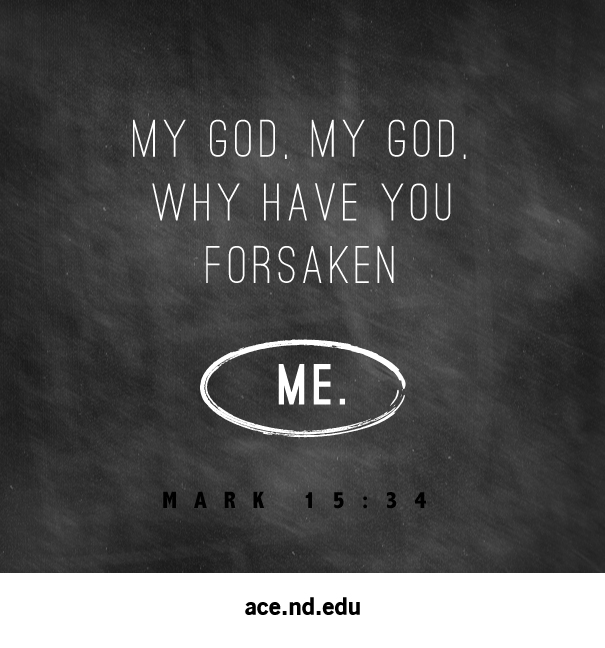
On Sunday we discussed one of the last sayings of Jesus, where he cries out in a loud voice:
“My God, My God, why have you forsaken me?”
And this is a verse with a lot of tensions and complexities. Many scholars don’t like the idea of the Father abandoning the Son. This also raises consternation and concern about the Father’s character for me too. So scholars offer two solutions. One, that Jesus isn’t actually being abandoned by God, he is just feeling like he is. But that just seems like semantics to me, and goes against what seems obvious: that Jesus is experiencing being abandoned by God, because he is being abandoned by God.
Other scholars point out that Jesus is quoting Psalm 22 (which he is). And taking the Psalm as a whole, it ends with vindication. That the suffering victim is eventually vindicated, justified, and that God overcomes the wrongful suffering. So they say Jesus is actually saying that he will trust in God to overcome this wrong. They (rightly) point out that speaking on a cross is incredibly painful and difficult. So Jesus couldn’t have quoted the whole Psalm (I agree), so he quotes one verse to bring the whole Psalm into view.
Again though I just think this goes against the plain reading. If Jesus could only quote one verse because of pain, and wanted to talk about God vindicating him, he could have quoted the last verses of Psalm 22. But he doesn’t, he quotes a verse about being abandoned.
So even though I might not like the idea of the Father abandoning or forsaking his Son, I think we are left with the plain reading of Scripture.
But there is one obvious fact that needs to be stated, that actually changes the whole perspective of this verse. It is stated from Jesus’ perspective. We don’t hear the Father’s perspective. So Jesus is being forsaken by the Father, and then we assume, that the Father is above pouring out wrath on Jesus in an emotionless dispassionate state.
People struggle with this verse because it makes it seem like Jesus is nice, whereas, the Father is stern, uncaring, judge, who abandons his son when he needs it most. But this is all based on an assumption, that the Father is unmoved by what his Son is going through. And this assumption is wrong, and what I not only challenged but worked through in more detail (download the sermon for more).
Jurgen Moltmann writes,
“In forsaking the Son, the Father also surrenders himself, though not in the same way. For Jesus suffers dying in forsakenness, but not death itself; for men can no longer suffer death, because suffering presupposes life. But the Father who abandons him and delivers him up suffers the death of the Son in the infinite grief of love…The son suffers dying, the Father suffers the death of the Son”.
And here is his key thought: “The grief of the Father here is just as important as the death of the Son.”
And this is what we need to get, that the Father and Son are both affected and separated because of our sin. It isn’t a singular choice on the Father’s side to abandon his son. It is a choice within the Trinity to experience the separation of sin so that we could be welcomed into fellowship with God. The Father doesn’t kill his Son, to forgive us. The Father experiences an abyss of separation from his beloved Son, so that we could become incorporated into the family of God. Sin ruptures, that’s what it does. And it does this at the heart of the Trinity. So yes, Jesus experienced being forsaken by the Father, and the Father experienced the death of the Son.
This led us to some simple but personal conclusions.
First, that we need to be in reverent thanks of what the Father, Son, and Spirit went through to include us in their life. The Son died, so we could live. And this affected all the Trinity, and for that we need to be grateful. We need to be reverently worshipful of the depth of what God went through for each and everyone of us.
Second, we talked about that sin is serious. That sin brought separation to the heart of God, and we need to own that. We did that. We killed the Son (read the Book of Acts). We need to recognize the seriousness of sin, and confess, repent, and rid ourselves of sin. If sin did this to God, we need to work at ridding ourselves of it.
So we ended with a challenge, to sit in thanks to God, and repent for sin. When we see the depth of what God went through, I think that is the right response: reverence and repentance.
Martin Luther said, “God forsaking God, who can understand it?” I know for sure we don’t all understand it because of one sermon (I certainly don’t), but I hope we got a little closer and most of all, a little more reverent and repentant.
Sermon Notes:
Big Idea: Jesus was abandoned by the Father for us; and the Father experienced the abandonment of the Son for us.
Teaching Points:
Challenge for Lent: 1) Pray Weekly Prayers of Repentance, 2) Pray Daily Corporate Prayers 2 Chronicles 7:14, 3) Fast Something for Lent
“God forsaking God. Who can understand it?” – Martin Luther
Jesus’ death is a moment of cosmic significance, and the cosmos recognize it by darkening
This passage is not about us, but what Jesus is experiencing.
We need to be honest with text – Jesus is being forsaken
Jesus is stating what is true from his perspective
Just as Jesus was forsaken, so too was the Father forsaken from the Son
If our sin separates Jesus from the Father; it separates the Father from the Son.
The grief of the Father here is just as important as the death of the Son. Moltmann
We cannot understand the depth of our sin, unless we understand that both Jesus and the Father are suffering in this moment on the cross.
The Son is losing the Father, but the Father is losing the Son.
Our sin doesn’t just affect Jesus, but affects God as a whole.
We should have holy and reverent awe for God.
We should repent and cast off sin.
Adult Discussion Questions:
What stuck out to you from the sermon? What was challenging to you? How did God speak to you through it? What was new? Have you practiced Lent before? What can you fast or give up this year? Had you ever struggled with the idea of the Father forsaking the Son before? Had you ever thought of what the Father went through when Jesus died? What do you think it was like for him? How does it make you appreciate God? How does it change or deepen how you see sin?
Discussion Questions for Young Families
Read the story today with your kids. Talk to them about the verse we read, about how Jesus was separated from his Dad because of our sin. About how hard it was, but that he did that for us. So that we can be loved, and welcomed in. Give them a chance to confess anything to Jesus in thankfulness for what he did.
Challenge for the Week: To sit and contemplate what Jesus went through, confess any sin, and reverently worship him this week






 { Andrew Mills }