
Creativity, Leadership, and Learning to Launch

1439539_30967932I want to begin by talking a little bit about creativity. Creativity is this weird thing. It’s something that we all have, but something most of us don’t capitalize on. And here is why: creativity always begins with unfinished, unpolished, and imperfect creations.

The truth is if you want to create, the first draft, step, or program will not be great. It will not be perfect, or flawless. Most likely it will be full of holes, and faults, and failures. And we hate that. We don’t like creating something that isn’t perfect, that isn’t a guaranteed success.

But here is the thing then: our fear is more controlling our destiny.

If you resist creating that book, that song, that new idea, that event, whatever it is – because it might not be perfect – you will never end up creating anything.

Tony Bronsink writes,

“Sometimes the first step of creating is the most awkward one. It’s an unfinished product, embarrassingly short of what we dreamed it would be, yet something more than we had before.”

And that is true and that is necessary. The first step in creating something is never perfect, but it is the first step that can lead to something life-giving and successful. If you wait to create that piece of art, that business, that new thing you want – until it’s perfect and guaranteed you’ll be waiting forever.

And here is the tie-in to leadership too. When we lead we love to lead to successes, and that should be the goal. But if the first step is often imperfect, embarrassingly short of what we dreamed, yet necessary, here’s the point: we should be okay with imperfection when we are striving forward. Imperfection shouldn’t stop us from taking the first step, and we shouldn’t just stop with a first step either, but we need to step out and try.

That’s my main point with this post. All of us have these things I think that we’d love to start. Maybe it’s a blog, a book, a neighborhood group, a Bible study, a new business, a piece of art, a new hobby – or whatever. But often what stops is isn’t a lack of ability or creativity – it’s a lack of courage in the face of fear that our first step won’t be perfect or a guaranteed success. Well here is the liberating truth: the first step is never perfect or a guaranteed success…so what’s stopping you from taking it?


Leadership Limits: The Art of Knowing When You’re Done

877270_52065388 Here is the truth: God created us all with limits.

This is just a simple fact, but one that so many of us don’t realize or accept. In fact, if you read through the creation accounts in early Genesis you’ll start to see that God created Adam and Eve with limits too. Limits remind us of something – that we need each other. We can’t do it alone.

And here is how this relates to leadership.

Leaders are often reluctant to embrace their limits. They push harder, they work longer, and dig deeper. None of this is bad in the short-term, but in the long-term it’s disastrous. To pretend that you can lead and push through and not acknowledge your limits will kill your leadership. It might not today, and it might not tomorrow, but it will happen.

When you refuse to admit you’re tapped out, you are actually denying part of the essence of leadership: relying on and empowering others. Pretending you don’t need anyone or don’t have any limits doesn’t help you, and it certainly doesn’t help your organization, business, or team. Limits are inherent to who we are, and knowing them helps us to lead better and longer.

Of course self-discipline, drive, and a strong work ethic are crucial to leadership. But so too is knowing when you start to run dry.

So here are two questions I ask myself at least once a month. And I think they are good questions for anyone in leadership to ask. It’s this:

  • Have I not asked for help this month when I needed it? 
  • Have I embraced both my limitation and my responsibilities?

These two question help me stay on track and I hope they help you too.

Being Missional Isn’t Just About Acting, but About Seeing

1395871_19682756A lot of discussion about being “missional” focuses on doing. Being missional means partnering in what God is doing all over the world, and in your neighbourhood. Being missional is about remembering that Christians are geared for mission – to serve, love, and change lives. And being missional matters.

Many of the seminars and speakers I’ve heard focus on some great actions to get us out into the community and caring. Things like throwing BBQ’s, being a real-life blessing to those around us, and caring for those who are hurting in our communities. Great stuff.

But I think the real art to being missional isn’t about doing, but about seeing.

The truth is God is already active all around us. God is doing things in our neighbourhoods, families, and communities right now. We follow an active, and dynamic God. A God on the move.

And so while certainly it is important to move and “do mission” with God – the most important practice is to first learn to see where God is moving. We, as Christians, need to become experts at spotting the initial moves of God’s Spirit in our lives, communities, and neighbourhoods. We need to become so in-tune with God’s Spirit that we catch his harmonies in conversations, that we sense his movements in the lives around us.

It’s important to act, but first it’s important to have “eyes to see” where God is already moving.

So how do you do that? Well sometimes the best answer is the simple answer. Start to pray. Pray as you walk around your street. Pray as you talk with neighbours and families. Pray that God will give you eyes to see how he is already moving around you, and how you can join him.

And trust me – this is a prayer God not only will answer, but I think one he wants to answer.

No Such Thing as Individual Prayer

1427656_44384918Andrew Root writes something that is both simple, and beautiful:
Prayer is a relationship because prayer cannot be done alone.
And that is true. When you are praying it is never done alone. It is done with others, in the power of the Spirit, through Jesus Christ, to God the Father. Prayer is a relationship, because it is based in relationships and changes relationships. So the next time you are praying, remember you aren’t doing it alone. And remember most of all prayer is a relationship, and it’s a relationship worth investing in.

Loving Your Neighbours and Why No One Can Tell You How

583245_74851881No expert can tell you how to best love your neighbour…Only the Spirit can guide you into faithful presence, which is the love of Christ. Paul Sparks, Tim Soerens, and Dwight Friesen

I think that this quote is just so – challenging and true. We know as Christians we are called to move out into our neighbourhoods, and love our neighbours. If we aren’t loving our neighbours well, we aren’t following Jesus well. That’s just true.

But the difficulty is in how to do this. We often at least in Christian circles, look to experts to tell us this. And if you don’t believe me, just look at how popular conferences and seminars on “How to Be Missional” are. They are everywhere (and I’ve led some…).

The point though is that no expert can adequately tell you how to love your neighbour. And to love our neighbours well, we don’t need more experts, we need a change in focus. We need to focus on Jesus and his Spirit.

It is only Jesus that can truly lead us into loving our neighbours well. It is only through listening to his Spirit that we can discern the right ways and the right times to show love in practical action. In all honesty what we probably need is less experts in our lives, and more dependence on Jesus. This isn’t a knock against practitioners, experts, and people who are inspiring us to live like Jesus. But that’s just the point, they can only inspire us to live like Jesus. It is only Jesus Christ himself who can direct us to live like him, who can transform us into his likeness.

So loving our neighbours is crucially important. And experts and practitioners are important too. But what is most important is learning to listen and follow Jesus and his Spirit well – because that’s the true first step in learning to love our neighbours well.

The Dynamics of Holding the Truth: Gritted Teeth, Judgement, or Love

201764_5120The other day I was reading through Ephesians, and one verse just jumped out at me.

It always seems weird to me how sometimes you’re reading the Bible and a verse just leaps off the page, and you wonder, “Has that always been there”. I don’t know how many times I’ve read Ephesians, but I can tell you that this for sure isn’t the first time. But here is the verse that just caught my attention:

“Instead, we will hold to the truth in love” Ephesians 4:15

And that verse just sounded so beautiful to me. Because isn’t that what we should be doing? Isn’t that what our world needs? For us as Christians to hold to the truth in love?

Because I don’t think we, as Christians, are so good at holding truth in love. We’ve got the hold the truth in self-righteousness down pat. We really know how to hold the truth in judgment over someone. We know how to hold truth in anger and aggressive verse quoting. But do we really know how to hold the truth in love?

I just think that this is something so worth striving for. Wouldn’t it be beautiful if when people talked about you or I they said, “They sure know what they believe, but they are so gracious with their beliefs” or “Even though we disagree, their love shines through.”

For me that verse just so clearly gave me a goal – for love to permeate all of my interactions. That I might hold the truth in love, share the truth in love, and live the truth in love.

I’m sure I must have read that verse before, but for today it just seemed brand-new, and needed more than ever.

What about you? What do you think of it?

Bye Bye Fear

Because God loves us, we don’t have to be afraid. Because God loves us, we are free to love others-even our enemies. And after all, once you take fear off the table, how many enemies do you really have? Brian Zahnd

So deep and so true.

Why not re-read it a few times and ask Jesus to help you take fear off the table.

Because being free of fear makes you free to love.

Why 4 Year Old’s Are the Best Theologians

I think I might be raising a theologian, or maybe better put Hudson is teaching me to be a better theologian. Hudson shared this with me about his grandpa who died, but whom he desperately wants to see.

“Daddy you know Grandpa is coming back because he loved God, just like Jesus who loved God died and came back”.

Yep that about covers it, that’s Easter, resurrection, and good theology all wrapped up in one simple sentence. Sometimes the young are the smartest.

Does Life Flourish Around Your Church?

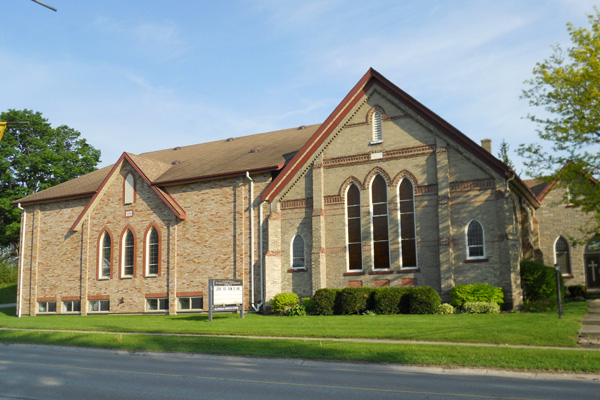
Plattsville_Missionary_ChurchI had the unique opportunity with working with two different churches outside of my denomination, and normal connections in the past month. Both times working with the church was the first time I’d encountered or met them. But the two encounters couldn’t be more difficult.

The first was difficult, at times troubling, and it was draining. The second church was gracious, open, and quite life-giving.

What I noticed was this. Life around the second church seemed to flourish, whereas,  life seemed to wilt around the first.

And of course, there could be a whole host of reasons why at this particular time one church seemed more life-giving than the other. Bad days, imperfections, and mistakes happen to us all.

So I’m not judging either church, but instead thinking about how we should judge or evaluate churches.

Traditionally churches measure budgets, buildings, or numbers. What if instead we started measuring the flourishing of life around the church?

Isn’t that a better metric? A truer metric?

Jesus says he will bring life. So it seems to me that if Jesus is being followed deeply, truly, and freely – life should flourish.

I think it’s a good question to ask about the churches we lead, participate in, or are a part of. I also think it’s a great question for us to ask personally, as people who are the church. Is life flourishing around us? Do our neighbors feel like we are a drain, or a welcome part of their lives? Is Jesus so active in our lives, that life seems to spring around us?

The point is simple: life flourished around Jesus, and it should flourish around his followers as well. It’s not always easy, but it is something to strive for. Something I know I want to strive for in my life and in my church. What about you?

“God helps me get to the North Pole” : Theology from a 4 year Old

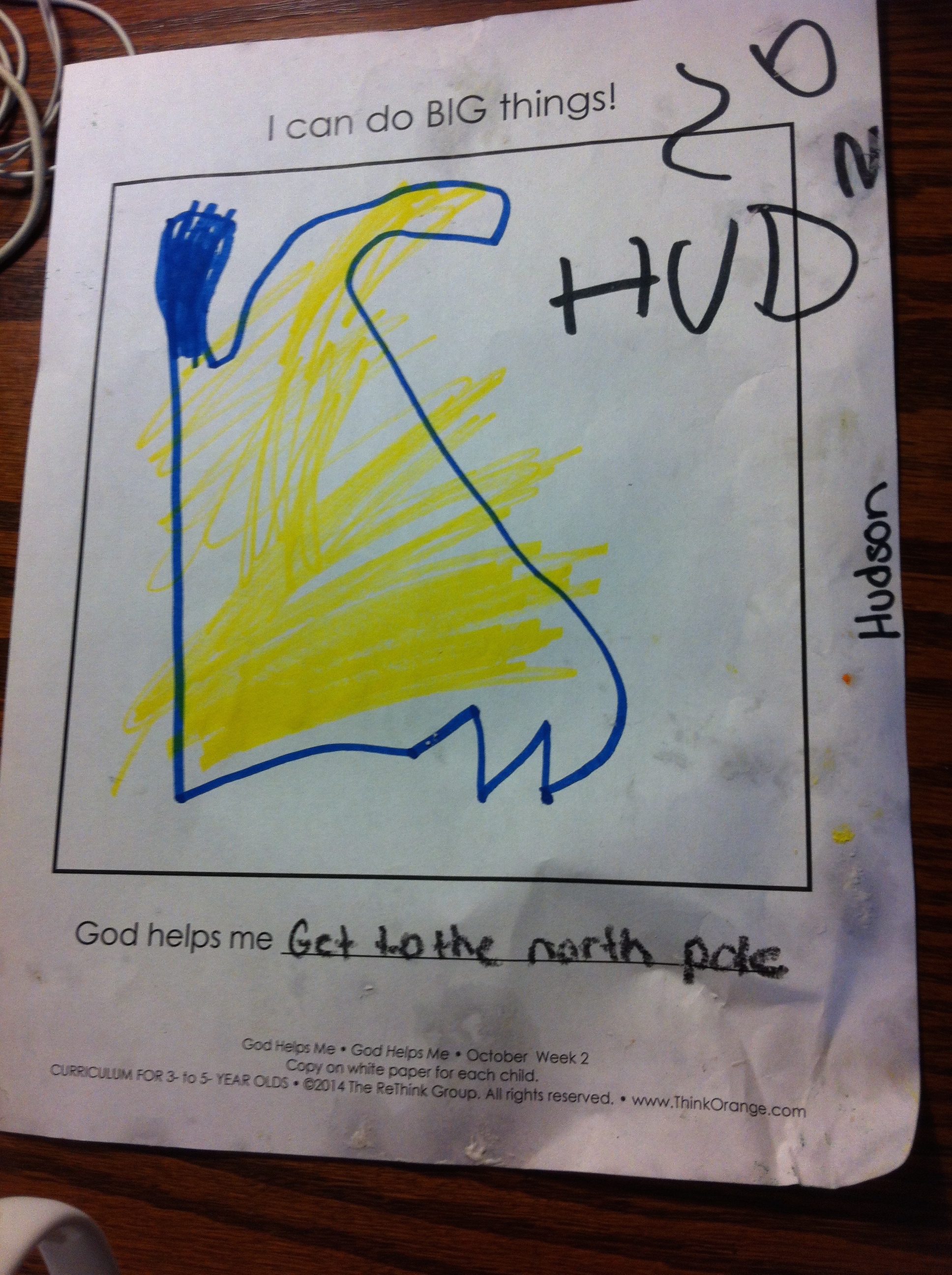
IMG_4512Today I’d like to share the work of my 4 year old.

Now I’m not sharing his work because he is an amazing artist, or because I want to sell his work or anything (although you’re welcome to buy it).

I share it because of something he had written at the bottom of the page.

God helps, “Get to the North Pole”

Now at first glance that is a very silly thing to say. It seems just like the type of thing a 4 year old would say. Except that this is actually a very deep theological statement, it’s just said in “Hudsonese”.

The past few weeks Hudson keeps talking about his grandpa, my dad, who died when he was just a few months old. He keeps talking about how he misses grandpa and wants to see him. So he asked where grandpa is, and I told him “Grandpa is in heaven”.

And because he’s 4 he had lots of follow up questions, “Is heaven far? Can we drive there and see Grandpa? Is it farther than Caleb’s house? Why can’t we see grandpa?”

And lastly, “How do we get there?”

We talked about this and the point he got was that God, because his love is so strong, can take us to heaven. And that heaven is far away, like the North Pole.

So when Hudson says God can help us get to the North Pole, it’s a comment on the power of God. That God is able to get us places we couldn’t get on our own. That the love of God is strong enough to draw us to heaven, and to bring heaven here. That God’s loving power is enough to do amazing things: like get us to heaven, bring reconciliation, cause resurrection, bring healing, bring hope, bring transformation, and of course, get us to the North Pole. 

While you might not see the phrase, “God helps me get to the North Pole” in any theology textbooks, it’s still a true statement. And may that statement give you hope today, just like it gives Hudson hope. That God’s love, power, and strength can change lives – and apparently get you to the North Pole.