
When Christians Fight Online

christianfight.pngToday, I want to talk about a reality that I bet many of you have seen on Facebook, Twitter, blogs posts and comment sections all over the Internet: Christians fighting online, publically and with vitriol (which is a big word for being nasty).

I bring this up because, not only do I think that this harming the reputation of the church, I also think it’s harming the Christian community and people.

Now, of course, right off the bat there are going to be some who say, “But shouldn’t we stand up for truth?,” “These issues matter!,” or “Shouldn’t we be able to debate within Christianity?” And, of course, I agree with all of that. We should remain firm to what we believe. Some issues do matter immensely and need to be addressed, and, of course, discussion and debate have always been part of Christianity and always will be.

My problem isn’t with the truth, discussion or addressing important social issues. My problem is subtler than that: It’s about what goes on in our hearts. My problem is when Christians actually start to enjoy all the debate, division and arguing.

Because, what I’m starting to see all over the place isn’t just people who love certain issues, topics and perspectives. It’s people who love to fight. It’s people seeking out to engage others in nasty back and forth arguments. It’s people who call out others and say “farewell” to so and so. It’s people who intentionally provoke, not to discuss, but to divide, distance and ridicule other positions. It’s people who actually relish in the fighting, provoking and dividing over whatever their issue is.

And, the problem with this is ridiculously obvious: If we love to fight, we are probably forgetting to love. If we love the conflict, the fray or the issue more than people, we are missing the point. Because, in a fight or argument, the goal is to win, convert and conquer – all of which can lead us away from loving. And, loving others isn’t optional in the Christian walk, but when we start looking for fights to have, we’ve stopped looking at Jesus and loving others.

So, to be clear, I’m not saying that certain issues don’t matter, that discussions are pointless or that we shouldn’t stand up for injustice.

No, what I want to raise to the surface is something that has happened in my heart, and something I think I see online all the time. Sometimes under the cover of standing up for truth, justice or whatever, what is really going on is that we are angry, looking for a fight and more interested in winning our theological or social agenda, rather than loving and listening.

Please hear me! Some things need to be changed. Some things are evil. Some things need to be called out. But, before we ever call someone else out online, I think it starts with calling out the sin, hate, anger and a pathological love of division within ourselves.

And, I’m pretty sure Jesus said something similar.

Cut the Labels

peopletaketime“People take time. But in our haste, we size them up or cut them down to what we take to be a more manageable size, labeling people instead of trying to hear, understand or welcome them.”

This statement by David Dark could not be truer. Because, the truth is, people take time. It takes time to get to know them. It takes time to understand them. It takes time to learn about their complexity and their story.

Yet, rather than taking the time, we find it easier to label others. Why? Because it’s faster. Labeling someone short-circuits the distance it takes to get to know them. It allows us to cut them down to a manageable size, and allows us to distance ourselves from them. Labeling allows us get out of the hard work of getting to know someone.

The problem is that labeling people, as a Christian, isn’t our calling. Our calling is to love others. And, to truly love people means pushing past labels and to get to know them.

I know I personally struggle with this. I know that, in my haste, I label people so that I don’t have to listen to people. I might say to myself, “Well they are just a “_____”, or “Of course they would argue that they are “_____”, or “Why listen to that [insert a group of people]?”

And, my point isn’t that labeling isn’t easy – or fast. My point is that it isn’t very Christ-like. Love requires getting to know people. Love requires some time. And, people require some time.

So, I write all this for one reason: the next time you are tempted to label someone, why not take the time to actually get to know them?

What is God really Like?

whatisgodlike.png

This is a question people often ask: What is God really like?

And, often when push comes to shove, even though we hear of God’s grace and love, we often fall back on a view of God as primarily angry, wrathful and vengeful. This idea of God as full of rage and wrath lingers in our theology, and it nags at the back of our minds.

Which is why I think we need to get something crystal clear: God looks exactly like Jesus.

Or, putting it another way, Jesus fully and absolutely reveals God. And what Jesus reveals isn’t a God full or rage and anger, but a God full of love. This is what is seen pre-eminently on the cross. Here Jesus doesn’t punish and exact vengeance on others, but takes on our punishment and what we rightfully deserve.

So what Jesus reveals is that at God’s core is love, even when we are tempted to believe its something else.

And, if this sounds, well, controversial or a little worrisome to you, that itself highlights the issue. We have been so influenced by a view of God that doesn’t look like Jesus, that we need to regain the only orthodox view of God that there is: Jesus fully reveals God.

Thomas Torrance puts it this way…

“Is God really like Jesus? Questions like that gnaw at the back of people’s minds but which they suppress and which come to the surface only in moments of sharp crisis and hurt, tell us of the insidious damage done to people’s faith by dualist habits of thought which drive a wedge between Jesus and God.

“Fearful anxiety arises in the human hearts when people cannot connect Jesus up in their faith or understanding with the ultimate Being of God, for then the ultimate Being of God can be to them only a dark, inscrutable, arbitrary Deity whom they inevitably think of with terror for their guilty conscience and makes them paint harsh, angry streaks upon his face.

“It is quite different when the face of Jesus is identical with the face of God.”

And, I think that’s true. Our view of God is not only better, but truer and more whole when the face of Jesus is identical with the face of God.

So, today I write this as both a challenge and invitation: A challenge to see God as identical with Jesus, and an invitation to change your view of God so that it looks completely like Jesus. Because, the Father doesn’t have harsh, angry or rage filled streaks on his face. His face is identical to Jesus, streaked with tears and love.

The Problem Inside All of Us

probleminside.png

I was reading the other day, as I often do, and the following quote made me stop completely. I actually couldn’t read any more for the rest of the day.

“How can we Christians claim to proclaim atoning reconciliation through the cross of Christ when we contradict it by refusing to be reconciled with one another, or to allow reconciliation through the body and blood of the Saviour to be translated into our Church divisions.” – Thomas Torrance

Read it again, if it didn’t stop you the first time.

Torrance’s point is for us to examine how we can proclaim that God reconciles us to Himself when we refuse to practice that with each other. How can we hold onto our divisions, debate and disagreements when Christ died to bring us together? How can we share the good news of reconciliation when we refuse to give up our inner Church disputes and divisions?

The easy (and preachy) thing to do would be to call out all the pastors who continue to divide over silly things. The easy thing to do would be to call out all the Christians who continue to hate one another and not forgive. The easy thing to do is to get on a soapbox and slam all of you who continue to hold onto grudges and divisions, and ignore the fact that Christ brought us together.

That would be easier, but not godly.

Because, the truth is, I struggle with holding onto bitterness and grudges sometimes. The truth is, I think my theology is obvious and right, whereas others is misguided at best and stupid at worst. The reason this quote stopped me isn’t because it highlighted the problems in the Church (although it does that); it’s that it highlighted the problems in me…

  • That I would rather divide than work through things.
  • That it’s easier to be right instead of reconciled.
  • That sometimes I love my theology, my perspective and my opinions more than other’s.

Torrance’s point reminded me that I’m part of the problem. That the church’s tendency to place personal opinions, past hurts or theological preferences above people is a problem. Jesus died to reconcile us together, and we shouldn’t contradict it by refusing to reconcile with others.

So, this post isn’t meant to point out anything wrong in anyone else, rather it’s meant to remind us that often the problem isn’t with “out there,” but “inside us.” And, that’s why I stopped reading. Because I realized I had some things to work on.


You are NOT a Layperson

I want to be honest and say I’d like to get rid of the word “layperson.” And, if you’ve never heard it…well, that’s good…but here is what it means: “A person without professional or specialized knowledge in a particular subject.”

At a base level, there is nothing wrong with this idea. That in some spheres or disciplines we might be a hobbyist or an amateur at something – like being an amateur filmmaker or electronics enthusiast or racing hobbyist.

The problem happens when this terminology gets infected with consumerism and spreads into the church. Because, here is what can subtly and quickly happen: We end up with two classes of Christians – the professional and the layperson. And, what can easily happen is that we expect more from the professional than the layperson, or we encourage the layperson to live vicariously through the professional.

Eugene Peterson puts it this way: “If I can be convinced that layperson designates who I am…then I am wide open-market for experts who are ready to tell me how to live my life and, in some cases, even live it for me…And so, I end up delegating the operations of my soul to the experts. I no longer deal with God myself – I’m a layperson, after all…following Jesus gives way to following Jesus-experts.”

I couldn’t agree more. This is a problem in the North American church. We are tempted to follow Jesus-experts, rather than get out into life itself and follow Jesus for ourselves.

Now, of course, this doesn’t mean we don’t need people who give up decades to studying the Bible and God. Our theologians, scholars and pastors can help us and they matter, but they can’t follow Jesus for us. We can’t delegate the core of following Jesus to experts who are trained in evangelism, knowing the Bible, hospitality or teaching. They can point us to Jesus, help us understand Jesus,  train us in the way of Jesus, but they can’t follow Jesus for us.


I write all this to remind you to not buy into the idea that you are layperson in the church. If you are a follower of Jesus, you ARE the Church. And yes, some of us have been doing it longer than others (and we should look to these people for help!), but they can’t fill our role or our calling

So, we need our models, leaders, pastors and teachers. But, let’s never let “following Jesus give way to following Jesus-experts.” Because the world needs all of us – including you.

Worship Everybody Does It

worship

Here is the truth…

Everybody worships something. Everybody moves toward something. Everybody has a goal that, for them, is ultimate and to which they are subservient. Even people who say, “No, I don’t worship. I’m totally independent.” In that case, what you worship is your independence. This is just the reality of life.

David Foster Wallace makes a startling claim about this in his famous commencement address at Kenyon College. And he says this not as a Christian, but as an observer of humanity…

“In the day-to-day trenches of adult life, there is no such thing as atheism. There is no such thing as not worshipping. Everybody worships. The only choice we get is what to worship.”

That’s just what I said, but now read what Wallace continues to say…

“An outstanding reason for choosing some sort of god or spiritual-type thing to worship…is that pretty much anything else you worship will eat you alive. If you worship money and things – if they are where you tap real meaning in life – then you will never have enough. Never feel you have enough. It’s the truth. Worship your own body and beauty and sexual allure, and you will always feel ugly, and when time and age start to show, you will die a million deaths before they finally plant you. … Worship power and you will feel weak and afraid, and you will need ever more power over others to keep the fear at bay. Worship your intellect – being seen as smart – and you will end up feeling stupid, a fraud, always on the verge of being found out.”

I couldn’t agree more. If you worship anything other than God, ultimately your desires and wants will eat you alive.

Wallace ends with this…

“The insidious thing about these forms of worship is not that they’re evil or sinful; it is that they are unconscious.”

And, this is the difficulty.

We all know living after these things aren’t healthy, but we still do it. We live a life that is unexamined and suffer the consequences. We slip into this kind of worship without ever being fully aware that that’s what you’re doing.

So, what is the solution? Well, it’s simple…

“Above all else, guard your heart, for everything you do flows from it.” – Proverbs 4:23 (NIV)

Guard your heart, examine your heart, challenge what you worship and put your trust in God. Because our desires lead us.

Where is your heart leading? Set it on God and follow that. And, most of all, guard your heart against these other desires that slip in silently and set you up for difficulty. Don’t let your heart go unexamined and unguarded because that will never lead you into life.

So, what do we do? We sit and really reflect on the question, what do I worship? Don’t answer it too quickly, but do answer it. Because your life, and experiencing life, might just depend on it.

Are We Looking?

are we looking.png 

If we’re honest, at certain times in our lives God can be difficult to find. If you’ve walked with Jesus long enough, there seems to be these seasons when God is either difficult to find, elusive or seemingly absent.

There are a lot of complexities and facets to this reality and feeling. There are a lot of potential reasons and points to consider when you are in this place. And, while I don’t want to offer a simplistic or one-size-fits all explanation for this reality, a new reason why God might be difficult to find did occur to me the other day. It happened as I played hide-and-seek, with my kids.

The truth is this, when I play hide-and-seek with my kids, I hide to be found. I don’t want to win; I want them to enjoy the search, to seek, to feel joy when they’ve found me and to celebrate when they discover me.

Then it hit me, does God sometimes “hide” for this same reason? That we might search for Him? That we might find Him? That we might be stirred to action?

This thought occurred to me as I stuffed my big 6 foot 4 inch body into a cupboard and desperately hoped my kids would find me, as it was incredibly uncomfortable. And, the longer they took, the louder I got yelling, “Over here, Asher, Eden, Hudson!!”

I wonder, does God ever do this? Remove Himself so that we might seek Him? Call out to us so that we might find him? Intrigue us, draw us and ask us to move toward Him?

Now, I certainly don’t want to downplay what you are going through or to dismiss any of your current realities, especially if you’re in a season when God seems absent. This isn’t saying that anytime God seems difficult to find, this is what going on, but perhaps, maybe God hides simply to be found.

The question is then: Are we looking?

How to Change Your Heart

How to Change Your HeartToday, I want to wade into a complex theological topic in about 500 words. Trying to explain desires, disconnect and why we don’t act how we should.

Here is the truth: Many of us want to live differently, but we struggle. We want to be more like Jesus, but find ourselves not living like Him. We want to be holy or righteous (to use more traditional language), but we find ourselves doing things we don’t want to do.
Paul puts it this way, “I don’t really understand myself, for I want to do what is right, but I don’t do it. Instead, I do what I hate.” (Romans 7:15) So, it seems like it isn’t just us that struggle with it, but also Paul.
Here is a controversial, but true thing: The solution to this problem isn’t more knowledge or more information. Yet, this is precisely what we gravitate to when we or someone else is struggling. We try to give them more information or we listen to more sermons about “How to Change Our Lives” and decide to “try harder.” And, I’m not saying that information or sermons are bad (clearly it’s my job!), but if deciding to try harder and gaining information led directly to transformation, we would be the most transformed and healthy society with all our information
The truth is, when we encounter a gap between what we know and how we live, the problem isn’t with the knowledge. The problem is with our desires.
Jamie Smith puts it this way, “It seems we can’t think our way to holiness.”
I cannot love this quote more. It’s so simple, yet also so true. We cannot think our way to holiness. We cannot decide our way to righteousness. Because, the disconnect in our actions is not with our intellect, but with our hearts. Because our hearts are following desires that lead us away from Jesus, holiness and righteousness. Because we are not just thinking things, but loving beings or wanting creatures.
So, what does this all mean, practically?
Well, what I think it means is that when we struggle to live differently, the problem often isn’t our moral muscle, resolve or lack of knowledge. The problem is that our hearts have not been attuned to love the way of Jesus over the other competing desires in our world.
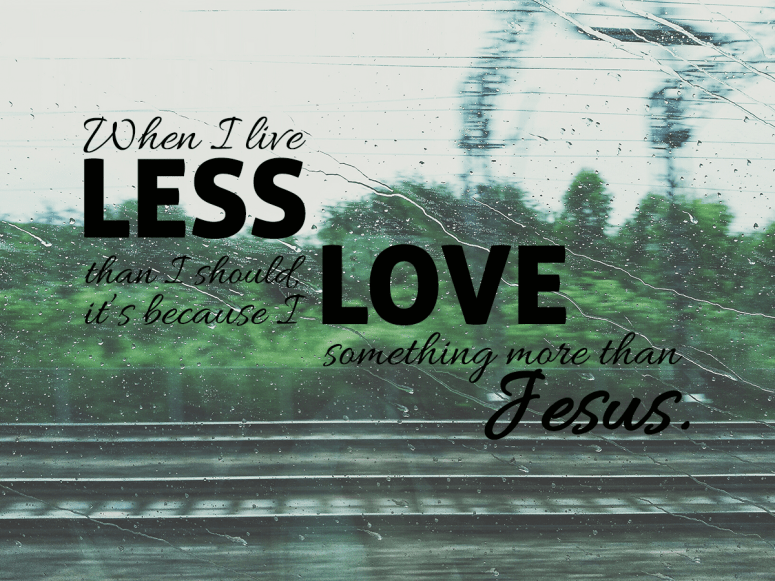
When I live less than I should, it’s because I love something more than Jesus.

So, my challenge this week is just this: When you act differently than you know you should, ask Jesus to help you shape and change your wants. Because that’s where transformation resides.

Pray and say, “Jesus, help me to want forgiveness more than revenge.”
Pray and say, “Jesus, help me to want generosity more than financial security.”
Pray and say, “Jesus, help me to want your way of love more than fear.”
Pray for your heart and wants/desires to change.
Because, it’s not just about knowing more, but loving differently.
P.S. To learn more, Jamie Smith’s book You Are What You Love is amazing.

Share the God You Know

simply share the god you know blogI want to talk a little bit about evangelism and apologetics. And, I want to take a bit of a different slant than normal.
Normally, we think of apologetics as seeking to convince someone of the reality of God. And, in many ways, this form of apologetics has a huge number of benefits and is really effective, especially in our modern world. It also has some drawbacks, but it is still an important area of thought in Christianity.

If we are honest, though, many of us would love to convince people of the reality of God, and their need of God, but we just don’t feel comfortable having those conversations. Maybe we feel like we’re not “smart enough,” don’t know the lines of reasoning or it’s just not our personality.

So, when it comes to apologetics and evangelism, many of us feel like that’s something for the “professionals” – the pastors, the theologians or Ravi Zacharias.

But today, I want to encourage you, because you can be part of sharing God to others, whether or not you know any apologetic argument at all. Because, in today’s postmodern world, you don’t need to talk about God. Rather, you can actually introduce people to God.

Tony Kriz puts it this way: “For the most part, we talk about God… Most people speak as if God is just an ideology: a set of concepts, arguments, guidelines and categories. God is presented as something that people need to be convinced of, as opposed to someone they can be introduced to.”

And, here is the beautiful thing: God is a person. So, if you know God, you can introduce people to Him. You can share about what He is like in your life. You can share about the difference He has made in your life. You don’t need to know every philosophical or rational argument about God. You can simply share the God you know.

My point with this short little post isn’t that apologetics or good reasoning isn’t needed. It is, and it’s incredibly valuable, deep and rich. It gives us confidence for our beliefs. And, it helps immensely with our questions and doubts.

But, my main point is that you don’t need to know every argument for God to start to share Him with people. God isn’t just a concept to know, but a person to share. And, you can do this if you know Him.

So, my challenge is to share the God you know – the God who is changing your life, the God who is active, the God who is real. Share what He is doing in your life and then, as more questions come up, that’s fine. Because, there are lots of great resources for why we believe what we believe.

But, don’t be intimidated by the idea that you need to know everything to start sharing. Because, if you know God personally, you can introduce Him to others. Right here, right now.


Changing Directions During Lent

changing direction blog.pngI’ve recently been convicted of something in my life by God and it’s this: I’m often tempted to use God for godly outcomes. And, here is what I mean by that…

I have noticed a consistent temptation, and even posture, of me using my relationship with God to ensure godly or good outcomes. And, that last part is important. I’m not seeking to use God for bad outcomes – sinful things – but rather for good and holy things – Kingdom things. And, here is what that might look like in the practical, tangible ways I’ve noticed in my life…

1. I spend time in prayer to ensure my preaching is good, but not to connect with God.

2. I serve to see God’s Kingdom grow, but not to find God in the serving.

3. I fast, but do it to ensure that a new project goes well, rather than as a way to sacrifice and focus on God.

4. I rely on God when I need Him, but rely on my gifting and skill at other times.

Do you see how subtle the shift is in practical, but real life ways? And, do you also see how dangerous it can be? Because prayer, serving and reliance can quietly shift from God to the ourselves or the good things God calls us to do. But, the truth is, as soon as the focus shifts from God to ourselves, we’ve lost the point.

Eugene Peterson puts it this way, “Along the way, the primacy of God and His work gives way ever so slightly to the primacy of our work in God’s Kingdom. We begin to think of ways to use God in what we’re doing. The shift is barely perceptible… We continue to believe the identical truth. We continue pursuing good goals. It usually takes a long time for the significance of the shift to show up. But, when it does, it turns out that we have not so much been worshipping God as enlisting Him as our trusted and valuable assistant.”

That last sentence is what stopped me in my tracks and caused me to really reflect on my motives, not just my actions.

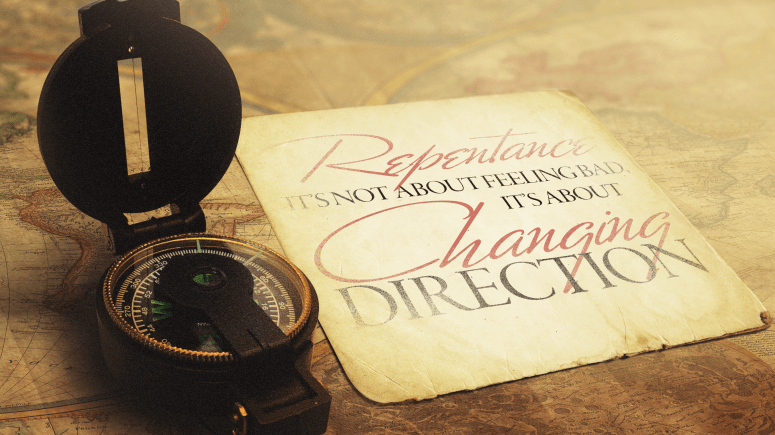
And so, I write all this because this is the season of Lent – a season when we are to take a hard and reflective look at our lives, and reveal any subtle shifts that have happened. Because, they can happen and they can be hard to notice, but they need to be revealed and repented of. And, I use that word in the proper way – repentance is not about feeling bad, but about changing direction. We need to repent of our tendency to use God, and move toward worshipping, loving and appreciating Him.

So, I write this because, my bet is, I’m not alone in this temptation. But, becoming aware of it is the first step to changing it. And, it’s something worth changing. It’s subtle. It’s a small shift. But, it can change everything.