
Theology 101: Christology, a Jesusy God, and Holy Humanity

gods-wrath(2)On Sunday we began with a cartoon. And with me there is a chance that its either Calvin and Hobbes, or The Farside (which I spent more hours reading in high school than…well probably any other book).

And Gary Larson has this great cartoon that looks like this. And here was my question for Sunday – how do we know God isn’t like this? Why is this funny? Why do we laugh – knowing its not like God has a smite button? How do we know that?

Because for many years, many people had this view of God. That if you step out of line, smiting, cursing, or punishment is on its way. If you’re crops failed, its because of that sin. If you get sick, its punishment and God smiting you. So how do you know that God isn’t like this?

Well the quick and easy, and true answer is this, because Jesus isn’t.

Jesus perfectly reveals God. Jesus is entrance into understanding God. God is Jesusy. The Bible makes it clear in multiple places that God is Jesusy (Hebrews 1; John 1:18; and others). And here is why this matters because:

If you’re God doesn’t look like Jesus, you have the wrong picture of God.

And there isn’t any other way around this. Gary Larson’s wrong, God isn’t like that, because Jesus isn’t like that.

And yes this surely brings up tensions, there are difficult parts to reconcile then in the Bible. But the point is this: we cannot compromise on the revelation of God in Jesus Christ, no matter what else we do. We will need to use care in exegeting some of the Hebrew Bible in light of Jesus, but we cannot compromise the revelation of God in Jesus.

With this understanding that Jesus reveals God, we got to know Jesu a bit better. We began by looking at the divinity of Jesus.

The divinity of Jesus was actually something that was debated for a while in early Christianity. Yet there are some clear indications that Jesus is fully God, as we attest and believe, in Scripture. We looked at the sinlessness of Jesus, we looked at how he forgave sins (something only God can do), and how he accepts worship. But by far the biggest thing that testifies to his divinity, is how he was resurrected from the dead by God. God through resurrecting his son, validates all his claims about whom he is (Rom 1:14).

We then looked at the humanity of Jesus. Now this is something that was clear to the early Christians, but that we struggle more with today. We like to think of Jesus as Superman. That he dresses up in humanity, like Clark Kent, but pulls out his superpowers to do miracles and so on. But this isn’t the picture the gospels paint – Jesus was fully  human and Jesus is fully human.

Michael Bird writes this, “The fact the that the Logos was able to take on human form suggest that divinity and humanity are not mutually exclusive modes of being…The incarnation is not simply God assuming human form, as if human flesh were a mask over his real nature. Rather, the incarnation is God as a human being and complexly sharing in human properties. The incarnation shows us what God intended humanity to be and what it finally will be” (Evangelical Systematic Theology)

So with that we came to our main point for Sunday. And it was this:

            That Christ is the Key

Jesus is the key for everything. He is the key for understanding God. He is also the key for understanding humanity and what it means to be human. Jesus is the key to everything. If you want to know God, if you want to know yourself – look to Jesus. So that was our challenge for Sunday – go home and read the gospels. Because the more you get to know him the clearer God becomes, and how to live life becomes clearer too.


Sermon Notes:

Big Idea: Christ is the key

Teaching Points:

  • The foundation of our faith is Jesus Christ, first and foremost.
  • Jesus perfectly reveals God.
  • The lens we interpret the Bible through is Jesus.
  • We can’t give up on the centre of our faith and compromise that Jesus reveals God
  • Reasons for Divinity of Christ: Miracles, Forgives Sin, Sinless, Accepts Worship, and Was Resurrected.
  • Jesus was and is human.
  • Incarnation when Jesus enters the world isn’t for a moment, but for eternity.
  • Christ is the Key
  • If you want to be certain about God, get close to Jesus.
  • Read the gospels
  • Our comfort does not lie in the fact that we have pure doctrine or pure revelation. Our comfort does not lie in intellectual or spiritual certainty. Our comfort does not lie in the belief that we have grasped Jesus. Our comfort and only hope is that He has grasped us, called us, named us and chosen us, all of us, and that He alone is our hope. Michael Hardin

Adult Discussion Questions:

What stuck out to you from the sermon? What was challenging to you? How did God speak to you through it? What was new? Have you ever thought of God as Jesusy? Is there anything in your picture of God, that isn’t “Jesusy”? How does having Jesus as the perfect revelation, give clarity to who God is? Which do you find easier to believe in: the humanity or divinity of Jesus? Why is that? Which of the gospels are you going to read?

Discussion Questions for Young Families

Ask your kids what God is like. Ask them what other people think God is like. Then share with them the most important thing – what Jesus says God is like! Have them think about how Jesus reveals God. Ask them, what is Jesus like? And then tell them that’s what God is like.

Challenge for the Week: Read the gospels.

Who’s Jesus?

On Sunday we are going to be continuing in our series looking at Theology 101. We are going to be discussing a key, or they 443072_50402965key central tenet of Christianity: Jesus Christ. This is called Christology, and we’ll be exploring the humanity, divinity, and most of all the revelation of Jesus Christ.

The revelation of Jesus is so key to our current culture. Currently there are lots of views floating around our culture about what God is like: a grandfather, non-existent, passé, an angry vengeful warrior, someone intensely interested in personal morality, or lots of things. The God I’m interested is none of these. The God I’m interested in is the one that Christ reveals, that Christ shares, and the one that Jesus says looks like him.

And that’s what we are going to be looking at, but before we get there I have a question for you. As you think about God, and what he’s like, here’s my question – does he look like Jesus? And if he doesn’t maybe there are some changes to be made.

Theology 101: The Doctrine of God, Holiness, and Why Love is always First

doctrineOn Sunday we kicked off our series on Theology 101 by looking at the doctrine of God right off the bat. We talked about theology and that it is important because we are always doing theology all the time. When we look around the world and say, “Well God wouldn’t do that” – that’s theology. When we see someone in suffering and say “I’ll pray for you” that’s all theology too. Theology is intimately tied with our practice. Ou practice actually reveals our beliefs. So the point isn’t whether or not we are doing theology, but whether or not we are doing good theology.

So that’s the point of this series, to give us a good foundation to practice good theology. To practice theology that sets people free, demonstrates God’s love, and participates in the Kingdom.

And so we began by looking at first how do we get our theology?

The quick and easy answer is: the bible duh!

But it’s actually not that simple. Those people who just say all I need is the Bible, it’s enough for me! Well beside them being perhaps well-meaning that view is also naïve, incredibly arrogant, and actually just downright wrong. We all come to the Bible with preconceived notions, thoughts, and baggage. So when it comes to doing our theology, the source isn’t just our Scriptures but other things play into it as well.

There are traditionally four areas or sources for our theology. Firstly, is obviously the Bible, but there is also our experience, reason, and tradition. Experience plays a huge part in our thoughts about God. I used to think that God had a purpose in death, but after experiencing the death of my dad, I no longer think this. I think God has a purpose to abolish death, but not in death. Experience shapes us.

So too does reason. When we look at beliefs we look at how they actually logically work. Andy Bannister writes this, “The Bible tells Christians to be transformed by the renewing of our mind, not the removal of.” And that’s true.

And last but not least, we get our theology from tradition. Now this is a weak area for Evangelicals. We often think that our beliefs are what Christians have always believed. But this is not necessarily true. So it is good to know our history. Tony Lane writes, “There are two sorts of Christians. Not those who are influenced by tradition and those who are not, but those who are aware of the influence and those who are not.”

So with that introduction we launched into discussing the theology of God proper and asked this question: what is God at His core?

Lots of people have lots of different ideas or metaphors. Some people say judge, some people say creator, some people say king. But by far one of the most popular ones is that God is Holy. But I believe that God, at his core, isn’t those things, but is instead love.

To understand this we talked about the difference between God’s essence (what he always is and always has been) and God’s attributes (something God is in relation to something else). And God surely is a creator but this isn’t at his core, because there was a time when God wasn’t a creator (i.e. before he made the earth). The same holds true for God’s holiness. Holiness is always something in relation to something else. For someone to be holy, there has to be something that is unholy (a reference point). The same thing holds true for someone being tall (if you are the only person on earth – you aren’t tall because there is no reference point). The point is then that in the beginning when it was only God, God wasn’t “holy” per se because there was nothing unholy around. Holiness is to be set apart, but there was nothing for God to be set apart from.

So what is God at his core then? The answer is clear from the Bible – love. God is love is stated often. And the supreme self-revelation of God, Jesus dying and rising for us, is a revelation of self-sacrificial love. So God is love and always has been love. And that was our main point on Sunday. That God is love.

But this is actually a practically challenging thing too. Because if God at his core is love, then as Christians our core should also be love. We should be known and seen as people of love first and foremost. Because love isn’t’ about how you view yourself, but how others view you. So if no one thinks you’re loving, you probably aren’t. The point is that we need actions behind our beliefs and demonstrate love. That’s the challenge I gave this week, to choose one person to demonstrate love to. Because if God is self-giving love, we as his followers should also show self-giving love. Love is at the centre of God, and it needs to be at our centre too.


Sermon Notes:

Big Idea: God at his core is love.

Teaching Points:

  • The truth is, we are all doing theology all the time.
  • The Bible was not written so that we would know about God, It was written so that we could become more like God
  • To follow God well, you have to know him well too
  • Theology literally means the study of God
  • Theology is not the study of the ideas about God; it is the study of the living God. Michael Bird
  • Theology is communal.
  • Theology is a communal study of the living God.
  • We get our theology from the Bible, Reason, Experience, and Tradition.
  • The Bible tells Christians to be transformed by the renewing of our mind, not the removal of. Andy Bannister
  • There are two sorts of Christians. Not those who are influenced by tradition and those who are not, but those who are aware of the influence and those who are not. Tony Lane
  • The Bible is our primary authority, but not our only authority.
  • Love is the fundamental divine attribute. Love is not merely one attribute of God among many. Rather, “God is love” is the foundational ontological statement we can declare concerning the divine essence. Stanley Grenz
  • God at his core is loving relationally.
  • Being loving isn’t how you see yourself but how others see you.

Adult Discussion Questions:

What stuck out to you from the sermon? What was challenging to you? How did God speak to you through it? What was new? Before today, what would have been your answer for what’s at God’s core? What shaped you to believe that? Who are you being called to love? How will you do it this week? Of the four areas (reason, experience, Scripture, tradition) which one do you feel most comfortable with? Which one don’t you feel comfortable with? What is one theology question you’ve always wanted answered?

Discussion Questions for Young Families

Talk about how God is love at his core. Maybe have your kids draw a picture, paint a picture of God being love, and then decide on whom you can love as a family. Maybe a school friend, maybe a neighbor, maybe someone sick. Ask them, and then make something happen!

Challenge for the Week: Be a person of love.

Theology 101 Series

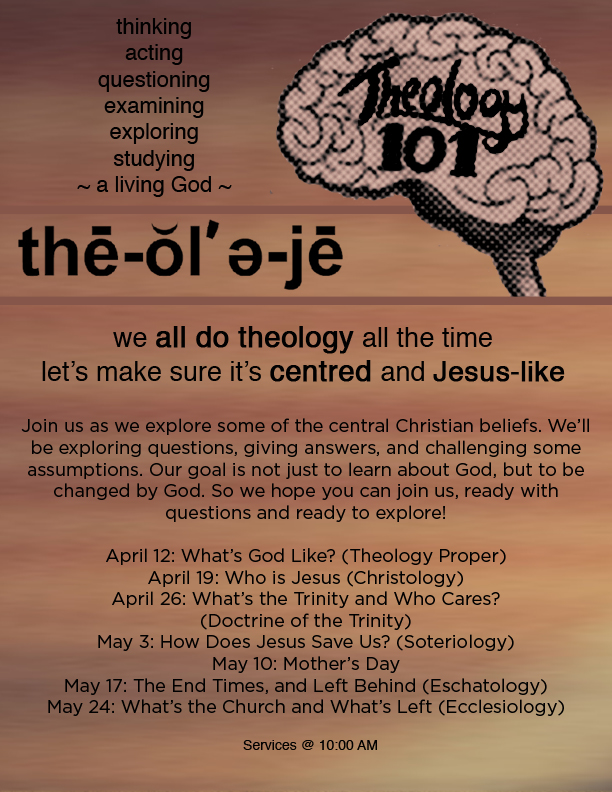
On Sunday we are kicking off a brand new series called Theology 101. We are going to be diving into some topics we kind of usually keep to the edges and might not really address like:

  • What is God really like (doctrine of God)
  • What is Jesus actually like and why is he God and does he have superpowers (doctrine of Christ)
  • What is the Trinity and does it even matter for our lives
  • How does Jesus actually save us – is there like a ledger sheet or something?
  • What will happen at the end of time? Is heaven full of clouds, and hell full of fire?

We are going to be looking at these questions and more. Giving time to thinking them through and asking more questions. So I hope you can join us!

Theology 101

Three Words to Change Your Life ~ That aren’t “I Love You”

6a012876cf8591970c01543608ca6b970c-800wiOn Sunday, for Easter, we explored Jesus first words he says after his resurrection. For the past 6 week’s we’ve looked at what Jesus said before he died. Now we wanted to look at what he says when he lives.

The key thing to notice first off is that words have power. They can both heal, or tear down. They can give life, or create death. Words have a power, a weight, an energy to them. And Jesus’ words especially have a power to them.

So the disciples are sitting in fear. They are filled with fear and worry and anxiety. Shame is covering their hearts, and guilt is seeping through their souls. They are hiding in a room and Jesus shows up. And before we jump to Jesus words, we need to first recognize one clear thing: for the disciples Jesus showing up would not seem like a good thing.

And at first that statement might seem funny – you might have even re-read it – but its true.

We know that Jesus comes with grace, and forgiveness – but the disciples didn’t. Remember at this point they are God-betrayers, God-abandoners,  and God-deserters. That’s who they are. They are not in the “good and righteous God followers” column or category. And they would have grown up in a world that talked about the “Day of the Lord” (the coming of God) as a good day for the righteous but an awful terrible day for sinners, gentiles, and the unrighteous. The Old Testament says if you are sinner, a gentile, or unrighteous that when God shows up it’s a day to be feared, it’s a dark day full of vengeance and punishment.

So when Jesus shows up we shouldn’t jump to the conclusion that for the disciples this was instantly good. They were filled with fear, and shame and most likely didn’t think of themselves as “righteous and good”. They would be wondering if Jesus is here to settle accounts, to bring rightly deserved punishment, to bring vengeance and sentence.

And its into this highly charged, tense filled silence – where the disciples worst fears are playing with their imaginations – where shame is leading their souls further from God – that Jesus speaks some of the most beautiful words ever: peace be with you.

Peace be with you. Peace be with you. Peace to your sins. Peace to your shame. Peace to your betrayal. Peace to your disappointment. Peace to your fear.

Jesus shows up and gives out radical peace and forgiveness to a group of men who didn’t deserve it. Jesus first words are about peace, not  judgment. This is a beautiful radical thing that we need to get. Jesus here is not just saying a short hello, or a salutation – Jesus is revealing the heart of God as about peace. Jesus is giving the trajectory of his kingdom that it will be about peace and not punishment and vengeance. God’s heart is about peace.

This is a radically freeing three words. Because then God isn’t to be feared, God is to be embraced.

Some of us believe that when Jesus shows up it will be to punish us for sins. But that’s not what this passage reveals. Jesus wants to free us from sin, not to punish us for sin. He has already taken all the punishment. And he wants to free us by offering us his peace.

So that’s where we landed on Sunday – with the Prince of Peace saying – Peace be with you. We closed with inviting everyone to simply picture Jesus saying to each of them – peace be with you. Peace to your fears, peace to your shame, peace to your guilt, peace to your brokenness, peace to your imperfection…peace…peace…peace

And that’s a good way to end, and to begin – with the peace Jesus wants to give us all.

Sermon Notes:

Big Idea: Peace be with you 

Teaching Points:

  • Words are powerful things
  • Shame is the heart disease of every era. People are dying from it – some quickly, others slowly. Shame deceptively but convincingly leads us to believe that we deserve to be shackled to it for the rest of our lives. We believe we don’t deserve to be free of shame. Silence always leads to more pain and guilt and shame festering inside. Pete Wilson
  • The disciples are not sure Jesus showing up is a good thing.
  • Jesus is saving the world, and creating the world in this moment through peace.
  • God at his heart is about peace
  • God is not someone to be feared, God is someone to be embraced
  • Jesus wants to free us from sin, not to punish us for sin
  • Fear and shame have no part of God’s Kingdom.
  • Peace rules in God’s Kingdom.
  • Resurrection means that sin is ended
  • Resurrection means that evil is ended
  • Resurrection means that shame is ended
  • Peace be with you, because I am with you – Jesus.

Adult Discussion Questions:

What stuck out to you from the sermon? What was challenging to you? How did God speak to you through it? What was new? Have you ever thought about how the disciples would have been feeling? Do you think they might have been fearful of Jesus? Have you ever been fearful of God? Why are Jesus words “peace be with you” meaningful for you? Who should you share Jesus words with? Who needs to hear them?

Discussion Questions for Young Families

Why not actually practice this passage today with your kids. Ask them if they have any worry, any fear, any shame or guilt or hurt. Talk to them, and then talk to them about Jesus gives us peace. Share his words with them, and have them repeat them with you. Share the peace of Jesus with your kids – that’s a good way to start.

Challenge for the Week: Hear Jesus say, “Peace be with you”

Seven Words: “My God, My God Why Have You Forsaken Me” ~ Answering Jesus’ Question and Prayer

sevenlastwords-4On Sunday we discussed one of the last sayings of Jesus, where he cries out in a loud voice:

“My God, My God, why have you forsaken me?”

And this is a verse with a lot of tensions and complexities. Many scholars don’t like the idea of the Father abandoning the Son. This also raises consternation and concern about the Father’s character for me too. So scholars offer two solutions. One, that Jesus isn’t actually being abandoned by God, he is just feeling like he is. But that just seems like semantics to me, and goes against what seems obvious: that Jesus is experiencing being abandoned by God, because he is being abandoned by God.

Other scholars point out that Jesus is quoting Psalm 22 (which he is). And taking the Psalm as a whole, it ends with vindication. That the suffering victim is eventually vindicated, justified, and that God overcomes the wrongful suffering. So they say Jesus is actually saying that he will trust in God to overcome this wrong. They (rightly) point out that speaking on a cross is incredibly painful and difficult. So Jesus couldn’t have quoted the whole Psalm (I agree), so he quotes one verse to bring the whole Psalm into view.

Again though I just think this goes against the plain reading. If Jesus could only quote one verse because of pain, and wanted to talk about God vindicating him, he could have quoted the last verses of Psalm 22. But he doesn’t, he quotes a verse about being abandoned.

So even though I might not like the idea of the Father abandoning or forsaking his Son, I think we are left with the plain reading of Scripture.

But there is one obvious fact that needs to be stated, that actually changes the whole perspective of this verse. It is stated from Jesus’ perspective. We don’t hear the Father’s perspective. So Jesus is being forsaken by the Father, and then we assume, that the Father is above pouring out wrath on Jesus in an emotionless dispassionate state.

People struggle with this verse because it makes it seem like Jesus is nice, whereas, the Father is stern, uncaring, judge, who abandons his son when he needs it most. But this is all based on an assumption, that the Father is unmoved by what his Son is going through. And this assumption is wrong, and what I not only challenged but worked through in more detail (download the sermon for more).

Jurgen Moltmann writes,

“In forsaking the Son, the Father also surrenders himself, though not in the same way. For Jesus suffers dying in forsakenness, but not death itself; for men can no longer suffer death, because suffering presupposes life. But the Father who abandons him and delivers him up suffers the death of the Son in the infinite grief of love…The son suffers dying, the Father suffers the death of the Son”.

And here is his key thought: “The grief of the Father here is just as important as the death of the Son.”

And this is what we need to get, that the Father and Son are both affected and separated because of our sin. It isn’t a singular choice on the Father’s side to abandon his son. It is a choice within the Trinity to experience the separation of sin so that we could be welcomed into fellowship with God. The Father doesn’t kill his Son, to forgive us. The Father experiences an abyss of separation from his beloved Son, so that we could become incorporated into the family of God. Sin ruptures, that’s what it does. And it does this at the heart of the Trinity. So yes, Jesus experienced being forsaken by the Father, and the Father experienced the death of the Son.

This led us to some simple but personal conclusions.

First, that we need to be in reverent thanks of what the Father, Son, and Spirit went through to include us in their life. The Son died, so we could live. And this affected all the Trinity, and for that we need to be grateful. We need to be reverently worshipful of the depth of what God went through for each and everyone of us.

Second, we talked about that sin is serious. That sin brought separation to the heart of God, and we need to own that. We did that. We killed the Son (read the Book of Acts). We need to recognize the seriousness of sin, and confess, repent, and rid ourselves of sin. If sin did this to God, we need to work at ridding ourselves of it.

So we ended with a challenge, to sit in thanks to God, and repent for sin. When we see the depth of what God went through, I think that is the right response: reverence and repentance.

Martin Luther said, “God forsaking God, who can understand it?” I know for sure we don’t all understand it because of one sermon (I certainly don’t), but I hope we got a little closer and most of all, a little more reverent and repentant.


Sermon Notes:

Big Idea: Jesus was abandoned by the Father for us; and the Father experienced the abandonment of the Son for us.

Teaching Points:

  • Challenge for Lent: 1) Pray Weekly Prayers of Repentance, 2) Pray Daily Corporate Prayers 2 Chronicles 7:14, 3) Fast Something for Lent
  • “God forsaking God. Who can understand it?” – Martin Luther
  • Jesus’ death is a moment of cosmic significance, and the cosmos recognize it by darkening
  • This passage is not about us, but what Jesus is experiencing.
  • We need to be honest with text – Jesus is being forsaken
  • Jesus is stating what is true from his perspective
  • Just as Jesus was forsaken, so too was the Father forsaken from the Son
  • If our sin separates Jesus from the Father; it separates the Father from the Son.
  • The grief of the Father here is just as important as the death of the Son. Moltmann
  • We cannot understand the depth of our sin, unless we understand that both Jesus and the Father are suffering in this moment on the cross.
  • The Son is losing the Father, but the Father is losing the Son.
  • Our sin doesn’t just affect Jesus, but affects God as a whole.
  • We should have holy and reverent awe for God.
  • We should repent and cast off sin.

Adult Discussion Questions:

What stuck out to you from the sermon? What was challenging to you? How did God speak to you through it? What was new? Have you practiced Lent before? What can you fast or give up this year? Had you ever struggled with the idea of the Father forsaking the Son before? Had you ever thought of what the Father went through when Jesus died? What do you think it was like for him? How does it make you appreciate God? How does it change or deepen how you see sin?

Discussion Questions for Young Families

Read the story today with your kids. Talk to them about the verse we read, about how Jesus was separated from his Dad because of our sin. About how hard it was, but that he did that for us. So that we can be loved, and welcomed in. Give them a chance to confess anything to Jesus in thankfulness for what he did.

Challenge for the Week: To sit and contemplate what Jesus went through, confess any sin, and reverently worship him this week

Seven Last Words: “It is Finished” – Jesus ~ Lenten Reflection

sevenlastwords-6On Sunday we looked at three of the most powerful words in Scripture, where Jesus says, “It is finished” (John 19:30).

Here though is the difficulty with these words: what is the “it”?

Because the context isn’t actually all that clear, lots of people have lots of ideas about “what” is finished in Jesus’ last words. People say things like sin, death, evil, Jesus’ mission, pain, and others. And surely all of them have theological warrant, but what we really wanted to get at was what does Jesus mean?

We have a tendency (and have been taught) that Jesus dies primarily for our individual sins. So when we come to a passage like this, we read our ideas into the text. So traditionally many people say that the price of sin has now been paid. That’s what’s finished.

But the text doesn’t mention sin, evil, payment or anything like that. So what is actually “finished”? That’s what we explored on Sunday.

And when the immediate context doesn’t help, you need to widen your scope, so we began in the beginning of John.

John is pretty clear in John 1:1 that he is telling a creation story. John begins with “In the beginning…”; this is a clear echo to Genesis. So John, right off the bat, is saying his story is going to echo, or be a riff, on the Genesis story.

The next thing we noticed was that in John he is counting miracles. He actually says this straight out (this is first miracle, the second miracle, etc). And if you count the miracles there are 7 miracles Jesus does. Seven acts of Jesus, just as in the beginning Genesis story there are seven acts of God.

There is this parallel between what Jesus is doing in John, and what God was doing in Genesis. 

But then comes the twist. Jesus dies and was resurrected. This is miracle number 8. This is the start of a new week, this is new territory, this is a new beginning.

It’s as if John is saying, that Jesus is starting a brand new creation story, that the old is gone. In fact, if you look at end of God creating the world in Genesis, he says “it is finished twice” in close connection. And John has Jesus uttering the same thing in John 19. He says “it is finished” twice in close connection (John 19:28; 30).

John is alluding to the fact that the old creation account is now complete. It is not just “evil, or sin” but the entire old way of living under the burden of sin is complete. That creation account, that world, that way of living is now finished. And with Jesus’ resurrection (miracle number 8) a brand new way of living is founded. A new kingdom, a new way of living, a new creation is starting.

John through hints, allusions, and out right clarity – is insisting that with Jesus’ death and resurrection, it is not just about our personal sin.

It is about a whole cosmos being infected with sin being finished, and a new world being birthed out of Jesus’ resurrection.

And he gives us two giant clues, or “wink, wink, nudge nudges” to see this. Jesus’ side is pierced and out comes water and blood, the classic two symbols of birth. And then when Jesus is first encountered, Mary thinks he is the gardener. You can almost sense John saying, “See? Do you get it? New gardener, new Eden, new creation. Wink wink – nudge nudge”

Jesus’ death and resurrection is the finishing of the old world, and the starting of the new. That’s what is finished, and what is before.

So we ended with asking are there any areas of our lives we are living in the old world. Are we seeking to earn God’s approval? Are we tied to sin? Are we choosing to live in sin – rather than in God’s kingdom? Because Jesus says that whole way of living is finished, there is a new way to live – a new gardener is here.

So our challenge was to live in God’s kingdom this week. And to help that we went old school – giving us a verse to memorize and pray daily this week. It’s from Philippians 1:6 “And I am sure that God, who began the good work within you, will continue his work until it is finally finished on that day when Christ Jesus comes back again”. There is our word again, “finished”.

So this week live in God’s new kingdom of hope, love, and peace. Don’t slide back into the old world of sin that is finished. And when you feel yourself sliding, pray this verse – trusting that God will finish what he has started. Because Jesus is right, the old is finished, and with him the new has come.


Sermon Notes:

Big Idea: The old is gone and finished, and a new world is here.

Teaching Points:

  • Challenge for Lent: 1) Pray Weekly Prayers of Repentance, 2) Pray Daily Corporate Prayers 2 Chronicles 7:14, 3) Fast Something for Lent
  • Whenever something gets familiar we are in dangerous territory.
  • What is familiar is not understood because it is familiar – Hegel
  • Beginnings are crucial to understanding endings
  • John is telling a story about a new Genesis
  • John’s gospel is about a new creation story
  • Jesus’ death and resurrection isn’t just about Jesus dying for our sinsit’s about Jesus creating a brand new world.
  • Finished = Teleo in Greek
  • The old world is finished,  and when Jesus rises again with him is a new world.
  • John is saying with Jesus’ death, the old world is finished, and a new world is being birthed because of Jesus.
  • Is there anything that needs to be finished in our lives today.
  • Some of us might still be living in the old world of earning God’s approval.
  • Some of us are still living under the lie that we are sinners, and unable to break free from sin.
  • Some of you are choosing to live in the old world of sin, evil, and hurt and you know it.
  • And I am sure that God, who began the good work within you, will continue his work until it is finally finished on that day when Christ Jesus comes back again” Phil 1:6

Adult Discussion Questions:

What stuck out to you from the sermon? What was challenging to you? How did God speak to you through it? What was new? Have you practiced Lent before? What can you fast or give up this year? Had you ever noticed some of the connections between John and Genesis before? Which ones were most surprising to you? What does the “old world” way of living look like – in your life? What does living in a new kingdom look like, and feel like? Is there anything that is “old” that you need to let go and say – it is finished too?

Discussion Questions for Young Families

Why not actually act out this with your kids? Get some cardboard, some glue, or paper mache and make a creation story. Make up trees, maybe a volcano for some fun, and talk about how God made the world. Talk about how Jesus re-made the world too, and with it we don’t need to hold onto hurt or hate anymore.

Challenge for the Week: Trust and live in the new world, the old is finished.

Three Powerful Words: It is Finished

There are three really powerful words when put together. And no it’s not “I love you”, although those are powerful words too.

The three words I’m thinking of are these: “It is finished.”

Those are really wonderful and powerful words to be able to say. Sometimes it feels good  just to say them after remodeling or renovating your house. Sometimes it feels good to say them after a hard day at work, saying “it is finished”.  Sometimes it is really powerful to say them after a huge project, or event.

it-is-finishedBut these words are really more powerful and meaningful when they are shared about soul level stuff.

  • Like when you can finally look back at a brutally dark period of your life and finally say, “It is finished”.
  • When you can look at a hurtful person, and finally because of forgiveness say, “it is finished”.
  • When you can look at some of your addictions (drugs, drinking, pornography, power, importance whatever) and be free from them and say, “It is finished”.

When you can look back on hurtful periods, sinful things, or difficult things and finally say “It is finished”, those are some of the most powerful three words to utter.

And come Sunday we are going to look at how you can say them in your life, over the things that hold you trapped. But first we are going to look at who said those three words first, what they mean, and how they can change your life.

“It is finished” – Jesus (John 19:30)

Seven Last Words of Jesus: “Father Into Your Hands…” Lenten Reflection

sevenlastwords-7On Sunday we looked at this saying of Jesus on the cross: “Father into your hands I commend my Spirit”.

There is a lot to be said about this statement, but we just focused on a few details. First, that this is a prayer that quotes Psalm 31:1. This is important because on the cross it was virtually impossible near the end to speak. You died of asphyxiation so speaking was not only difficult, but excruciating. So Jesus, for his last words, prays the first line of this Psalm. And here is the rest of the verse:

I entrust my spirit into your hands. Rescue me, Lord for you are a faithful God. Psalm 35:1

When we take Jesus’ words in light of the rest of the verse we see that Jesus’ prayer is both a prayer of trust, and rescue.

The second thing we noticed was that while the translation of the word, “spirit” is correct in English, it is lacking. When we hear “spirit” we think of soul or the opposite of “body” or the material world. But the word in both Greek and Hebrew has earthy roots. Jesus here is not praying to hand over his “soul” but his entire being. This is why Eugene Peterson’ in his translation, translates this verse as, “I’ve put my life in your hands”. And this gets at the heart of what is happening. Jesus is trusting the Father, not just with his soul, but his entire life.

And what is so remarkable about this, is that Jesus at the end of his life turns to faith. We sometimes cheapen this moment by thinking, “Well Jesus…was Jesus he knew he would be resurrected”. But we are saying that on this side of history. Jesus hasn’t lived it yet, and so while he has faith the Father will rescue him, it simply put hasn’t happened yet. So Jesus is starting into death, darkness, and the weight of sin knowing he is about to be abandoned but in his last moments he doesn’t give up on faith, he gives in to faith. He says “Father I trust you even now”, you are all I can hold onto.

What is beautiful is that because Jesus prayed this prayer so can we. We will never know what Jesus experienced, nor will we ever go through the depth of what he experienced. But because of Jesus, even when we are at our worst, in our deepest struggle, because his spirit lives and moves within us – we can pray this prayer like him. When we come up against darkness that doesn’t quit, death that steals our life, we can choose to trust in God. To say, “Father I trust you with my life” which is where we ended on Sunday.

It was a prayer of unquestioning trust…Uncalculating trust. A no-questions-asked readiness to leave everything in the hands of the Father. Eugene Peterson


Sermon Notes:

Big Idea: That if Jesus prayed this prayer, so can we.

Teaching Points:

  • Challenge for Lent: 1) Pray Weekly Prayers of Repentance, 2) Pray Daily Corporate Prayers 2 Chronicles 7:14, 3) Fast Something for Lent
  • There is cosmic significance to what is happening.
  • I entrust my spirit into your hands. Rescue me, Lord for you are a faithful God. Psalm 35:1
  • Jesus’ prayer is both a prayer of trust, and rescue.
  • That if Jesus prayed this prayer, so can we.
  • It was a prayer of unquestioning trust…Uncalculating trust. A no-questions-asked readiness to leave everything in the hands of the Father. Eugene Peterson

Adult Discussion Questions:

What stuck out to you from the sermon? What was challenging to you? How did God speak to you through it? What was new? Have you practiced Lent before? What can you fast or give up this year? Is there any difficulty you are facing right now? What is it? Can you name it? Can you trust God in the midst of it? What might that look like? Can you pray the prayer Jesus prayed?

Discussion Questions for Young Families

Read the story today with your kids. Talk to them about how Jesus, in the most difficult moment, trusted in his Father. Remind them they can always trust in God.

Challenge for the Week: Pray, “Father I trust you with my life”

Where Are You God?

On Sunday we are tackling one of the most difficult texts in the Bible actually. It’s a familiar one so sometimes we don’t push back against it very much. But when you start to think about it – it raises tons of questions.

The text is this, where Jesus cries out, “My God, my God, why have you forsaken me?”

And that’s the question we want to really pursue. Why? Why? Why would the Father abandon his only Son? Why would the Father who is demonstrated and revealed by Jesus to be full of grace and forgiveness – abandon his Son when he needed him the most?

And don’t just give the easy answer of – “well he did this for our sin. “

Years ago when I was a youth pastor, one of my Jr. High’s pointed out, “sometimes the problems’ with the easy answers.” I had just told him that exact answer, and in clarity he raised a new tension for me with this verse.

He said this:

“Well Andrew, when I forgive my sister I don’t have to kill my cat, or abandon my dog. Why does God kill his son, and abandon him. Why doesn’t he just forgive?”

And that gets to the heart of the tension with this text – why God? Why are you doing this? What is going on? WHY?

And we’re in good company raising our voices, shouting, and screaming “why would you do this God”?  Because Jesus does the same thing.

So we are going to try to walk through some of this, examine it, and hope to find some answers. It will be tough, as Martin Luther the great reformer said, “God forsaking God, who can understand it?”

Well on Sunday we are going to give it a shot.