
“Today You Will Be With Me in Paradise” ~ Lenten Reflection

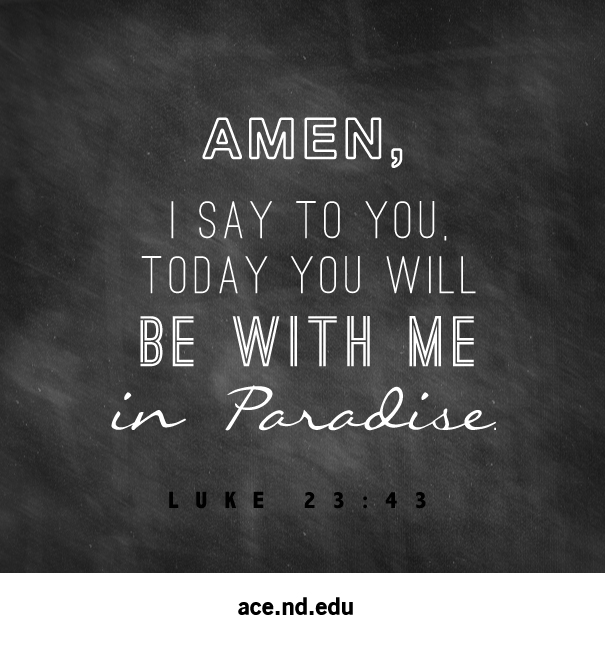
sevenlastwords-2On Sunday we looked at the fourth word of Jesus found in Luke 23:43. Jesus says this, “I assure you, today you will be with me in paradise.”

We looked at how Luke introduces us to two thieves who hang next to Jesus. The word “thieves” though probably bring up the wrong connotations for us. We think of common street thugs, when we should be thinking political terrorists. Because that’s what these two thieves were in the eyes of Rome – insurrectionists, revolutionaries, or political terrorists.

They are expecting a Messiah to show up and to overthrow Rome. The Messiah would “save” them from Rome. The Messiah would, through strength, power, and violence if needed, toss out the Romans and inaugurate God’s reign (or Kingdom) in Israel. This is what they were waiting for. This is what they were looking for.

So when these two men look at Jesus, all they see is a failed Messiah. Real Messiahs don’t get nailed to cross. Real Messiahs don’t get crushed by Rome, they overthrow Rome.

So one of the thieves hurls abuse at Jesus. The Greek word is a strong word, and it demonstrates that this thief continues to hurl abuse and blasphemy at Jesus constantly. It’s not once or twice, it’s a constant barrage of abuse.

But we get a completely different reaction from the second thief. He seems to have had a change of heart. He isn’t hurling abuse; Jesus seems to have somehow convinced him that he is who he says he is.

What is interesting is two men experience the same thing, but have different responses. One hurls abuse at Jesus, the other accepts Jesus.

I think it has to do with seeing Jesus offer forgiveness to those who killed him. For the one thief this is a betrayal of his most deeply held beliefs. You do not forgive your oppressors; you kill them and overthrow them. Yet for the other thief, he sees a different thing. He sees not weakness in forgiveness but strength, and it causes him to believe that even as Jesus is dying – he is somehow coming into his kingdom.

So he says essentially two words: Remember me. Remember me. Remember me.

He doesn’t confess his sins, he doesn’t offer a prayer of repentance, he just says “remember me”. And it’s enough. And it’s always been enough. So Jesus says something remarkable – “today you will be with me in paradise.”

And from this we asked a very personal but poignant question: what type of prisoner are you?

  • Are you like the first – hurling insults at Jesus and seeing nothing but weaknesses and irrelevance?
  • Or are you like the second – who sees something more amidst the hell he was going through?

Because it is the second that received a promise, in the midst of his own personal hell, for paradise to enter his life. This is a promise that is worth finding. This is a promise worth hearing  – but it only comes when we choose to trust in Jesus.

So we ended with that question, and invited a response. That if today you want to find paradise and Jesus, to simply say two words: “remember me.” The thief didn’t know how paradise would enter his world, and I don’t know how it might enter yours if you trust in Jesus. What I do know though is that it is always through Jesus, and begins by saying “Remember me”.

Sermon Notes:

Big Idea: What type of prisoner are you?

Teaching Points:

  • Challenge for Lent: 1) Pray Weekly Prayers of Repentance, 2) Pray Daily Corporate Prayers 2 Chronicles 7:14, 3) Fast Something for Lent
  • Crucifixion was a punishment that the Romans used almost exclusively for the crime of sedition. Reza Aslan
  • Jesus is not dying because of his religious ideas, but because of his political ideas.
  • The people were expecting a messiah who would save them, not die for them.
  • What kind of prisoner are you?

Adult Discussion Questions:

What stuck out to you from the sermon? What was challenging to you? How did God speak to you through it? What was new? Have you practiced Lent before? What can you fast or give up this year? Had you thought of Jesus dying before because of politics and power more than religion? What do you think about that? What thief can you relate to more and why? Have you ever been like the first thief hurling abuse? What brought you there? Have you ever been like the second thief trusting? What brought you there? Where are you today – trusting – or distrusting?

Discussion Questions for Young Families

Today read the story and talk to your kids about Jesus’ words. Help them to see that if we choose to trust in him, he will promise us paradise in our lives. Ask them if any of them might want to trust in him.

Challenge for the Week: Pray – Remember me
Finding Paradise

screen-shot-2011-04-22-at-9-04-38-amOn Sunday we are looking at the 4th word Jesus says, before he dies, where he says, “I assure you, today you will be with me in paradise”.  Luke 23:43.

This is truly a beautiful statement and promise Jesus gives to a thief that hangs next to him.

What I find interesting is that both thieves mock Jesus. Both thieves seem to disbelieve in Jesus. Both thieves seem to think Jesus is a joke. But then both thieves have the same experience with Jesus. They both hear his words, they both see how he is nailed to the cross, they both see the look on his face as people mock him. And yet one thief continues to hurl abuse at Jesus, where the other has a change of heart.

And this change of heart prompts him to hear, “Today you will be with me in paradise”. On Sunday I want to look at this phrase, and what led the one thief to the place where he could hear that phrase. Because if there is something I think we all need, it’s to be with Jesus. This is the promise the thief receives, because of how his heart changed. So we will look at how that happens, and how it might happen in us as well.

Being Missional Isn’t Just About Acting, but About Seeing

1395871_19682756A lot of discussion about being “missional” focuses on doing. Being missional means partnering in what God is doing all over the world, and in your neighbourhood. Being missional is about remembering that Christians are geared for mission – to serve, love, and change lives. And being missional matters.

Many of the seminars and speakers I’ve heard focus on some great actions to get us out into the community and caring. Things like throwing BBQ’s, being a real-life blessing to those around us, and caring for those who are hurting in our communities. Great stuff.

But I think the real art to being missional isn’t about doing, but about seeing.

The truth is God is already active all around us. God is doing things in our neighbourhoods, families, and communities right now. We follow an active, and dynamic God. A God on the move.

And so while certainly it is important to move and “do mission” with God – the most important practice is to first learn to see where God is moving. We, as Christians, need to become experts at spotting the initial moves of God’s Spirit in our lives, communities, and neighbourhoods. We need to become so in-tune with God’s Spirit that we catch his harmonies in conversations, that we sense his movements in the lives around us.

It’s important to act, but first it’s important to have “eyes to see” where God is already moving.

So how do you do that? Well sometimes the best answer is the simple answer. Start to pray. Pray as you walk around your street. Pray as you talk with neighbours and families. Pray that God will give you eyes to see how he is already moving around you, and how you can join him.

And trust me – this is a prayer God not only will answer, but I think one he wants to answer.

Seven Last Words of Jesus: Father, forgive them…

sevenlastwords-1

On Sunday we really waded deeply into this well known saying of Jesus. “Father, forgive them; for they do not know what they are doing”. Luke 23:43.

The first thing we noticed is how the “them” in this prayer is pretty vague. Jesus is surely referring to the guards killing him, the officials who sentenced him, and the religious leaders who arrested him. But I also think when Jesus says, “Forgive them” he also means “Forgive us”. I think the “them” includes us. And here is why:

Is it not also our sin, that causes Jesus to be killed? Is he not killed because we too are sinful, and complicit in a sinful and evil world?

I think that this “them” must include us, because we cannot so distance ourselves from this event to pretend that we are innocent of it. We cannot say, since we were not there we have no part in it – since we take part in the culture of sin everyday that nailed Jesus to the cross. We too are complicit and also then thankfully included in his forgiveness.

The second thing we noticed is that when Jesus said  “forgive them, for they know not what they are doing”. That in one sense the guards, officials, and religious leaders knew exactly what they were doing. They were killing someone who might be innocent, for the claims of being the Son of God and upsetting the political power structures of the day. That’s why Jesus was killed. So what does he mean by that statement when he says? It’s not as if the people involved didn’t cognitively know they were killing someone. What I think they didn’t know, and didn’t see is how the kingdoms of this world are caught in systems of violence, power, evil, and sin. We get in Genesis a picture of the world being founded on sin and violence and it continues today. Power, violence, and empire all get wrapped up into one – so much so that we lose sight of what we are doing. The guard, officials, and religious leaders believe they are saving and keeping society going by killing Jesus. That’s what they don’t see, how complicit they are in a system of violence, evil, and sin – and so often neither do we.

We also noticed how odd Jesus’ prayer must have struck his hearers. What people would be expecting is vengeance, promises of retribution, and curses. That’s what was expected. Just look at the story of the Maccabees, or Samson, or even Elijah. People expected judgment and vengeance when a prophet or a revolutionary was killed, not forgiveness. But here Jesus forgives his oppressors, as they are killing him. This is so radical and so unexpected that it shocked some of the guards into believing Jesus was the Son of God. We’ve heard this verse so often that’s it’s lost its shock, but it should shock us. Because it is revealing to us the heart of God, and it is radically about forgiveness.

And that’s where we landed at the end. That this amazing prayer of Jesus, while it certainly involves us, is not about us. What this prayer is actually about is revealing the heart of God. Jesus prays to the Father, “Forgive them”. We are getting a glimpse of the inner heart of God the Father, Son, and Holy Spirit and it is all centred on forgiveness. So while this prayer affects us and frees us, we cannot just narrow it to be about us. Because it is really about revealing God. And what it should evoke out of us, is a sense of reverent awe and thanks.

And that’s where we closed on Sunday. Challenging people to sit in reverent thanks of a God who died, to answer his own prayer of forgiveness. To sit in thanks of a God who would be killed for us, so we can be saved. To sit in worshipful awe of a God who would rather forgive than kill, and for that we should be thankful.


Sermon Notes:

Big Idea: That God’s heart is forgiveness

Teaching Points:

  • Challenge for Lent: 1) Pray Weekly Prayers of Repentance, 2) Pray Daily Corporate Prayers, 2 Chronicles 7:14, 3) Fast Something for Lent
  • Who is the “them” Jesus is forgiving?
  • We are all complicit in Jesus’ death.
  • Society is built on murder and sin
  • The kingdom of this world is built on rivalry, accusation, violence, and domination.
  • Messiahs weren’t expected to forgive oppressors, but overthrow oppressors.
  • The story of Luke has a trajectory of forgiveness first.
  • That we are tempted to narrow this amazing last request to about us and being forgiven by God
  • Jesus’ last prayer reveals the heart of God.
  • God is still about forgiveness because God is always about forgiveness

Adult Discussion Questions:

What stuck out to you from the sermon? What was challenging to you? How did God speak to you through it? What was new? Have you practiced Lent before? What can you fast or give up this year? Had you thought about this verse deeply before? Do you think that the “them” does include you? How come? What else was new to you in this sermon? Can you imagine how unexpected these words of Jesus would be? How can we regain some of their initial shock and radicalness? How can you be thankful to God today for what he did for us?

Discussion Questions for Young Families

Today read the story and talk to your kids about Jesus words. Share with them how Jesus even when he is being hurt, forgives. That at his heart is forgiveness. Tell them today that if they need anything forgiven, Jesus is willing because he is always willing.

Challenge for the Week: Today spend time being grateful to God

Father Forgive Them For They Know Not What they Are Doing…

On Sunday we are looking at one of the most well-known of all of Jesus’ sayings. And the saying we are looking at is this:

“Father, forgive them; for they do not know what they are doing.” Luke 23:43

And sometimes things that become well-known, also become shallowly known. Since we are familiar with a thought or a saying, we think we deeply understand a thought or a saying. Sometimes the biggest enemy of understanding, is familiarity.

So I want to make this saying a little less – familiar to you. To bring up some questions to intrigue you, and some dissonance to help us to dive deeper.

First question, “who is the “them” in this last request of Jesus? Who is the “them” that should be forgiven?” Because in the Scripture itself the “them” isn’t clear. Is it the Roman guards crucifying him? Is it the rulers and authorities? Or might it even be…us he is forgiving? I think it’s n important question to dive into

Second question, “what does “For they know not what they are doing” mean?” I mean honestly, the Romans knew they were killing someone. They knew they were killing someone probably innocent (look at the interaction with Pilate). It’s not like they didn’t know they were killing someone. They also knew they were killing an emissary of God, or someone who claimed to be the Son of God. That’s the whole reason he is being killed anyway. They knew of the miracles and all that Jesus is stirring up so they kill him. So what does “for they know not what they are doing” actually mean?

Third question, “who is the statement addressed to?” We like to think it’s about us, and how God will forgive us. But that’s just our self-centeredness talking because the prayer is not addressed to us at all. It’s addressed to the Father. So how does that change how we interpret this verse? Well I’ll give you a clue, if it’s not addressed to us, it can’t be primarily about us.

But those are just some of the initial questions I have with this verse I want to pursue on Sunday. Because as familiar as this verse is, I don’t actually think it’s that well understood, and it has a lot to teach us.

No Such Thing as Individual Prayer

1427656_44384918Andrew Root writes something that is both simple, and beautiful:
Prayer is a relationship because prayer cannot be done alone.
And that is true. When you are praying it is never done alone. It is done with others, in the power of the Spirit, through Jesus Christ, to God the Father. Prayer is a relationship, because it is based in relationships and changes relationships. So the next time you are praying, remember you aren’t doing it alone. And remember most of all prayer is a relationship, and it’s a relationship worth investing in.

Seven Last Words of Jesus: I Thirst, and Woman Behold Your Sun ~ Lenten Reflection

On Sunday we began our series of Lent, “The Seven Last Words of Jesus”. We are looking at the seven last sayings Jesus utters prior to his death. For Lent we want to pause, reflect, repent, and not rush through the dark to Easter. Instead, we want to pause with Jesus and reflect on what his death means before entering into the joy of Easter. Without pausing before Easter, Easter can seem like any other day. This is why the practice of Lent, and the focus on Jesus is so crucial.

So we began our series by looking at the first two sayings in the book of John: “Woman, behold your son. Son, Behold your mother.” (John 19:26–27) and “I thirst.” (John 19:28).

The first of Jesus’ saying is really quite moving. Pain has a tendency to shrink people’s worlds’ to just their own needs. But this isn’t what we see in Jesus. While he is in pain, he is seeking to take care of his mother. He wants to ensure that she is protected and supported. Jesus, as he is dying, is still thinking of others. And this is beautiful.

William Barclay the great commentator wrote:

There is something infinitely moving in the fact that Jesus in the agony of the cross, in the moment when the salvation of the world hung in the balance, thought of the loneliness of his mother in the days when he was taken away. Jesus never forgot the duties that lay to his hand.

And that is true.

From there we hear Jesus cry out, “I thirst”. John makes it clear that this is connected to two prophecies in the Psalms, and this is true. But one cannot simply focus on the fulfillment of the Psalms without also acknowledging that Jesus’ thirst was not metaphorical. Jesus was thirsty, Jesus was in agony, Jesus was suffering. Sometimes we jump over Jesus’ humanity, and think only of the “spiritual suffering” he must have experienced or that Jesus was spared from human suffering. But the incarnation and John here reminds us of something important: our God suffers.

And this matters tremendously. This matters because if you suffer, God knows that same feeling. This matters because it teaches us that while there is suffering in the world, God himself is not exempt from suffering. God does not remain a distance from suffering, but enters into it to free us from it.

So it is crucial to remember that the thirst Jesus feels not only fulfills prophecy, but is also real. He suffers with us, so that he can free us.

From here we landed on the main point for this sermon: That Jesus knows what it is to suffer, and while we suffer reminds us of his love.

This is what these two words of Jesus remind us of. That Jesus is one who knows what it is to suffer, but he also in suffering gives love and protection. That’s what Jesus does for  Mary, in his suffering and in hers, he gives her a tangible reminder of his love – a disciple to support her.

The point is that Jesus knows what it is to suffer, and he knows how, while we suffer, we need a reminder of his love.

We ended the sermon with a time of prayer and contemplation – because I firmly believe that while we are studying the “Seven Last Words of Jesus” these are not his last words. Jesus still speaks, and can still speak. And if while he is dying he notices those he loves and cares for them, he can surely do that now and today. So we ended with a time of prayer to simply listen for what Jesus might say to us. To imagine we are there with Mary and to simply notice Jesus noticing us. To notice Jesus noticing us, and to listen because our God who died, is still speaking, still caring, still entering into suffering, and changing lives. And it begins by noticing him, noticing us, and listening.

Sermon Notes:

Big Idea: Jesus suffers with us, and in our suffering gives us a reminder of his love

Teaching Points:

  • Challenge for Lent: 1) Pray Weekly Prayers of Repentance, 2) Pray Daily Corporate Prayers 2 Chronicles 7:14, 3) Fast Something for Lent
  • Jesus death was a political death
  • Another important point is that Jesus’ death was a political death. If you ask the crucial theological question – why was Jesus killed? – the answer isn’t “Because God want us to love one another.” Why would anyone kill Jesus for that? That’s stupid. It’s not even interesting. Why Jesus gets killed? Because he challenged the powers that be.    Stanley Hauerwas
  • Pain seems to shrink people’s worlds, but not Jesus’.
  • There is something infinitely moving in the fact that Jesus, in the agony of the cross, in the moment when the salvation of the world hung in the balance, thought of the loneliness of his mother in the days when he was taken away. Jesus never forgot the duties that lay to his hand.   William Barclay
  • Jesus was and is human.
  • Jesus knows what it is to suffer.
  • God is not exempt from suffering.
  • God is a suffering God
  • Even as Jesus is suffering he is also caring and protecting.
  • That in suffering, Jesus suffers, and reminds us of his love.
  • Suffering does not mean God is not with us, It means God is suffering with us.
  • Jesus cannot suffer with you, and change your suffering unless you let him in.

Adult Discussion Questions:

What stuck out to you from the sermon? What was challenging to you? How did God speak to you through it? What was new? Have you practiced Lent before? What can you fast or give up this year? What must Mary be thinking as she sees her son on the cross? Have you ever thought about Jesus’ suffering before? What does it make you feel when you think about it? Why do you believe the fact that God suffers is meaningful? What did Jesus say to you?

Discussion Questions for Young Families

Rather than just discussing this story with your kids, why not put it into practice a little bit. Think of a tangible reminder of your love you can give your kids: maybe a ring, necklace, a book, a teddy bear – something that will mean something to them. And give it to them, and share how you care for them, and how it’s a reminder of your love. Then remind them of how God does the same thing for us when we are hurting.

Challenge for the Week: Listen for Jesus, and notice him, noticing you.

Baptisms, Faith, and Why You Need Others in Your Life

445128_29914509This Sunday was a beautiful Sunday, because it was baptism Sunday. There is something beautiful, special, and wonderful about joining with others as they commit to following Jesus publicly. There is something so moving about seeing and hearing people’s testimony and desire to follow Jesus.


And that’s what this Sunday was about.


But it was also about recognizing a key of faith: you can’t do it alone.


The only reason we had baptisms is because people invested in others. Is because people realized they can’t do faith on their own, and had others join their journey.


We often believe in our culture that it’s all about our own personal willpower, drive, and strength that leads to success. But not only isn’t that true, it’s one of the most damaging lies in our world. The truth is we are only as strong as those who are journeying with us.


There is an African proverb that says, “If you want to go fast, go alone. If you want to go far, go together”. And that is true.


And so on Sunday we looked at how we need each other. But we ended with a very personal but important question: who are you journeying with? Who is close enough to you to support, care, and miss you when you drift? Who knows your struggles and your strengths? Who are you journeying with, and who is journeying with you?


This question isn’t a light one, but a crucial one to our faith. If we want to not only start well in life, but finish well in life – we need one another.


So we gave a challenge on Sunday. That if you can’t think of someone who is journeying with you, to invite someone in. Ask for a mentor, find a spiritual guide, don’t go it alone – but go together.


So that was our challenge on Sunday, and it’s a personal one, but it’s a needed one. Because we all need someone.


Sermon Notes:


Big Idea: Journey with others

Teaching Points:

  • It’s not starting that’s hard, it’s finishing.
  • We think succeeding is about us, and our willpower. It’s actually about others, and who is journeying with us.
  • We need others to care for us, support us, and miss us when we start to drift.
  • We simply can’t do this thing called Christianity alone.
  • The friends you have will often determine the quality and direction of your life.
  • To think of one person you can invite to walk with you this year.


Adult Discussion Questions:

What stuck out to you from the sermon? What was challenging to you? How did God speak to you through it? What was new? What were your first impressions to the topic for today? Does it seem to you that growing older does limit your future? How would you answer the question “Who are you trusting to guarantee your future?” What do you believe your future looks like right now? What does your future look like with God involved? What does he want to do in your future?

Discussion Questions for Young Families

Today talk with your kids about their futures. Ask them what they want to do, and who they want to be. Today learn from your kids. Sense the enthusiasm, the belief, the sense of excitement and possibility. Learn from them, and seek to bring that into your relationship with God today.


Challenge for the Week: To think of one person you can invite to walk with you this year.

Baptisms and Walking with Others

772301_79279389This Sunday we are having Baptisms to end our series on “Finding a Fresh Start”. Could there be any better way to end talking about finding a fresh start, than seeing baptisms? That’s what they are all about – starting fresh. Saying I want to follow you Jesus, going down into the waters, and coming out confirmed in Christ’s death and resurrection.

It’s a beautiful thing.


But something we will learn this Sunday is this too, it is not an individual thing. Baptisms are a corporate thing, body-thing, community thing.


And while this distinction might seem small it isn’t. It is crucial and important. Because the truth is that while we can find a fresh start on our own, we can’t keep a fresh start going on our own. We need others investing and involved in our lives. Faith is a communal journey, not an individual journey.


So on Sunday as we see people take a next step, and see a fresh start we are also going to be reflecting on this question: “whom are we journeying with”? Because faith is passed on through others, sustained with others, and developed with others. So who are the others in your life?


That’s our question for Sunday, and it’s a good question for today too.

An Expanding, and New Future…

1435800_47324731On Sunday we looked at the topic of finding a new future. And to be honest this is something I think we need. I think we all need to dream about new possibilities and what God might want to do in and through us.

The tough part is that while in theory we say we trust in God for our futures, in practice we don’t.

If I were to ask you: who guarantees your future?

Who do you trust in for your future? While many of us might want to say Jesus, I think in practice many of us trust in different things.

Some of us trust in our bank accounts for our futures. That if we have more money our futures will be secure. Some of trust in our doctors for our futures, that their diagnosis determines whether the future will be good or bad. Some of us trust in our present circumstances to determine our futures. That if things are going well, we think they’ll continue, or if they go bad, they’ll keep going bad. Some of us actually trust in our sins for our futures. I know, a weird way to put it, but true. We believe that because of this past sin, mistake, choice, whatever, our future is limited or constricted in some way.

The point I want to make is that while in theory we might trust in God for our futures, in real life the temptation is to trust in so many other things. To trust in our own abilities, present conditions, or current trajectory of life.

The point is what if we trusted in God?

Because God says this:

I am doing a new thing. Are you alert? Are you watching for it? Because it is happening. It’s bursting out! Don’t you see it? (Isaiah 43:19)

This is God’s position on our futures, that he is doing something new. The question is do you trust in him to do something new – in you? That’s the question, and it’s only by  trusting in God that our futures open up, expand, and become limitless.

God has proven again and again that he loves to take broken, burnt out, and passed over people to change the world. Just look at Abraham, Moses, David, or Paul. God specializes in doing a new thing.

So on Sunday we gave a challenge to trust that God wants to do a new thing in your life and to discover it, by listening to him. I believe that God can be taken at his word, that he is doing a new thing, and that if we are alert, watching for it, we will find it.

And my prayer is that you do find the new thing God is doing, because it is happening, it is bursting out, do you see it?

Sermon Notes:

Big Idea: God can give you a new future if you trust in him

Teaching Points:

  • Our futures can shrink, as we age.
  • Who is your future dependent on?
  • Who are you trusting to guarantee your future?
  • I am doing something new – God
  • God is in the business of doing new things.
  • God can give you a new future if you trust in him.

Adult Discussion Questions:

What stuck out to you from the sermon? What was challenging to you? How did God speak to you through it? What was new? What were your first impressions to the topic for today? Does it seem to you that growing older does limit your future? How would you answer the question “Who are you trusting to guarantee your future?” What do you believe your future looks like right now? What does your future look like with God involved? What does he want to do in your future?

Discussion Questions for Young Families

Today talk with your kids about their futures. Ask them what they want to do, and who they want to be. Today learn from your kids. Sense the enthusiasm, the belief, the sense of excitement and possibility. Learn from them, and seek to bring that into your relationship with God today.

Challenge for the Week: Trust in God for your Future.