
 Today, I want to tackle something that at times is a bit controversial…doubt.
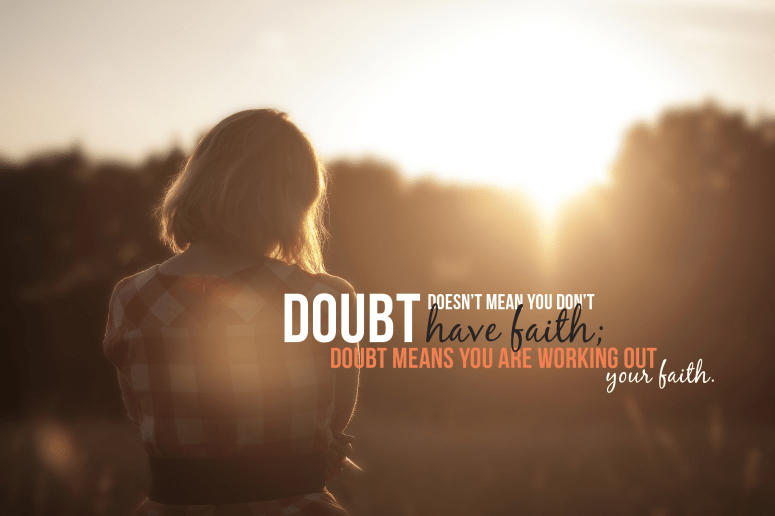
Because, here is the truth – all Christians, at times, face doubt. Doubt is often the crucible through which faith grows. Doubt doesn’t mean you don’t have faith; doubt means you are working out your faith. But, we need to be honest with this so that when we are in those places, we can actually have honest conversations with one another; that we can actually support and love one another; that doubt doesn’t have to have the last word, rather doubt can be the catalyst for conversations that lead to deeper and truer trust.
C.S. Lewis is a name many of you might be familiar with. Someone you might not be as familiar with is George MacDonald whom Lewis said was a tremendous influence and the catalyst for some of his writings. MacDonald writes this,
“Do you love your faith so little that you have never battled a single fear lest your faith should not be true? Where there are no doubts, no questions, no perplexities, there can be no growth.”
And I think that MacDonald is onto something – that when faith stops struggling, it often stops growing.
So, I write all this to remind us of one simple truth – it’s okay to have doubts and struggles; that’s part of the journey of faith. But, what isn’t really okay, healthy or helpful is to just try to deal with those doubts on your own. The Christian faith isn’t individual and isolated; it’s about community and journeying together. So today, if you have struggles, why not share them with a trusted friend? Why not have coffee and work through some of your doubts or difficulties? Because, when we bring them forward, sometimes that’s when we actually find the way forward.
We actually see this frequently in the Bible – people wrestling with their faith. We see this all the time in the Psalms as people cry out to God and wrestle with difficulty. We see this all the time in the lives of the saints who have gone before us.
So, don’t be surprised if you find it in your life too. Just don’t try to go it alone. Because others have been there along the way, others can help you find your way, and it’s in wrestling through things together that we all come to deeper faith, which is the point.
 As you might have noticed, I actually believe that Christianity is meant to have an impact in the world; that we are actually called, as Christians, to partner with God in changing the world. And that sometimes happens by just changing someone’s world.
 On Sunday we had a great celebration, that our church has been here 60 years. We have been blessed with 6 decades of change and influence in our community and partnering with change in people’s lives.

 On Sunday we opened up the beautiful poetic, mystical, and masterful book of John. John is a beautiful book about deeply connecting and communing with Jesus. John is about fully becoming one with Jesus experiencing his joy and his connection. And John uses all of these metaphors to speak of it: being born again (John 3), having springs of living water (John 4), partaking the bread of life (John 6), connecting to the vine (John 15), being one with the divine life (John 17), and breathing the breathe of the divine (John 20).
 On Sunday we are going to be really diving deeply into the book of John. And in many ways I think that this is a book that is really needed for our day and age. In general we as a Christian culture I think are much more comfortable with tame, reasonable, and expected interactions with Jesus. We are less comfortable with things that seem…mystical…mysterious…or beyond us.
 I’m really looking forward to Sunday, because on Sunday we are doing some baptisms. So for me this is a real highlight of the year because we will hear testimonies of what God is doing in people’s lives, we will hear people share about Jesus, and we will watch them take a big step in obedience.
 On Sunday we continued our series looking at the different gospels, why they were written and what are some of the “big themes” we can get from them. And on Sunday we looked at the gospel of Mark and the reality of darkness. Because in many ways if you read the book of Mark what you realize is this: it’s face, it’s punchy, and it’s actually pretty dark.
 { Andrew Mills }