On Sunday we are going to be continuing our conversation about mental health. This is a conversation that needs to be continued if we are going to break the stigma and exclusion surrounding it.
Last week we looked at some of the myths surrounding it, and this week we are going to be looking at what we can do as a community.
So to help us with this we are going to do something different, and have a panel of experts and professionals in the field share with us what we as a community can do to help in this area. And while we absolutely need professional’s care, expertise, and necessary work – we as a community are also needed. It is not enough for someone to find healing and stability with just professional intervention, people also need caring and supportive communities. So join with us to learn about mental health from professionals, and also what we as a community can do – to do our part!
So join with us to learn, and discover some next steps for us as a community.
On Sunday we opened up a really important topic: mental health. Mental health is someone that affects huge numbers of people (estimates are around ¼ of people), yet it is one health challenge that has tremendous stigma, exclusion, and a lack of understanding surrounding it. And that’s something we want to change.
So we began by exploring some of the realities of what mental health is. We shared some basic information about three major mental health illnesses. But then to move it away from theory, and “clinical” descriptions I read the following first hand accounts from people struggling with mental health challenges.
Liz writes:
“Depression is a very emotive subject for me, especially among people who have never had to live with it. It is that hidden disability that no one really understands fully – least of all those who suffer with it. The symptoms include feeling overwhelmingly tired, angry, emotional and with a need to withdraw from the world around you. Seeking treatment can also make you feel even more depressed as you feel that you are even more of a failure at not being able to get through it on your own.”
William Styron writes in Darkness Visible:
“The pain is unrelenting, and what makes the condition intolerable is the foreknowledge that no remedy will come – not in a day, an hour, a month, or a minute. If there is mild relief, one knows that it is only temporary; more pain will follow. It is hopelessness even more than pain that crushes the soul. So the decision-making of daily life involves not, as in normal affairs, shifting from one annoying situation to another less annoying – or from discomfort to relative comfort, or from boredom to activity – but moving from pain to pain. One does not abandon, even briefly, one’s bed of nails, but is attached to it wherever one goes.”
And Miriam writes:
“As someone with a mental health illness, you get the feeling that somehow you are more difficult to deal with within the institution of the “church”. In a naïve way I believed the church would be open to all. However, my experience makes me feel that I am on the outside of the institution and an embarrassment.”
The truth is that Jesus never turned away from someone in need, so neither can the church.
So to begin this conversation I unpacked 3 myths I see in the Christian world concerning mental health, and then next week we’ll look at how to help and support those with mental health.
The three myths we unpacked were: mental health is caused by sin, mental health can be cured by prayer alone, and mental illness isn’t welcome in the church.
The truth is that we love simple and easy explanations so when it comes to mental health we often reach for those easy solutions: you must have sinned. Yet this reduction of a complex issue that involves emotions, chemical imbalances, physical realties, and social environments to just personal sin that is “God is sending consequences” is directly against the Bible. I know that sounds harsh but in John 9 when the disciples try to reduce someone’s illness to personal sin – Jesus directly confronts them and contradicts their view. So we need to contradict this myth as well.
Secondly, we looked at how mental health is still believed to be cured by prayer alone by 35% of the church. This is also incredibly unhelpful and a myth. I’m not saying I don’t believe in prayer for healing, but that with any other physical illness we not only pray but also seek medical help. But when it comes to mental health there is the myth that prayer, reading your bible, and more self-discipline will be enough. This is simply not true, not helpful, not Biblical (see my sermon on James 5 for more), and needs to be stopped. I absolutely believe that prayer can cure mental illness, I just don’t believe it is the only cure.
Thirdly, we looked at how mental illness isn’t welcome in the church. I say this is a myth not because I don’t believe it’s true, or that it doesn’t happen in churches; but that in the church as it’s meant to be this exclusion should never happen. Jesus would never exclude or isolate someone who is hurting. So if we want to follow Jesus, this idea that mental illness isn’t welcome in the church needs to go. Following Jesus requires that we welcome and include especially in this area.
So those are three myths we unpacked, along with the myth that “the church can’t make a difference” in this area, because I believe we can. I believe that if we get serious about journeying with people and supporting them. Yes professionals and health care experts are needed (see next week) but so too are caring communities of support. And that’s what the church can and should be.
Jean Vanier & John Swinton write this,
The church has a history of pioneering in health and social care and I believe it is time for us to step up to the challenge of working in the area of mental health.
So on Sunday to wrap up I gave us one main point and one challenge. The main point was: Mental health is real and we need to address it. And then the challenge to do this was simple this week: to learn more about it. To fight against the stigma, lack of awareness, and exclusion by learning and growing. This is obviously just the first step but it’s a necessary one. And next week we’ll learn how to take another step as a community.
“Give to us grace, O Father, not to pass by suffering or joy without eyes to see; give us understanding and sympathy; and guard us from selfishness that we may enter into the joys and sufferings of others; use us to gladden and strengthen those who are weak and suffering; that by our lives we may help others who believe and serve you, and project your light which is the light of life.” H.R.L. Sheppard (1880-1937)
Sermon Notes:
Big Idea: Mental health is real and we need to address it.
Teaching Points:
¼ people experience an episode of mental health challenges.
It is not okay to hold prejudice against those with mental health challenges.
Three major mental health illnesses: bipolar, major depression, dissociative identity disorder.
Myth #1: Mental Health Challenges are caused by personal sin and punishment from God.
We cannot reduce the cause of mental illness to sin.
Myth #2: Mental Health Challenges can be cured by prayer alone
I absolutely believe that prayer can cure mental illness, I just don’t believe it is the only cure.
Myth #3: Mental Health is not welcome in the church.
We believe that people struggling with anything are welcome in this place
The church is one of, if not the most important thing in combating mental illness and changing it.
The church has a history of pioneering in health and social care and I believe it is time for us to step up to the challenge of working in the area of mental health. John Swinton and Jean Vanier
The greater our understanding the greater or depth of care
Adult Discussion Questions:
What stuck out to you from the sermon? What was challenging to you? What was new? What experiences have you had in relation to mental health? Did you realize that mental health was that prevalent? Why do you think it’s important to talk about? What myths have you believed about it, or are still working through? How can you learn more about it this week?
Discussion Questions / Responses for Young Families
Today learn more about mental health. Look up on the internet for some good discussion guides to talk to your kids, and use one!
On Sunday we continued in our series on starting 2016 strong, and specifically in the area of our families. During the sermon we journeyed with a family via video and watched their baby grow up and eventually move out, showing us that there are different phases in life and we need to make sure we don’t miss them.
If you missed it you can find the video’s and the presentation here:
Here are the 5 questions we looked into on Sunday:
How am I connecting my child to a wider circle of influence?
Who do I want my child to become?
How am I fighting for the heart of my child?
How has spiritual development been part of our family rhythm this week?
Is my relationship with God, growing, authentic and personal?
Here are some of the main points that we discussed on Sunday:
Parenting priorities
What matters more than anything is that my kids have an authentic relationship with God.
My wife and I are not the only adult influences my children need.
My children need to know that I will never stop fighting for a right relationship with them.
My relationship with God and with my wife affects my children more than I realize.
Just being together can never substitute for interacting together in a meaningful way.
No one has more potential to influence your child than you.
You are the primary influence in the life of your child.
Teachers, pastors and coaches will never have as much potential to influence a child’s character, self-esteem, perspectives, or faith as a parent does.
That teacher pastor or coach will have influence that is temporary, your influence as a parent will be permanent.
Your relationship gives you the potential to influence in ways that others cannot.
You are not the only influence your children need.
tap into other influences that also have the potential to impact your children’s future.
You can leave your children alone to discover random influences who will shape their character and faith, or you can help them proactively pursue strategic relationships for their lives.
Two combined influences will make a greater impact than just two influences.
If they work together they can potentially make a greater impact than if they work alone.
The 5 questions at the beginning of the page are focused around 5 values come from the book Parenting beyond your capacity by Reggie Joiner and Carey Nieuwhof
Value 1) Parenting Values Widen the Circle
Invite others to invest in your children, so that your sons and daughters have other voices that help shape and determine the direction of their lives.
The time will come when your child needs another trusted adult who would give them a safe place to wrestle with difficult issues.
The church has huge potential to provide community for children. Research tell us that teens who had at least one adult from church make a significant time investment in their lives were more likely to keep attending church and that the more adults the better.
This community gives them a sense of belonging and significance.
It allows mentors to DO ministry with the child and serve with them.
Widen this circle as early as possible before children need them so that they will be there when they need them.
Key Question: How am I connecting my child to a wider circle of influence?
Value 2) Imagine the End
Focus your energy and effort on the issues that matter most and will make a lasting impact.
It is more important to leave a legacy of faith rather than an inheritance of wealth.
Moses said everything I have said and everything I will say hinges on one essential truth: our God is God. Everything is really about Him.
A child’s relationship with God is more important than their relationship with parents. That they would pursue a relationship with God as their highest priority.
Key Question: What do I want my child to become?
Value 3) Fight for the Heart
Create a culture of unconditional love in your home to fuel the emotional and moral health of your children.
Sometimes it is easy to win an argument and force the right behaviour, but lose the heart in the process.
Don’t fight with your children, fight for
One of the greatest gifts parents can give to their children is simply to prove that they can be trusted over the long haul.
Key Question: How am I fighting for the heart of my child
Create a Rhythm
Tap into the power of quality moments together, and build a sense of purpose through your everyday experiences.
Increase the quantity of quality time you spend together.
Much of daily life consists of repeated patterns of waking up, eating, going out and going to bed.
Deut 6 talks about impressing faith as we sit at home, walk along the road, lie down and get up. Consider the following ideas:
Eating meals together is an optimal times to have a focussed discussion. Use a variety of discussion starters, games and activities, before, during or after a meal. Make it natural and fun.
Walking or travelling together provides a great opportunity for informal dialogue in a nonthreatening environment.
Tucking children into bed can be a great time to have an intimate conversation and listen to the heart of your child.
Getting up in the morning provides a blank page for the family to start fresh relationally. Just a few encouraging words carefully spoken or written can give your children a sense of value and instil purpose.
Key Question: How has spiritual development been part of our family rhythm this week?
Value 5) Make It Personal
Put yourself first when it comes to personal growth.
When it comes to spiritual and character formation, your journey impacts them deeply. If you want it to be in them, it needs to be in you.
Let kids see your struggles. They need to see your authenticity and hear your transparency.
We are not expert parents before we start, but we learn as we go and we make spiritual growth a priority.
Find a community of friends who you to talk to and learn from.
Strengthen your relationship with your spouse. Don’t underestimate the importance of a child seeing a mother and a father engaged in friendship and interacting in an affectionate way.
Key Question: Is my relationship with God, growing, authentic and personal?
On Sunday we opened up a bit of a difficult or uncomfortable topic: money. Most times churches talk about this, it’s because they want more of it. But on Sunday the point wasn’t that I wanted anything from anyone, I wanted something for everyone. And what I believe we all need, isn’t more money, but a better relationship to money.
The truth is that money will not fix your life, or make it better. And while at first glance that seems well…just not true. Who wouldn’t love more money? The truth is we know that it is true.
We all know people who make way less than us, but are much happier than us.
We all know people who make way, way, way more than us but whose lives aren’t full of happiness and joy.
We all know people who have maybe won the lottery, inheritance or whatever, only to see that money…vanish.
The truth is that while our culture tells us that money will fix our problems, the Bible teaches that our relationship to money is the problem. Getting a huge raise, or money doesn’t actually automatically generate more generosity, self-control, or self-discipline. And the truth is if we want financial freedom it doesn’t come from having more money, but a better and different relationship with money.
So we looked at this small passage in Acts where Paul’s preaching says this, “You should remember the words of the Lord Jesus: ‘It is more blessed to give than to receive.’” And this is so true! Expect for many of us it doesn’t feel…well true. For many of us it honestly feels better to receive a huge bonus, then it does to give and cut our neighbors lawn. But that’s actually not what Paul is talking about or Jesus for that matter. Paul is not talking about individual experiences or moments, but a lifestyle.
A better way to translate that passage for our context would be this: a generous life is wholer, better, and happier than a stingy life.
And that’s true.
When was the last time you met a truly generous jerk?
When was the last time you met a really happy, fully alive, stingy person?
It just doesn’t happen.
Jesus is right; a generous life is better than a stingy life. The trouble is that generosity is not random, it is strategic and a discipline. And disciplines are hard to create and generate.
So we ended the sermon with a few steps to starting to create the discipline to be generous so that we might find new freedom. The three steps were pretty simple and straightforward: make a budget, choose a % to give, and track your money.
Generosity doesn’t start with randomness but with a plan. So make a budget to examine your life and where you are spending and where you should be spending. Then choose a % to give. The main problem with generosity is that it is not habitual, so giving a % is key. Start anywhere but keep increasing it as you grow. And lastly, track your money. What you don’t manage soon becomes a disaster. So manage your money.
These are three simple steps, and there is so much we could get into but they will give the basis for a strong start this year. And to go deeper we are having a financial course here at the church, and if you’d like to be part of it just email the church office here for details.
So we ended with a challenge: put effort into our finances. Because no one has ever regretted putting effort into it and becoming a more generous person.
Sermon Notes:
Big Idea: A generous life is happier, fuller, and better, than a stingy life
Teaching Points:
The key to financial freedom is not having more money.
Having more money will not fix your financial life.
Money will not solve all our problems.
The problem isn’t money or the lack of it; the problem is us
It’s better to give than to receive.
A life orientated around giving and generosity is the way to live.
Generous people don’t give when they have enough; generous people orient their lives so they will always have enough to give.
Having more money doesn’t give us more self-control.
A generous life is happier, and better than a stingy life.
Generosity is a discipline.
Make a budget, choose a % to give, and track your money.
Adult Discussion Questions:
What stuck out to you from the sermon? What was challenging to you? What was new? What did you think about Andrew’s statement “The key to financial freedom is not having more money “? How does that relate to your life? Would you say your life is orientated around generosity? How can you maybe start to take some of those steps? Do you have a budget? Who can help you to create one? Can you start or increase your % of giving? How can we support you in this?
Discussion Questions / Responses for Young Families
Today rather than talking about generosity, start to teach it. Start to encourage your kids to give money away. If you do an allowance, ask them to give a %. Start to teach generosity from the beginning.
Challenge for the Week: Put effort into your financial life to become generous.
On Sunday we are looking at finances. I know something everyone hates talking about. And with good reason. Too many churches, around money, beg, bribe, or berate people to give to them. Too often giving and finances have been tied to guilt, something Jesus never seems to do.
But even though this topic is one that has been covered so poorly for so often, it’s actually really needed.
Because guess what the number one cause of divorce is? Finances. Guess what most people think would fix their lives? More money. Guess what most people stress over? Finances and debt.
And so for this series we are looking at having a strong start to this year. To having a year that really takes off with hope, and purpose, so this is a topic that we need to address. But my promise to all of us is this: there is no second offering, there will be no guilt, there will be no pressure or anything like that. Instead, I just want to open up this topic with honesty, and clarity and talk about the importance of being generous. Because here is the truth: Jesus says a generous life leads to happiness. What if he is right? That’s what we want to explore on Sunday.
So I know an awkward topic, but it’s a needed one too.
I’ve been preparing for a series on Mental Health that’s coming up. And I came across this one line from a book called Darkness is My Only Companion, by Kathryn Greene-McCreight.
It just so resonated with me, and it’s something to sit and ponder because there is power in its simplicity.
Suffering is not eliminated by the resurrection but transformed by it.
On Sunday we opened up the book of Proverbs to learn about friendships. Friendships are these things that are all around us, that I think we end up taking for granted so often. But this is something that not only do we need to change, that Solomon would argue we must change to have a full life.
So we jumped in looking at various different sayings of Solomon pulling out three key points:
Friendship can matter more than family
Friendship will determine the quality and direction of your life
Friendship based on deep trust is all that matters
So first we looked at how friendship can matter more than family. This is something pretty shocking to say; not only in our day but in Solomon’s day and age. Because in his day and age you had no health insurance, crop insurance, or retirement. Your insurance or safety net was your family. Family was obligated to help in a time of crisis.
And this is actually why Solomon says that friendship can matter even more than family. He writes, “there are “friends” who destroy each other, but a real friend sticks closer than a brother”. (Proverbs 18:24). Friends can stick closer than family.
And Solomon’s point is that any relationship built on chosen love, rather than obligation will be stronger and better. And this is just true. He’s not saying family doesn’t matter, but that friendship can run deeper than just family relations. Any relationship (family based or not) built on love, and choice will always beat any relationship based on obligation. And this is why we need to invest in our friendships and why they matter because they are formed by love and not by obligation.
Secondly, we learned that friendships determine the quality and direction of our lives. Solomon writes this, “Walk with the wise and become wise, for a companion of fools suffers harm” and this is true. That the people we are close to rub off on us for good or for bad. This is another reason that we need to choose our friends carefully, and invest in them wisely. We choose our friends, but once our friends have been chosen they will choose our destiny. This is why we need to continue to see and raise the importance of the value of our friendships.
And also, but not least, Solomon reminded us that if our friendships are not based on deep trust that they aren’t really friendships. That if someone lies to us and laughs it off, they are worse than a destructive killer (Proverbs 26:18-19). That a true friend will not let us walk into difficulty but will warn us (Proverbs 27:5-6). That true friends provide heartfelt care and counsel, not just what we want to hear.
So on Sunday from these three general themes: friendships matter more than family, friendship determines the quality and direction of our lives and true friends are built on trust; we came to our main theme. Our main idea was simple but needed: We need to choose and invest in good friendships.
We need to choose and invest in good friendships.
If we want to have a strong start we will not regret investing in good friendships, and key relationships. We will never regret strengthening our relationships, and distancing away from difficult ones.
So we gave a challenge to choose and invest in good relationships. To seek out good ones and to cultivate them. No relationship just “starts” and becomes amazing without work and effort. Friendships require cultivation to be forged. So we challenged one another to actually put the effort in. To put the time into the good relationships built on trust, and limit the ones that cause harm. To seek out good friends and invest in them with our lives.
One thing is sure if we want to have a great 2016, a strong start, it won’t happen with poor, nonexistent, or shallow relationships. A great year starts with great friendships, so start investing in them today.
The Chinese have a proverb, “The best time to plant a tree was 20 years ago. The second best time is now.”
The best time to invest in friendships was 20 years ago. The second best time is now.
Sermon Notes:
Big Idea: We need to choose and invest in good friendships
Teaching Points:
Three challenges: Serve weekly, connect with God daily, journey with 2 others
“Is it wise” is always a better question than “is it wrong”
Friendships are more important than family
Relationships built on love beat relationships built on obligation every time
Friendships determine the quality and direction of our lives
We choose our friends, but once our friends have been chosen they will choose our destiny
True friends are honest and trustworthy friends
We need to choose good friends
We need to invest in good friends
Friendships are not “found” but forged and cultivated
Friendship is born at that moment when one man says to another: “What! You too? I thought that no one but myself. C.S. Lewis
Friendship is unnecessary, like philosophy, like art…. It has no survival value; rather it is one of those things which give value to survival. C.S. Lewis
The best time to invest in friendships was 20 years ago. The second best time is now. Chinese Proverb
Adult Discussion Questions:
What stuck out to you from the sermon? What was challenging to you? What was new? Had you thought about friendship being more important than family before? What do you think of that? How have you seen it be true that friendships determine the quality and direction of our lives? Who are your closest friends? Are they trustworthy and honest? Who should you be investing in? And how can you be better investing in them?
Discussion Questions / Responses for Young Families
Talk to your kids about the importance of friendship and how it determines our quality of life. Ask them who their best friends are? And ask them are they wise friends? Do they make good choices? Help them to think through making the best friends.
Challenge for the Week: Choose to invest in friendships this year.
On Sunday we are looking at a really important topic but one that’s sidelined in our world: friendship.
I know right away the word sounds a little…well my little pony with rainbows and stuff. It sounds kind of weak, or something you’d hear on a children’s show talking about the “power of friendship”.
And while I have those initial reactions and resonances I also know that they are untrue. There is power in friendship. In fact, it’s probably the one thing in our culture that we need to regain more than anything else. We have so many connections, but not that many deep friendships. We know lots of people, and know how to network, but not how to cultivate decade long journeying with others. And this is something I want to address on Sunday.
Why are relationships and friendships so important?
What makes them unique?
How do we invest in them?
And why do we need them?
And to do that we are going to look at Solomon who says some pretty shocking things about friendships. That friendship will determine the quality of your life and the direction, more than finances, or even your family. That friendships are more important than family and are closer than family. That having good friendships is the key to a good life.
So that’s where we are going on Sunday. I hope you can join us, to learn about the “power of friendship” even though I know that sounds lame, but it is anything but that.
I think parenting is an exercise in trust and hope. I mean you spend hours and hours with your kids, coaching, guiding, and if you’re at all like us – disciplining your kids.
Sometimes if I’m honest you wonder if it’s all worth it.
Like you know it’s all worth it, but after a giant fight at bath time, when your soaking, and kids are crying doubt creeps in. I think that’s why parenting is hard, because you are really playing the long-game in parenting. You are hoping that what you do today, pays off in decades. And it’s hard sometimes to keep motivated or to even know if all your effort is having an impact when the results are years and years away.
But then every now and then you see some glimmer, you see a glimpse, you see some of the fruit.
As many of you know Krista and I accepted a new position, so we’ll be moving and changing churches in the next few months. This was an incredibly hard decision, but one we feel certain about. A tough point though came when we came to tell our kids.
We sat down with Hudson, told him about the move. He asked great questions, he processed it all, and in the end he asked to pray. This is what he prayed,
“Dear God help daddy to trust you with this move, find us the best house, best new friends, and help daddy with his new job to do really really great. Help mom and dad not to be sad, but excited. Amen”
And sometimes after hours and hours of wondering if anything sinks in, to little ears that don’t always seem to listen, you have a moment like this. You have a moment when you realize that your kids aren’t just kids, but people God speaks to. People who can pray better than you, and say the things you struggle to say, and people who remind you God is always working.
So all of this is to say that if you’ve had a long week with your kids, don’t forget all that’s growing underneath. Because when God reveals their little hearts, you realize all the effort is worth it. It’s always worth it.
On Sunday we began a brand new series looking at how to have a strong start this year. We looked at a very well known story of Jesus and the disciples crossing the sea, and coming up of a fierce storm. In this story Jesus is sleeping and the disciples wake him, and he calms the storm.
And there is so much packed in this little short narrative. Things like how Jesus sometimes leads us out into the unknown, how storms can come upon us quickly, how we can forget about God in struggles.
But on Sunday I wanted to land on one main point: Always remember who is in your boat.
The truth is that as we look forward into our futures we have no idea what they may hold. There may be already storms on the horizon, or it might look calm and peaceful. But we never know what might come upon us. And this isn’t something to bemoan or pretend isn’t true. We shouldn’t just count on positive thinking to get us through life. We should count on God, and that no matter what happens God was in the boat with the disciples and this makes all the difference.
Imagine if you could be assured God would be with you, no matter what you faced? Wouldn’t that make a difference, wouldn’t that change everything? Wouldn’t that give you hope?
And I think that’s something we need to take from this story, that God is with us through it all. God is able to calm the storms that come upon us, he is able to guide us through them. But we do need to rely on him. The disciples go to Jesus in the story and we need to as well.
So on Sunday we lingered just on that one idea: always remember who is in your boat.
We closed by looking at this wonderful piece of art by John Hendrix, and took home his piece of art as a reminder for us that no matter where life takes us – always remember who is in your boat.
Sermon Notes:
Big Idea: “Always remember who is in your boat”
Teaching Points:
Crossing the sea is an image of transformation
Denying fear is useless
We shouldn’t have more faith in the storms around us than our saviour
“Always remember who is in your boat”
We are never alone
Adult Discussion Questions:
What stuck out to you from the sermon? What was challenging to you? What was new? When you look forward in this year what do you see? Is it dark, hopeful, unsure? What do you hope to get out of this year? How can remembering God is with you help? How can you make sure you remember God is with you?
Discussion Questions / Responses for Young Families
Today it’s simple – share the story with your kids. Show them the artwork and have them create their own.
Challenge for the Week: “Always remember who is in your boat”

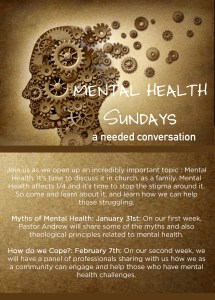 On Sunday we are going to be continuing our conversation about mental health. This is a conversation that needs to be continued if we are going to break the stigma and exclusion surrounding it.
 On Sunday we opened up a really important topic: mental health. Mental health is someone that affects huge numbers of people (estimates are around ¼ of people), yet it is one health challenge that has tremendous stigma, exclusion, and a lack of understanding surrounding it. And that’s something we want to change.
 [GUEST POST: Andrew Epp ~ Family Pastor]

 I’ve been preparing for a series on Mental Health that’s coming up. And I came across this one line from a book called Darkness is My Only Companion, by Kathryn Greene-McCreight.
 On Sunday we opened up the book of Proverbs to learn about friendships. Friendships are these things that are all around us, that I think we end up taking for granted so often. But this is something that not only do we need to change, that Solomon would argue we must change to have a full life.
 On Sunday we are looking at a really important topic but one that’s sidelined in our world: friendship.
 I think parenting is an exercise in trust and hope. I mean you spend hours and hours with your kids, coaching, guiding, and if you’re at all like us – disciplining your kids.
 { Andrew Mills }