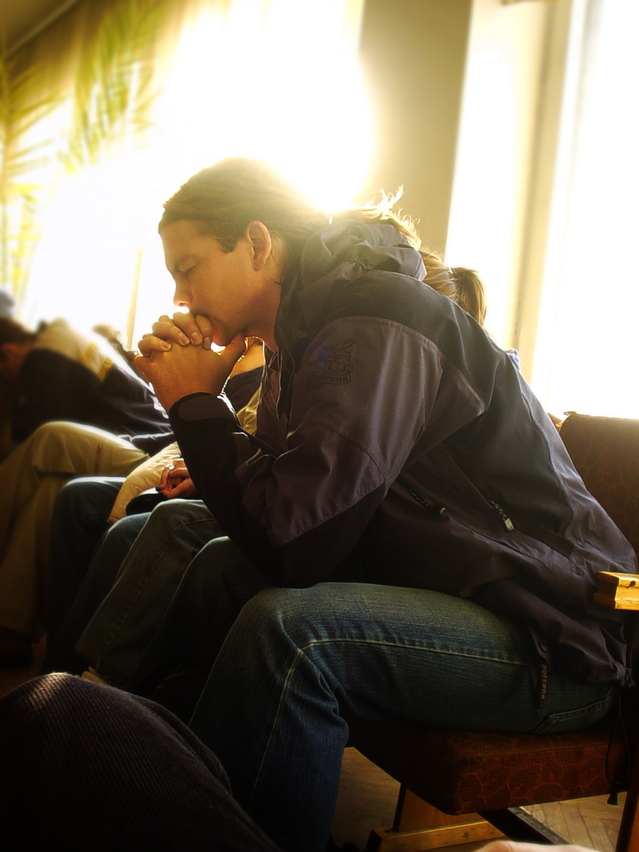
On Sunday we are going to talk about prayer. Prayer is something that is really important and should be part of the regular fabric of our lives. Prayer is something that really releases God to work in the world and in our lives.
So on Sunday I am going to teach on prayer, but more importantly we are going to have a chance to practice prayer. We are going to have a time to actually pray for another. We are going to have a time to anoint people with oil, because I believe that prayer can heal. Prayer can change lives. So that’s where we are going on Sunday. We are going to be looking at this passage:
Are any of you suffering hardships? You should pray. Are any of you happy? You should sing praises. Are any of you sick? You should call for the elders of the church to come and pray over you, anointing you with oil in the name of the Lord. Such a prayer offered in faith will heal the sick, and the Lord will make you well. And if you have committed any sins, you will be forgiven. Confess your sins to each other and pray for each other so that you may be healed. The earnest prayer of a righteous person has great power and produces wonderful results. Elijah was as human as we are, and yet when he prayed earnestly that no rain would fall, none fell for three and a half years! Then, when he prayed again, the sky sent down rain and the earth began to yield its crops.
On Sunday we looked at another pretty challenging teaching of James, but also one filled with hope and promise.
James writes this, ““So humble yourselves before God. Resist the devil, and he will flee from you. Come close to God, and God will come close to you”. (James 4:7-8)
James is sharing that the heart you respond to God with, is how he will respond to you. That if you are open to God, seeking God, humbling yourself to God – he will draw you close. But if you are pushing him away, fighting him, and rejecting him – God honours our freedom but still seeks to care and have compassion for us.
So James reminds us to check our hearts, to see if they are pushing God away, or opening up to him.
James also reminds us that if we resist the devil he will flee from us. And as I’ve said before, even if you don’t believe in the devil, you’ve experienced him. In the Bible the devil is the source of accusation, fear, and someone who actively seeks to separate ourselves from God. The truth is we have all felt accusation, and fear which separates us from God.
James wants to remind us that this doesn’t need to be so. That if we just were to resist the accusation, the guilt, the fear, the separation, the devil would flee and we would move closer to God. That if we would but draw close to God, he will draw close to us and the devil must flee as we move closer to God.
We ended up with a pretty clear main idea, that we need to repent and rely on God.
God promises to be there with us, to push away the devil, accusation, guilt, and fear but we need to repent and rely on him. As long as we are going our own way, as long as we assert our independence, as long as we pretend we don’t need him – he can’t help us. He can’t help us when we are resisting and pushing him away.
So on Sunday to make this real, we did something I don’t often do. We did an altar call. We invited people to simply come forward who wanted to physically say to God ~ I need you in some area. And that was it.
But sometimes we need to do something tangible to connect with God. And the truth is we are all broken and need God, so we can all use with doing something tangible.
So if you are in the place where you need God today – do something tangible. Maybe kneel, maybe write out your needs, maybe ask someone to pray. But do something, because God’s promise is that if you move closer to him, he’ll move closer to you.
Sermon Notes:
Big Idea: We need to repent and rely on God.
Teaching Points:
“God gives what he demands” – Augustine
God will respond with the heart you have for him.
One of the primary roles of Satan is to separate God and people.
Draw close to God and he will draw close to you.
How often do we try to go it alone and hide our flaws?
We live with a lack of light, because we refuse to rely on him.
We need to repent and rely on God.
Adult Discussion Questions:
“The reason we struggle isn’t because we can’t overcome our failures, but because we are too proud to ask God to move.” What do you think of this statement? Have you experienced the truth of these promises: that God WILL come near as we come to Him in true humility, and that Satan WILL flee from us as we resist him? What do you need to repent of? Confess? Get clean from? Admit? (Remember, this is how James says we come closer to God – it is crucial in our relationship with Him) About what things are you too proud to admit the truth? (Our pretending prevents God from working) How can you practically turn from these things and rely on God, beginning today?
Discussion Questions for Young Families
Have you ever needed help with something, but you didn’t want to admit that you couldn’t do it alone? How can we come to God today, letting Him be the one that helps us through our weaknesses and failures?
Challenge for the Week: To repent and rely on God…today.
James 4 has lots of wonderful things within it, and also lots of challenging things. The area I want to focus on is this verse:
“So humble yourselves before God. Resist the devil, and he will flee from you. Come close to God, and God will come close to you”. (James 4:7-8)
I want to focus in on how we can draw close to God, on how we can be free from Satan – the source of accusation, fear, and separation. I want to look at how we can find life by moving closer to God.
The trouble is that to do this we need to admit that we need God. And admitting our failures is something most people struggle with, myself included. I don’t like to think that I’m broken, flawed, or in need of much. I don’t like putting myself in places where my lack of knowledge will be revealed – which is why I never go to hardware stores or near tools. But the truth is that we all have flaws, and that there is a beautiful promise of God. That if we would but humble ourselves, admit our need, move away from fear and guilt of the devil, towards God, we will find him drawing closer and closer.
And I’m not sure about you, but this is something that I want in my life.
So why not join with us on Sunday to discover how it can happen in yours.
Today I’m not writing a blog post. I’m simply going to post a quote, it’s long and it’s good, and I’m going to go take a nap. I think you should after reading this too:
“Maybe what we all need most is time to process what we already know that we can put it together differently, even more effectively than ever before. Maybe we need to think a bit, out on a porch in a summer breeze, down by the creek when the trout are running, back in the garden when it’s time to put the beet and beans in again.
Turn off the television and read a good book. Quit texting and ride your bike. Close the computer and go to a movie. Don’t’ answer any emails. Don’t try to ‘get ahead’. Don’t’ take any callback. And during the family dinner, turn off the phone. And when the television is on, watch it instead of talking through it. Reclaim your life, your thoughts, your personality, your friends, your family.
No, the world will not end. And no, the rest of the staff will not get ahead of you. They’ll be too tired to even think about catching up. It’s time to sleep in like you did in the good old days. Have a late breakfast. Read the newspapers all day long. Call some friends in for a game of pinochle. And then, on Monday, go back to work – having really gotten away from it all – feeling like what you have to do is really worth doing. As Ashleigh Brilliant says, ‘Sometimes the most urgent and vital thing you can possibly do is to take a complete rest.” – Joan Chittister
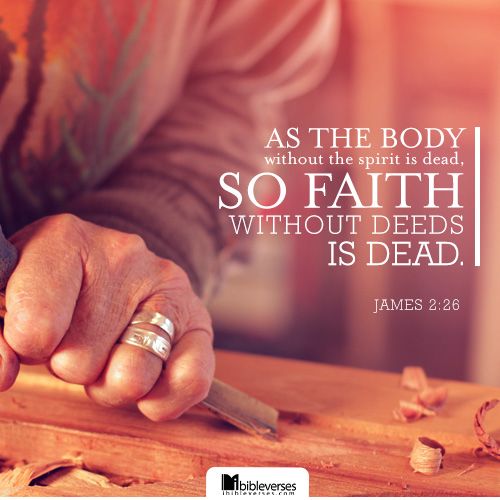
On Sunday we opened up probably the most famous verse of James in James 2 where he says, “Faith without works is dead”. This is a verse that is deservedly famous, but also does bring up a tension. Because this verse looks almost directly contradictory to some of the teaching of Paul. For example Paul says this:
Ephesians 2:8-9. “For it is by grace you have been saved, through faith—and this is not from yourselves, it is the gift of God— not by works”
Romans 3:27, “Can we boast then that we have done anything to be accepted by God? No because our acquittal is not based on our good deeds. It is based on our faith. So we are made right with God through faith and not by works”
Galatians 2:16, “And yet we Jewish Christians know that we become right with God, not by doing what the law commands, but by faith in Jesus Christ…for no one will ever be saved by obeying the law”.
This tension though is more in perspective than in reality. James is writing to people who are using their faith as an excuse to not do works. Paul is writing to people who are seeking to use their works as reason to be accepted. And the different contexts make all the difference.
James is not arguing that works must be added to faith, but that genuine faith includes works.
Douglas Moo puts it this way,
The difference between the [teachings of James and Paul] is the context in which these works are done. Paul denies that works can have any value in brining us into a relationship with God; James is insisting that, once that relationships is established, works are essential”.
So works don’t save you, but show that you are saved.
Or as Calvin puts it, “Paul contends that we are justified apart from the help of works, so James does not allow those who lack good works to be reckoned righteous”.
So we ended with James’ main point: Faith without works is dead. And we challenge people to actually put James’ point into practice.
At the beginning of the service we had everyone write down five needs they see around them. Which is a great practice, and one you should do right now actually.
But at the end of the sermon I called people to look at their lists, and remember faith without works is dead. And that they each had a list of needs they could meet. So I challenged them to meet some needs. Because if faith is about works, it’s time to get to work.
Sermon Notes:
Big Idea: Faith without works is dead.
Teaching Points:
Faith leads to change.
James is arguing that genuine faith includes works.
Works don’t save you, but show that you are saved.
Adult Discussion Questions:
What stuck out to you from the sermon? What was challenging to you? What was new? What were some of the needs on your list? Which ones are hardest to meet? Are there people who can help you meet them? Why do you think faith needs works? What happens when faith doesn’t include works?
Discussion Questions for Young Families
Talk to your kids about how when we follow Jesus we need to actually “do things”. Ask them the things that Jesus did, and then ask them which things they could do. Take time to do it then together.
Challenge for the Week: Put faith into action and meet a need.
On Sunday we are looking at the most well-known passage of James. The passage where James says “faith without works is dead”.
And we are going to wander into this world and statement of James and explore some of the tension with what he is teaching. And there is a tension because Paul says this in Romans, “So we are made right with God through faith and not by works”.
There is this tension that we want to explore theologically, but then also practically with our lives. So with that why not read all of James 2, to hear his arguments, and thoughts before Sunday. Let his words rattle around a little bit, because the beauty of James is that as he rattles around – he will shake things up. And that’s what we need.
What good is it, dear brothers and sisters, if you say you have faith but don’t show it by your actions? Can that kind of faith save anyone? Suppose you see a brother or sister who has no food or clothing, and you say, “Good-bye and have a good day; stay warm and eat well”—but then you don’t give that person any food or clothing. What good does that do? So you see, faith by itself isn’t enough. Unless it produces good deeds, it is dead and useless. Now someone may argue, “Some people have faith; others have good deeds.” But I say, “How can you show me your faith if you don’t have good deeds? I will show you my faith by my good deeds.” You say you have faith, for you believe that there is one God. Good for you! Even the demons believe this, and they tremble in terror. How foolish! Can’t you see that faith without good deeds is useless? Don’t you remember that our ancestor Abraham was shown to be right with God by his actions when he offered his son Isaac on the altar? You see, his faith and his actions worked together. His actions made his faith complete. And so it happened just as the Scriptures say: “Abraham believed God, and God counted him as righteous because of his faith.” He was even called the friend of God. So you see, we are shown to be right with God by what we do, not by faith alone. Rahab the prostitute is another example. She was shown to be right with God by her actions when she hid those messengers and sent them safely away by a different road. Just as the body is dead without breath, so also faith is dead without good works.
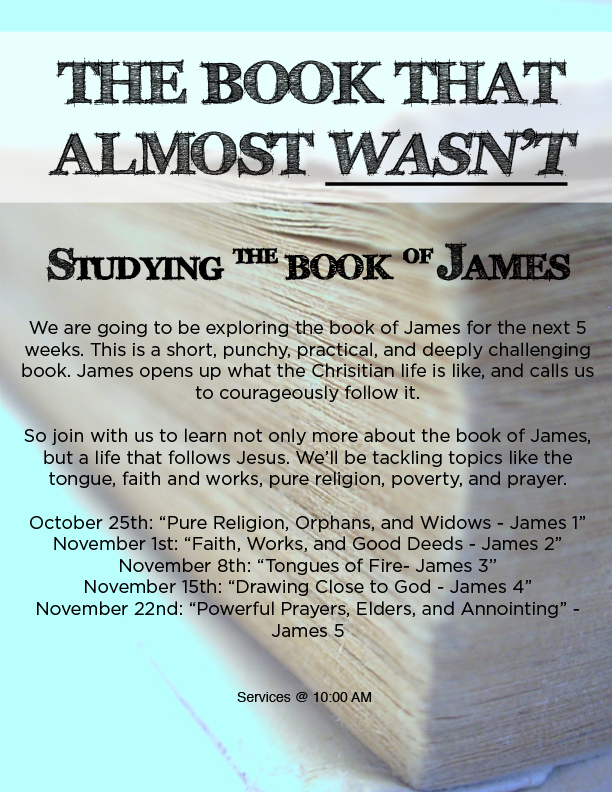
On Sunday we started a brand new series looking at James. We opened up this book by realizing that it is a short, straightforward, and punchy book. James pulls no punches and rattles off challenge after challenge in this book. And it’s a needed book.
Douglas Moo says this about James,
All too easily Scripture becomes a book to be analyzed rather than a message to be obeyed. This message is urgently required. All across the world, people are awakening to biblical Christianity. Third World churches are burgeoning, American ‘evangelicalism continues to attract much attention, and European Christians are seeing renewal and a new evangelistic concern. Yet the personal and social transformation that should accompany such revival are, very often, sadly lacking. Why is this? Surely one of the main reasons is that the simple plea of James – ‘do the word’ – is not being heeded. The bible is being translated, commented on, read, studied, preached and analyzed as never before. But it is questionable whether it is being obeyed to a comparable degree. All this suggests that the message of James is one that we all need to hear – and obey. No profound theologian, James’ genius lies in his profound moral earnestness; in his powerfully simple call for repentance for action, and for a consistent Christian lifestyle.
So we are going to look at one chapter a week, highlighting a key text in that chapter. And while James 1 has lots of great things to look at we focused in on verse 27.
Pure and genuine religion in the sight of God the Father means caring for orphans and widows in their distress and refusing to let the world corrupt you.
And this is probably one of the most well known verses in the Bible and in the book of James. But it is also a really challenging verse. James here pushes past what we say we believe, to examine our lives. He pushes past whether or not “you believe” in Jesus and asks, what do your actions say about what you believe. Do you care for the poor? Do you care for the orphans, the widows, the oppressed and vulnerable?
James wants to shift the discussion from beliefs to actions. And this is one that makes us uncomfortable because we can hide behind our beliefs. We can say we believe the right things, and then not do the right things. James won’t have any of that. So he invites us to examine our lives – are we active in binding ourselves to the poor and oppressed?
But James isn’t done there. He then reminds us not just to actively care for the poor, but to also actively reject systems of oppression. He says, “Don’t let the world corrupt you”. And we hear this and think in terms of morality – like sexual sins or doctrinal deviancy. But that’s not James’ point. James’ point is actually about money, poverty, and economics. James’ point is that we should not let the world corrupt us by joining in a system that exploits the poor, vulnerable, and oppressed.
James is an Old Testament prophet and in many senses what mattered was caring for the oppressed (widows, children, etc). And so James says start doing that, and pull out of systems that do not do that. Who cares if the world says it’s okay to live on the backs of the poor – God says it’s evil.
So James calls us to examine not only our actions, but our economic activities to see if there are areas where we are hurting others. And if we live in the West then for sure our economic activity is hurting others. We know this, that things are cheaper here because someone wasn’t paid fairly elsewhere. There are tons of examples of this all over. And James wants to raise it to our eyes and say this needs to change.
Abraham Joshua Heschel writes this,
The exploitation of the poor is to us a misdemeanor; to God, it is a disaster. Our reaction is disapproval; God’s reaction is something no language can convey.
That’s true. So what do we do with all of this?
Well on Sunday I gave the challenge that we need to bind ourselves to the poor. That means both taking positive action of finding ways to supporting and caring, and also “negative” actions. And by that I mean removing things from our lives that hurt the poor, whether that’s supporting companies profiting from war, buying cheap stuff because it’s easier, or whatever else. We are called to actively support the poor, and actively remove things that hurt the poor.
That’s the call of James – it’s clear, and it’s tough for how to live it out. But it’s something worth trying. And that’s the challenge James is calling us to.
Sermon Notes:
Big Idea: Following Jesus means binding your life to the poor and oppressed.
Teaching Points:
James is punchy, straightforward, and needed.
The true test of any religious profession is not the outward rituals but real actions demonstrated in real lives.
James says what matters isn’t doctrine but deeds.
We can hide behind our doctrine and our dogma.
We want to talk about our beliefs; James wants to examine our lives.
If we are to care for the poor we cannot be part of a system that exploits the poor.
Adult Discussion Questions:
What stuck out to you from the sermon? What was challenging to you? What was new? Have you thought about how your actions are your beliefs before? What was most challenging in this sermon for you? Were you aware of how some of our buying habits hurts others? What habits might Jesus be asking you to change?
Discussion Questions for Young Families
Take your family to serve widows, orphans, or the poor this week. Pick a date and plan it out. Maybe serve at a soup kitchen, maybe get toys together to give to a shelter, maybe bake cookies for someone who has lost someone. Make it real and practical.
Challenge for the Week: What can you add to your life to bind yourself to the poor, and what can you cut out that oppresses the poor.
On Sunday we are launching a new series looking at the book of James.
I would just say this, that this is a book that is really neglected. People say it’s not “theological” enough, not like some of Paul’s writings. Others say it’s too disjointed with little bits of wisdom and challenge sprinkled everywhere. I say though that it’s needed.
James is punchy, straightforward, and challenging. James is theological because he refuses to let us share our beliefs, but instead calls out our actions. James is unashamedly Jesus orientated reiterating teaching of Jesus, most often found in Matthew. James is someone our society needs because we are infatuated with beliefs, ideas, theories, and debates. James wants us to care for the poor. James wants us to control our tongues. James wants us to pray.
While we are busy debating, James was busy doing – and we need this reminder. So come Sunday that’s what we are doing, launching into this important, neglected, and almost forgotten book. Hope you can join us.
There was a book that came out a while ago called, “The Secret”. I’ve never read it but many people have. But interestingly enough the Bible too has a “secret”. A secret not in the “keep it quiet” kind of secret but in the special kind of secret. Secrets can be fragile, life-changing things. And this is the kind of secret that the Bible gets to – a kind that can change your life and that’s a promise for a deeper life.
And on Sunday we are going to look at this secret. The secret that Paul shares in Colossians 1 about who you are, and who lives in you.
But I don’t want to give it all away too soon, so why not go and read Colossians 1. It’s worth it – trust me. Because there is a secret there that will change your life, more than any book. A secret Paul comes right out and shares. Because good secrets, really good on
es, are worth sharing.
It is the deconstructive work that is painful because we have learned to emotionally invest , not in Jesus, but in our theology. A good test to determine whether Jesus or our theology takes precedence is to discern the degree to which we are willing to unlearn something and learn something new about Him. Michael Hardin
Ooh that one hits home. The truth is our theology is never perfect, but are we actually open to having it be changed by God? Are we actually willing to unlearn something, to learn something new?
As I look back on my life as a Christian, pastor, and theology-nerd the amount of stuff that’s changed is dramatic. The question though isn’t how have I changed, but am I willing to continue to be changed by the prompting of God’s Spirit and Truth? Because one thing is for sure, I don’t have it all perfectly together. And I need to invest in Jesus, not in my theological thoughts about Jesus. And the difference between those two things can sometimes be wider than we think.
But what about you? How have you changed and grown in depth with Jesus? How has your theology changed? How is it changing?
Because one thing is sure, we all need to become more like Jesus and that process involves change and it never ends. May we be open to that process and to the prompting of God’s Holy Spirit to conform us more and more into the likeness of Christ.

 On Sunday we are going to talk about prayer. Prayer is something that is really important and should be part of the regular fabric of our lives. Prayer is something that really releases God to work in the world and in our lives.


 There was a book that came out a while ago called, “The Secret”. I’ve never read it but many people have. But interestingly enough the Bible too has a “secret”. A secret not in the “keep it quiet” kind of secret but in the special kind of secret. Secrets can be fragile, life-changing things. And this is the kind of secret that the Bible gets to – a kind that can change your life and that’s a promise for a deeper life.
 { Andrew Mills }