Theology 101: Hermeneutics ~ How to Read the Bible

1427657_88656835On Sunday we looked at Bibleology, the study of the Bible. Specifically we looked at two things: how the Bible came to be, and how to read the Bible.

We talked about how the Bible came to be over a period of years, and how there were different criteria for books to be included in the Bible. These criteria were: Apostolicity, Orthodoxy, Antiquity and Catholicity or Usage.

Apostolicity is that the writings needed to be connected to an apostle. Orthodoxy meaning that it conformed to the overall emerging tradition. Antiquity meaning that it was written early and close to the time of first-hand and eye witness accounts. And lastly, Catholicity or usage meaning that it was used by the majority of the early church, and attested to its usefulness.

From there we moved on to discuss three poor ways to the read the Bible, and three helpful ways to read the bible.

The first poor way to read the Bible was what I called foundationalism. This is where the Bible is the foundation of our faith. Where we build up a historical, reasonable, and irrefutable arguments for the validity of the Bible and of faith itself. And while I believe in apologetics and using reason and history to demonstrate the reliability of the Bible, this view has one major flaw for me. And it’s this: the Bible is not the foundation of our faith. I know that sounds controversial but it shouldn’t be. The foundation of our faith is Jesus Christ. And yes, the Bible attests to that fact, but it is still not the foundation of our faith.

For me foundationalism misses the point because it raises the Bible above Jesus. So to put it clearly I don’t believe in Jesus because of the Bible, I believe in the Bible because of Jesus. That’s the correct order of priorities of things. And yes, of course, we get to know Jesus through the Bible, but the Bible should never become more important or foundational than Jesus. The Bible actually has a word for that, and it’s idolotary and leads to poor readings of Scripture.

Secondly, we talked about how a poor way to read the Bible is to read it flat. We read it as if each part is equally authoritative for our lives right now. All of the Bible is God-breathed, absolutely!, but we do prioritize or privilege certain parts – specifically Jesus. When we read the Bible we need to take into account the overall arc or trajectory of Scripture, and interpret in light of that. So what this means to give a practical example, we no longer practice “eye for an eye” because Jesus says not to do that. To read the Bible flat though makes these two teaching authoritative even though they contradict. Instead, we need to read the bible through the light and revelation of Jesus Christ, the full revelation of God. So reading it flat is taking each part equally without placing the commands of God, in the history, context, and overall scope in which they are given.

The third issue is that we read the Bible plainly or naively. Sometimes people say, “The Bible says it, I believe it, and that settles it”. But that is a really naïve way of reading, because we interpret all of the Bible even the clear parts. Because what is clear to you, might not be clear to others. Most of us in the West who are very wealthy do not take Jesus clear words “Go and sell everything” as his clear command. We take them metaphorically, even though they are clear. My point is that we need to learn to read the Bible not naively or plainly but deeply. And ask some key questions is this text just describing a time, or prescribing how we should relate for all time? What is the context here? How does this relate to other parts of the Bible? I think that to approach the Bible with just a forced naivety without a willingness to study is problematic.

And lastly, I gave three other quick ways to read it correctly. First, was to read it through the lens of Jesus. If Jesus is the complete revelation of God, we need to read the Bible through that revelation. Jesus is the standard, so we need to start there.

Secondly, we need to start reading the Bible through not only the lens of Jesus, but also the lens of love. This is because this is what Jesus explicitly says. When he summarizes all of the Old Testament he says its summary is to love God and love others. That this is the trajectory or goal of the Old Testament to teach how to love. So we need to read the Bible in light of that. And St. Augustine agrees, saying this: “Whoever, then, thinks that he understands the Holy Scriptures, or any part of them, but puts such an interpretation upon them as does not tend to build up this twofold love of God and our neighbor, does not yet understand them as he ought”

And lastly, I argued that we need to read it looking for things to practice. The classic verse that is used to argue for the inspiration of Scripture actually points us to the meaning or purpose of Scripture. Paul in 2 Timothy 3:16 says:

All Scripture is inspired by God and is useful to teach us what is true and to make us realize what is wrong in our lives. It corrects us when we are wrong and teaches us to do what is right.

The purpose of Scripture is to teach us how to live. That’s the point of it, “teaches to do what is right”

So when I come to read the Bible this is what I try to do:

  • To not place the Bible above Jesus, but to help me discover Jesus
  • To not read the Bible flat, but to look for how to act
  • To not read the Bible plain, but through the lens of love

We ended with this main point: The Bible matters, but what matters most is following Jesus. And when we keep that priority and relationship right, it helps everything. So the challenge was simple this week. To go home and read your Bibles, to really dive deeply into them, to wrestle with them, and read them through the lens of love, through the lens of Jesus, and looking for things to place into action.

The truth is reading the Bible flat, plainly, or as the main priority are just immature ways of reading it. They are great starting places, but we need to grow deeper than that. And that happens through practice. So read, study, and let God guide you in that.


Sermon Notes:

Big Idea: The Bible matters, but what matters most is following Jesus

Teaching Points:

  • Criteria for the Bible: Apostolicity, Orthodoxy, Antiquity, Catholicity or Usage
  • The Bible isn’t the foundation of our faith, Jesus is.
  • I don’t believe in Jesus because of the Bible, I believe in the Bible because of Jesus.
  • Scripture has a trajectory and a goal to it.
  • Don’t read it flat, but in light of Jesus.
  • Reading the Bible “plainly” or “naively” rather than deeply isn’t helpful.
  • Read the Bible through the Lens of Jesus
  • Read the Bible through the Lens of Love.
  • Whoever, then, thinks that he understands the Holy Scriptures, or any part of them, but puts such an interpretation upon them as does not tend to build up this twofold love of God and our neighbour, does not yet understand them as he ought. St. Augustine
  • Read the Bible for action and praxis.

Adult Discussion Questions:

What stuck out to you from the sermon? What was challenging to you? How did God speak to you through it? What was new? How can reading the Bible without context lead to difficulty? Which way of reading the Bible (lens of love, Jesus, or action) do you really need to focus most on? How often do you read the Bible? What are your struggles with reading the Bible? Who can help you?

Discussion Questions for Young Families

Today rather than asking questions, why not do something together. If you’re not already in the habit of reading the Bible with your kids daily – why not start? There are some great Story Bibles even for little kids like Whirl Story Bible. Pick one up and start reading.

Challenge for the Week: Read the Bible everyday this week.

How to Read the Bible and Why it Matters

1336080_83711862Well on Sunday were are looking at something so obvious you may even wonder why we are looking at it: how to read the Bible.

At first glance this doesn’t seem to be something we need to be taught…but it is. And here is why. Because we have probably all encountered bad readings of the Bible.

This is where people use the Bible, but leave feeling like they missed the point. Or they used it poorly, or hatefully, or just plain wrong. Let’s be clear, you can use the Bible to make almost any point you want. And just because something is in the Bible, doesn’t mean just quoting it – makes it right. Just look at Satan in the temptations with Jesus; he uses the Bible as a weapon to try to actually stop him from accomplishing his mission.

So there are healthy and unhealthy ways of reading the Bible. And even though if you’ve grown up in the faith and it seems pretty straightforward, I think this could be one of the most revealing and interesting sermons all year. So I hope you can make it. I know it’s a long weekend ~ but I promise not to preach…too long 🙂

Theology 101: Soteriology ~ How Does Jesus Save Us?

1442779_37518210On Sunday we looked at Soteriology, or the study of how Jesus saves us. We looked at different Atonement Theories. These are theories that seek to explain how Jesus’ death and resurrection actually saves us.

So we began by looking at what’s called Ransom Theory. This is the idea that Jesus pays the price, to buy our freedom from Satan. That we are held by Satan, and Jesus is exchanged for us. This view might be familiar if you’ve ever seen or read the Lion, the Witch, and the Wardobe which is used there.

The next we looked at recapitulation. This is the view that the “Son of God became man so that we might become God” (Irenaeus). The basic idea is this; that Jesus fully participates in God, so that we might fully participate in God. And like Ransom theory this theory too has biblical support, particularly Romans 5:17-19.

And there are lots of other views including Moral Influence Theory, Governmental Theory, Satisfaction Theory, and even more. Yet we finished by focusing on the two most current or prominent views, Penal Substitutionary Atonement, and Christus Victor.

Penal Substitutionary Atonement states that Jesus took our place (substitutionary) and took on our punishment (penal). Jesus died to pay the price of our sin and disobedience to God. And since God is just and holy he abhors sin and its need to be punished. So Jesus takes on the punishment rightly deserved for us. John Calvin puts it this way, “This is our acquittal: the guilt that held us liable for punishment has been transferred to the heart of the Son of God”.

And while this view is probably the default view of evangelicalism, and quite popular, it has some issues inherent within it. For example, God, as an act of justice, punishes an innocent person, which raises questions about God’s justice. This view also traditionally sees sin in a very individualistic manner rather than systemic. This view can also lead people to fear the Father (who pours out his wrath on Jesus) rather than embrace the Father.

So while this view is very popular, and has been incredibly helpful in leading people to Jesus (myself included!) – there are some complications or questions with it. So with that understanding we then dove deeply into my preferred, or privileged atonement theory: Christus Victor.

Christus Victor in short is: A picture of God in Christ liberating humanity out of bondage from sin, death, and the devil (Derek Flood). Jesus dies, not simply as payment for sin, but to destroy death, evil, and sin. Jesus enters into the dungeon of death, and breaks its chains and leads us to resurrection.

Derek Flood continues writing,

“Christus Victor understands our salvation within the larger picture of a cosmic victory over evil. It is about our healing, and the healing of our world. This is tremendously significant because it means salvation is not simply a private religious affair, but entails putting all of life under Christ – our social, political, economic, nation and legal systems all need to reflect Christ’s way. Christus Victor captures the full scope of the redemption of both us and our world”.

And so while I personally lean toward Christus Victor, none of these atonement theories are necessarily in competition with one another. You don’t need to believe one to the exclusion of another. Michael Bird, an evangelical systematic theologian, writes this: The doctrines of penal substitution and Christus Victor do not compete against each other. And he personally holds Christus Victor as primary, yet also believes that Penal Substitutionary Atonement explains the specifics of God’s salvation.

So the main point though is that regardless of how you believe that Jesus saves us, that you believe that Jesus is the one who saves us. This is the centre.

And we ended with the main idea that Jesus’ death and resurrection has secured our freedom. Our freedom from sin, evil, injustice, death, and all that is anti-God. So we can have hope. Even if we don’t fully understand how Jesus saves us, that doesn’t stop us from experiencing his salvation!

Derek Flood writes, “What happened to Jesus was horribly unjust, and yet it was how God brought about justice. It was wrong, but God entered into that wrongness and turned it around to make things right. This is the great reversal of the cross. God enters into our darkness and makes justice come about despite injustice. God chose to make something good out of something bad. This does not mean that God condones evil and pain, but that God overcomes evil with good. It means that God can enter into all of our ugliness, evil, and hurt, and turn it around.”

And that’s he beauty of the cross. That Jesus can enter into all our ugliness, evil, and hurt and turn it around. That was our challenge on Sunday; to let God into all our evil and turn it around. That whether for the first or hundredth time to let God in, to save us, and transform us.

The essence of salvation is not to obtain something but to live with God…Salvation is not a possession but a relationship. Andrew Sung Park


Sermon Notes:

Big Idea: Jesus’ death and resurrection has secured our freedom

Teaching Points:

  • Soteriology ~ Study of Salvation
  • Atonement means “at-one-ment”
  • We want to be unified in our belief that Jesus saves us, and allow diversity for how we believe that happens.
  • Ransom theory: Jesus died to ransom us back from Satan.
  • Recapitulation Theory: For the Son of God became man so that we might become God – Irenaeus
  • This is our acquittal: the guilt that held us liable for punishment has been transferred to the heart of the Son of God. John Calvin
  • “The justice of God is not primarily or normatively as retributive justice or a distributive justice but a restorative or reconstructive justice, a saving action by God that recreates shalom and makes things right”.   Chris Marshall
  • Christus Victor is a picture of God in Christ liberating humanity out of bondage from sin, death, and the devil. Derek Flood
  • What we see Jesus doing specifically in his life (healing, freeing, forgiving); Jesus is doing universally on the cross.
  • What happened to Jesus was horribly unjust, and yet it was how God brought about justice. It was wrong, but God entered into that wrongness and turned it around to make things right. This is the great reversal of the cross. God enters into our darkness and makes justice come about despite injustice. God chose to make something good out of something bad. This does not mean that God condones evil and pain, but that God overcomes evil with good. It means that God can enter into all of our ugliness, evil, and hurt, and turn it around. Derek Flood
  • God can enter into all of our ugliness, evil, and hurt, and turn it around. Derek Flood

Adult Discussion Questions:

What stuck out to you from the sermon? What was challenging to you? How did God speak to you through it? What was new? Had you ever heard any of the theories before? Which one resonated most with you? How would you explain why and how Jesus saves us? Do you have any questions that still need answering?

Discussion Questions for Young Families

Talk to your kids about Jesus’ death and resurrection. Talk about how Jesus is stronger than even death, and how he conquered all sin, death, and evil. Ask them is there anything in your life that you need some freedom from? (Fear, worry, etc). And then pray to Jesus about it.

Challenge for the Week: Open yourself to Jesus today

How Does Jesus Actually Save Us?

Well come Sunday we are going to be talking about one area of theology that has had the most discussion. It’sOLYMPUS DIGITAL CAMERA called Soteriology – the study of salvation. And specifically we are going to be examining what is called “Atonement Theories”. These are explanations for how Jesus’ death and resurrection actually saves us. If the question is “how are we saved” ~ atonement theories try to give us some answers.

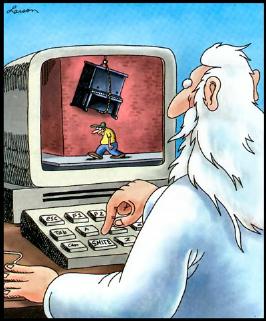
Here’s the thing though that is interesting: there is no standard answer.

The early church in the creeds developed lots of theology around Jesus, the Trinity, and lots more. But there is no standard, all encompassing, or definitive statement. What all Christians believe is that it is through Jesus Christ that we are saved. How this actually works is where there is lots of discussion.

So we want to wade into this discussion and go over some of the different alternatives, viewpoints, and theories. The hope through this is that not only will we come to a better understanding of how Jesus saves us, but that we might continue to be saved and transformed by Jesus.

So before we get there why not give this some thought. How does Jesus’ death and resurrection actually save us? And come Sunday I’ll give you my best answer

The Holy Spirit that Brings Challenge Not Just Confirmation

Holy-Spirit-15788I want to talk about the Holy Spirit, and theology in a moment. And to do that I want to use a quote from Michael Hardin.

Just a heads up though before reading further. This next quote is both true, and also challenging. And if it doesn’t challenge you, then read it again, pray, sit, and it soon will.

Here is what Michael Hardin says about the Holy Spirit, God, and theology:

If all the Holy Spirit does is to confirm your personal theology, it probably isn’t the Holy Spirit. The work of the Spirit is to conform each of us as persons and together as a people into the image of Jesus.

And this is just so true, and disturbing at the same point. It is obvious none of us are Jesus, none of us are Christ. We each have areas that need to be remade, transformed, or shaped into being Christlike.

And Hardin raises the point that if all the Holy Spirit does is comfort you, confirm your view of God, and counsel you, it probably isn’t the Holy Spirit. Because part of what the Holy Spirit does is to challenge you to conform to Christ. This means dying to parts of yourself, this means being convicted of sin and changed.

The point is that if the Holy Spirit isn’t doing any challenging or convicting, we’re probably just not listening enough…

Theology 101: Christology, a Jesusy God, and Holy Humanity

gods-wrath(2)On Sunday we began with a cartoon. And with me there is a chance that its either Calvin and Hobbes, or The Farside (which I spent more hours reading in high school than…well probably any other book).

And Gary Larson has this great cartoon that looks like this. And here was my question for Sunday – how do we know God isn’t like this? Why is this funny? Why do we laugh – knowing its not like God has a smite button? How do we know that?

Because for many years, many people had this view of God. That if you step out of line, smiting, cursing, or punishment is on its way. If you’re crops failed, its because of that sin. If you get sick, its punishment and God smiting you. So how do you know that God isn’t like this?

Well the quick and easy, and true answer is this, because Jesus isn’t.

Jesus perfectly reveals God. Jesus is entrance into understanding God. God is Jesusy. The Bible makes it clear in multiple places that God is Jesusy (Hebrews 1; John 1:18; and others). And here is why this matters because:

If you’re God doesn’t look like Jesus, you have the wrong picture of God.

And there isn’t any other way around this. Gary Larson’s wrong, God isn’t like that, because Jesus isn’t like that.

And yes this surely brings up tensions, there are difficult parts to reconcile then in the Bible. But the point is this: we cannot compromise on the revelation of God in Jesus Christ, no matter what else we do. We will need to use care in exegeting some of the Hebrew Bible in light of Jesus, but we cannot compromise the revelation of God in Jesus.

With this understanding that Jesus reveals God, we got to know Jesu a bit better. We began by looking at the divinity of Jesus.

The divinity of Jesus was actually something that was debated for a while in early Christianity. Yet there are some clear indications that Jesus is fully God, as we attest and believe, in Scripture. We looked at the sinlessness of Jesus, we looked at how he forgave sins (something only God can do), and how he accepts worship. But by far the biggest thing that testifies to his divinity, is how he was resurrected from the dead by God. God through resurrecting his son, validates all his claims about whom he is (Rom 1:14).

We then looked at the humanity of Jesus. Now this is something that was clear to the early Christians, but that we struggle more with today. We like to think of Jesus as Superman. That he dresses up in humanity, like Clark Kent, but pulls out his superpowers to do miracles and so on. But this isn’t the picture the gospels paint – Jesus was fully  human and Jesus is fully human.

Michael Bird writes this, “The fact the that the Logos was able to take on human form suggest that divinity and humanity are not mutually exclusive modes of being…The incarnation is not simply God assuming human form, as if human flesh were a mask over his real nature. Rather, the incarnation is God as a human being and complexly sharing in human properties. The incarnation shows us what God intended humanity to be and what it finally will be” (Evangelical Systematic Theology)

So with that we came to our main point for Sunday. And it was this:

            That Christ is the Key

Jesus is the key for everything. He is the key for understanding God. He is also the key for understanding humanity and what it means to be human. Jesus is the key to everything. If you want to know God, if you want to know yourself – look to Jesus. So that was our challenge for Sunday – go home and read the gospels. Because the more you get to know him the clearer God becomes, and how to live life becomes clearer too.


Sermon Notes:

Big Idea: Christ is the key

Teaching Points:

  • The foundation of our faith is Jesus Christ, first and foremost.
  • Jesus perfectly reveals God.
  • The lens we interpret the Bible through is Jesus.
  • We can’t give up on the centre of our faith and compromise that Jesus reveals God
  • Reasons for Divinity of Christ: Miracles, Forgives Sin, Sinless, Accepts Worship, and Was Resurrected.
  • Jesus was and is human.
  • Incarnation when Jesus enters the world isn’t for a moment, but for eternity.
  • Christ is the Key
  • If you want to be certain about God, get close to Jesus.
  • Read the gospels
  • Our comfort does not lie in the fact that we have pure doctrine or pure revelation. Our comfort does not lie in intellectual or spiritual certainty. Our comfort does not lie in the belief that we have grasped Jesus. Our comfort and only hope is that He has grasped us, called us, named us and chosen us, all of us, and that He alone is our hope. Michael Hardin

Adult Discussion Questions:

What stuck out to you from the sermon? What was challenging to you? How did God speak to you through it? What was new? Have you ever thought of God as Jesusy? Is there anything in your picture of God, that isn’t “Jesusy”? How does having Jesus as the perfect revelation, give clarity to who God is? Which do you find easier to believe in: the humanity or divinity of Jesus? Why is that? Which of the gospels are you going to read?

Discussion Questions for Young Families

Ask your kids what God is like. Ask them what other people think God is like. Then share with them the most important thing – what Jesus says God is like! Have them think about how Jesus reveals God. Ask them, what is Jesus like? And then tell them that’s what God is like.

Challenge for the Week: Read the gospels.

Who’s Jesus?

On Sunday we are going to be continuing in our series looking at Theology 101. We are going to be discussing a key, or they 443072_50402965key central tenet of Christianity: Jesus Christ. This is called Christology, and we’ll be exploring the humanity, divinity, and most of all the revelation of Jesus Christ.
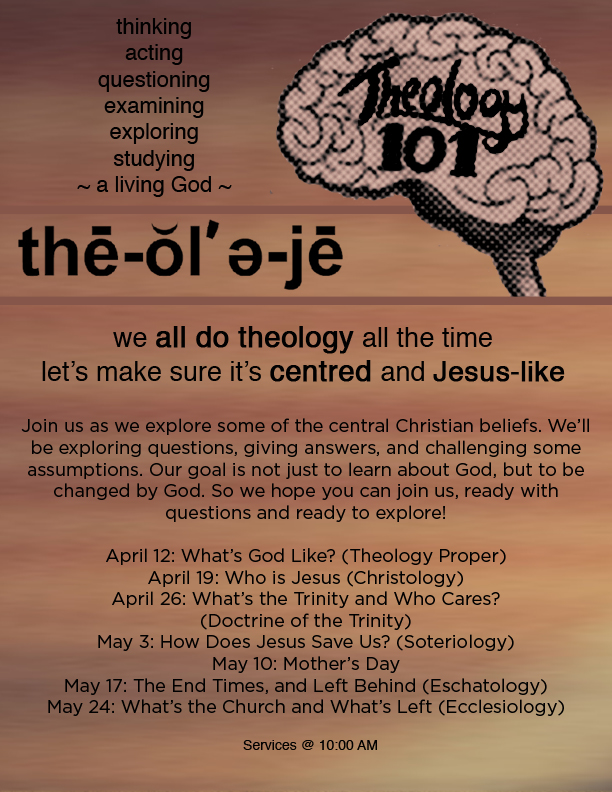
The revelation of Jesus is so key to our current culture. Currently there are lots of views floating around our culture about what God is like: a grandfather, non-existent, passé, an angry vengeful warrior, someone intensely interested in personal morality, or lots of things. The God I’m interested is none of these. The God I’m interested in is the one that Christ reveals, that Christ shares, and the one that Jesus says looks like him.

And that’s what we are going to be looking at, but before we get there I have a question for you. As you think about God, and what he’s like, here’s my question – does he look like Jesus? And if he doesn’t maybe there are some changes to be made.

Theology 101: The Doctrine of God, Holiness, and Why Love is always First

doctrineOn Sunday we kicked off our series on Theology 101 by looking at the doctrine of God right off the bat. We talked about theology and that it is important because we are always doing theology all the time. When we look around the world and say, “Well God wouldn’t do that” – that’s theology. When we see someone in suffering and say “I’ll pray for you” that’s all theology too. Theology is intimately tied with our practice. Ou practice actually reveals our beliefs. So the point isn’t whether or not we are doing theology, but whether or not we are doing good theology.

So that’s the point of this series, to give us a good foundation to practice good theology. To practice theology that sets people free, demonstrates God’s love, and participates in the Kingdom.

And so we began by looking at first how do we get our theology?

The quick and easy answer is: the bible duh!

But it’s actually not that simple. Those people who just say all I need is the Bible, it’s enough for me! Well beside them being perhaps well-meaning that view is also naïve, incredibly arrogant, and actually just downright wrong. We all come to the Bible with preconceived notions, thoughts, and baggage. So when it comes to doing our theology, the source isn’t just our Scriptures but other things play into it as well.

There are traditionally four areas or sources for our theology. Firstly, is obviously the Bible, but there is also our experience, reason, and tradition. Experience plays a huge part in our thoughts about God. I used to think that God had a purpose in death, but after experiencing the death of my dad, I no longer think this. I think God has a purpose to abolish death, but not in death. Experience shapes us.

So too does reason. When we look at beliefs we look at how they actually logically work. Andy Bannister writes this, “The Bible tells Christians to be transformed by the renewing of our mind, not the removal of.” And that’s true.

And last but not least, we get our theology from tradition. Now this is a weak area for Evangelicals. We often think that our beliefs are what Christians have always believed. But this is not necessarily true. So it is good to know our history. Tony Lane writes, “There are two sorts of Christians. Not those who are influenced by tradition and those who are not, but those who are aware of the influence and those who are not.”

So with that introduction we launched into discussing the theology of God proper and asked this question: what is God at His core?

Lots of people have lots of different ideas or metaphors. Some people say judge, some people say creator, some people say king. But by far one of the most popular ones is that God is Holy. But I believe that God, at his core, isn’t those things, but is instead love.

To understand this we talked about the difference between God’s essence (what he always is and always has been) and God’s attributes (something God is in relation to something else). And God surely is a creator but this isn’t at his core, because there was a time when God wasn’t a creator (i.e. before he made the earth). The same holds true for God’s holiness. Holiness is always something in relation to something else. For someone to be holy, there has to be something that is unholy (a reference point). The same thing holds true for someone being tall (if you are the only person on earth – you aren’t tall because there is no reference point). The point is then that in the beginning when it was only God, God wasn’t “holy” per se because there was nothing unholy around. Holiness is to be set apart, but there was nothing for God to be set apart from.

So what is God at his core then? The answer is clear from the Bible – love. God is love is stated often. And the supreme self-revelation of God, Jesus dying and rising for us, is a revelation of self-sacrificial love. So God is love and always has been love. And that was our main point on Sunday. That God is love.

But this is actually a practically challenging thing too. Because if God at his core is love, then as Christians our core should also be love. We should be known and seen as people of love first and foremost. Because love isn’t’ about how you view yourself, but how others view you. So if no one thinks you’re loving, you probably aren’t. The point is that we need actions behind our beliefs and demonstrate love. That’s the challenge I gave this week, to choose one person to demonstrate love to. Because if God is self-giving love, we as his followers should also show self-giving love. Love is at the centre of God, and it needs to be at our centre too.


Sermon Notes:

Big Idea: God at his core is love.

Teaching Points:

  • The truth is, we are all doing theology all the time.
  • The Bible was not written so that we would know about God, It was written so that we could become more like God
  • To follow God well, you have to know him well too
  • Theology literally means the study of God
  • Theology is not the study of the ideas about God; it is the study of the living God. Michael Bird
  • Theology is communal.
  • Theology is a communal study of the living God.
  • We get our theology from the Bible, Reason, Experience, and Tradition.
  • The Bible tells Christians to be transformed by the renewing of our mind, not the removal of. Andy Bannister
  • There are two sorts of Christians. Not those who are influenced by tradition and those who are not, but those who are aware of the influence and those who are not. Tony Lane
  • The Bible is our primary authority, but not our only authority.
  • Love is the fundamental divine attribute. Love is not merely one attribute of God among many. Rather, “God is love” is the foundational ontological statement we can declare concerning the divine essence. Stanley Grenz
  • God at his core is loving relationally.
  • Being loving isn’t how you see yourself but how others see you.

Adult Discussion Questions:

What stuck out to you from the sermon? What was challenging to you? How did God speak to you through it? What was new? Before today, what would have been your answer for what’s at God’s core? What shaped you to believe that? Who are you being called to love? How will you do it this week? Of the four areas (reason, experience, Scripture, tradition) which one do you feel most comfortable with? Which one don’t you feel comfortable with? What is one theology question you’ve always wanted answered?

Discussion Questions for Young Families

Talk about how God is love at his core. Maybe have your kids draw a picture, paint a picture of God being love, and then decide on whom you can love as a family. Maybe a school friend, maybe a neighbor, maybe someone sick. Ask them, and then make something happen!

Challenge for the Week: Be a person of love.

Theology 101 Series

On Sunday we are kicking off a brand new series called Theology 101. We are going to be diving into some topics we kind of usually keep to the edges and might not really address like:

  • What is God really like (doctrine of God)
  • What is Jesus actually like and why is he God and does he have superpowers (doctrine of Christ)
  • What is the Trinity and does it even matter for our lives
  • How does Jesus actually save us – is there like a ledger sheet or something?
  • What will happen at the end of time? Is heaven full of clouds, and hell full of fire?

We are going to be looking at these questions and more. Giving time to thinking them through and asking more questions. So I hope you can join us!

Theology 101

Loving Your Neighbours and Why No One Can Tell You How

583245_74851881No expert can tell you how to best love your neighbour…Only the Spirit can guide you into faithful presence, which is the love of Christ. Paul Sparks, Tim Soerens, and Dwight Friesen

I think that this quote is just so – challenging and true. We know as Christians we are called to move out into our neighbourhoods, and love our neighbours. If we aren’t loving our neighbours well, we aren’t following Jesus well. That’s just true.

But the difficulty is in how to do this. We often at least in Christian circles, look to experts to tell us this. And if you don’t believe me, just look at how popular conferences and seminars on “How to Be Missional” are. They are everywhere (and I’ve led some…).

The point though is that no expert can adequately tell you how to love your neighbour. And to love our neighbours well, we don’t need more experts, we need a change in focus. We need to focus on Jesus and his Spirit.

It is only Jesus that can truly lead us into loving our neighbours well. It is only through listening to his Spirit that we can discern the right ways and the right times to show love in practical action. In all honesty what we probably need is less experts in our lives, and more dependence on Jesus. This isn’t a knock against practitioners, experts, and people who are inspiring us to live like Jesus. But that’s just the point, they can only inspire us to live like Jesus. It is only Jesus Christ himself who can direct us to live like him, who can transform us into his likeness.

So loving our neighbours is crucially important. And experts and practitioners are important too. But what is most important is learning to listen and follow Jesus and his Spirit well – because that’s the true first step in learning to love our neighbours well.