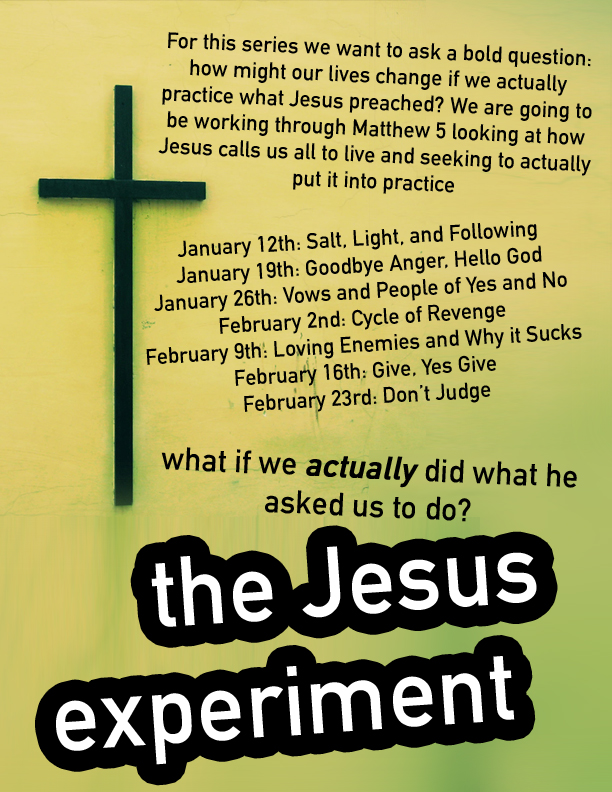
What If We Just Did What Jesus Said?

walking-away-1418812-mOn Sunday we are really exploring a radical question. What if we just followed Jesus in what he said?

We are beginning to explore his teaching on the Sermon of the Mount and will be seeking to actually practice it. Because here is what I believe: the teachings of Jesus aren’t primarily to be debated, to be forgotten, reworked, or skipped over. They are to be practiced.

Our guiding quote for this whole series is from Dietrich Bonhoeffer. Commenting on the sermon of the mount, with his usual succinctness and challenge he says:

“The only proper response to this word which Jesus brings with him from eternity is simply to do it”

And I think he is right. What if we just did what Jesus said? Dream with me a moment how might your life be different? How might your family’s life be different? How might your community be different? How might this world be different if we all got serious about following what Jesus said?

That’s why I’m excited for Sunday because I think it will start something in our lives so meaningful.

So before we get there why not take a moment and simply sit and read over Matthew 5 a few times. See what stands out, see what Jesus asks you to do, and then don’t forget to put it into practice.

Following

“Daddy I’m Not Special Because You Love Me”

1470072_10153676442255643_402969151_nA few days ago I was talking with my three-year old. And sometimes I think three-year olds should be in charge because in their simplicity and understanding they are brilliant. But, of course, if they were in charge we’d probably have to watch more Dora than we’d want to but that’s a side point.

As I was talking with Hudson I told him he is so special and loved by mommy and daddy. And he got mad. Down right angry. And he told me, “No daddy I’m not special because you love me”. And I started to get a little frustrated that it kind of felt like he was rejecting a bit of my care and love for him. So I told him, “No you are special because daddy and mommy love you and will always love you no matter what.” And he said again “No daddy I’m not special beause you love me” And he started stomping his feet.

Just as I was feeling a little inwardly unsure about what to do, Hudson said this. “Daddy I’m special because God loves me, mommy told  me that. God loves me, made me, so I’m special”.

See three year olds can be brilliant – right?

And Hudson is right. That is the foundation for why we are all special, unique, and valued. And I pray to God that he will never ever forget that foundation. I pray that he holds onto that truth for every day of his entire life. I pray that he will never seek to find his validation in love from anyone else, from anything else, or from any other substitute. I pray that he will know he is special, matters, and has value because God loves him.

If you think about how might our lives be different if we would have just held onto that truth?

How might decisions in high school have been different, if we knew with such conviction, like Hudson, that we matter because of God? How might our decisions in our marriage, in our jobs, and in our families be different if we were so secure in God’s love for us?

So on that day Hudson taught me something important. He is special because God loves him, and so am I, and so are you.

Beatitudes, Blessing, and The Best Sermon Ever

1336079_98421028On Sunday we looked at the most beautiful sermon ever given…and of course it was given by Jesus. We looked at the Beatitudes found in Matthew. These are beautiful promises, pronouncements, and announcements that blessing is being given by God. That in God’s Kingdom blessing flows. The beautiful thing about the Beatitudes are that they aren’t extra to-dos. The Beatitudes aren’t telling us what more we need to do to be blessed. The Beatitudes are telling us that God is about blessing, and he is giving it free of charge. Are you poor in spirit – burn out and broken? Blessing is for you. Are you mourning – experiencing loss and hurt? Blessing is for you. Are you trying to show mercy in chaos? Blessing is for you. This is the radical nature of the Beatitudes and of our God. That he gives blessing regardless of whether we deserve it, can earn it, or even appreciate it. God is about blessing and life.

And so on Sunday we really tried to rest in this reality. To help to do this we read and listened to the Beatitudes. We simply sat and asked God to speak to us through his promises in the Beatitudes. To help with this I read a targum (an expanded and interpretation added version) of Matthew 5:3-10. I simply invited the church to ask God to speak to them through it. And I’m going to invite you to do the same. Why not sit, read, and ask God to speak to you through it. And of course, my hope is that you  might experience some of the blessing God wants to give.

God blesses those who realize their need for him, Because with less of you there is more room for God.  When you’re are at the end of your rope, and your strength is failing, that’s when he shows up in a furious torrent of love and strength. When you’re lost and wandering in the desert, His love will chase and capture your heart leading you to his rest, presence, and purpose

God blesses those who mourn, who weep, who have lost, and feel broken. He will not let you break, he will not let your heart run empty of hope. When your heart is broken, healing is on the way – hope on the horizon. When your spirit is lost and low, God sends his Holy Spirit that mends the tears and wipes away the tears.

God blesses those who are gentle and lowly. When you’re simply content with just who  you are – no more, no less, the world belongs to you – because you belong to God. Those who place trust in God – and not others, will know great peace and victory over all things, and all evil.

God blesses those who are hungry and thirsty for Justice. Who see the world as God sees it. For you will know righteous living flowing from you like a river, changing the tide of history. When you desire justice – You will be filled. When righteousness is your hunger, God will fill your soul – and loose the Spirit in your life.

God blesses those who are merciful because mercy will be abundantly theirs. When kindness becomes a habit, God’s presence becomes a never-ending reality. When you find yourself full of caring, you will find yourself cared for by the lover of your soul.

God blesses those who have a pure heart, for they will see God. For those who know Jesus, God’s presence is never far away but always right before your eyes ready to be seen.

God blesses those who work for peace, who stand up for reconciliation in the midst of chaos. You are invited into God’s family. Your peace and grace-filled actions mark you as God’s and God’s alone – You are his firstborn.

God blesses those who are persecuted, because the kingdom is yours – here today. When you are slandered, taken to town, and thrown to the dogs because of your love of Jesus, know that you do not stand alone – Jesus stands with you and stands up for you. When you are hurt -and you respond in grace, then the kingdom is fully alive in your life – bursting out sending light to dark places.

Best Sermon Ever Given

65671_5202On Sunday you will be hearing the best, most moving, and most beautiful sermon ever given.

I hope you’re excited, and I hope you also know me well enough to get that clearly it won’t be coming from me.

Instead I want to read and focus on the most beautiful sermon ever given, and of course, it was given by Jesus Christ. On Sunday we are going to be exploring and going deep into the beatitudes found in Matthew 5. We are going to not only explore Jesus’ teaching, but actually experience Jesus’ teaching.

So before we get there why not simply spend sometime with the best sermon ever given. Why not read over the Beatitudes found in Mathtew 5 a few times, and simply let Jesus speak through it to you. And come Sunday, that’s what we’re going to do too.

Matthew 5:3-10

“God blesses those who are poor and realize their need for him, for the Kingdom of Heaven is theirs.

God blesses those who mourn, for they will be comforted.

God blesses those who are humble, for they will inherit the whole earth.

God blesses those who hunger and thirst for justice, for they will be satisfied.

God blesses those who are merciful, for they will be shown mercy.

God blesses those whose hearts are pure, for they will see God.

God blesses those who work for peace, for they will be called the children of God.

God blesses those who are persecuted for doing right, 
for the Kingdom of Heaven is theirs.

Spiritual Top Ten Lists

1428251_62762229

On Sunday we looked at the top ten lessons that I thought God had taught us this year.

I think this practice is really important. I think taking time to review and reflect on how God has been faithful is so key to being able to follow God. To follow God deeply, we need to remember where he has led us in the past, so that we might get a glimpse of where he is leading us in the future.

So I’d encourage you to take time today, and review you’re year. What were the special highlights, the memories, the occasions you celebrated? And as you reflect on those things remember what happened around those times. How was God active? What was he teaching you? When was he faithful? When did you wish he was more present? What was challenging? What gave you hope?

I think reflecting and remembering is part of following. So do that today. And if you’re interested here are some of the questions we walked away with on Sunday to help us reflect and remember.

  1. How has your trust in Jesus grown or struggled this year? How come?
  2.  How faithful have you been to Jesus this year? What do you need to do to be faithful to Jesus? How faithful has he been to you?
  3. Have you experienced the presence and fullness of Jesus this year at all? When, where, and how?
  4. Have you left God’s side and moved away from him at all this year? If so are you willing to go back to God and let him accept you?
  5. Is God in control and directing your life – or are you?
  6. Did God have your attention this year? Does he have your attention now?
  7. What new thing did God get started in you this year?
  8. Who have you shared your story with this past year? Who are you called to share your story with in the next few weeks?
  9. Have you been a person of grace? How can you show God’s grace?
  10. What direction does God have for you – for this upcoming year?

Sermon Notes:

Big Idea: We need to reflect and remember how God has been active in our lives.

Take Aways…

10 Big Questions to Explore:

  • 1. How has your trust in Jesus grown or struggled this year? How come?
  • 2. How faithful have you been to Jesus this year? What do you need to do to be faithful to Jesus? How faithful has he been to you?
  • 3. Have you experienced the presence and fullness of Jesus this year at all? When, where, and how?
  • 4. Have you left God’s side and moved away from him at all this year? If so are you willing to go back to God and let him accept you?
  • 5. Is God in control and directing your life – or are you?
  • 6. Did God have your attention this year? Does he have your attention now?
  • 7. What new thing did God get started in you this year?
  • 8. Who have you shared your story with this past year? Who are you called to share your story with in the next few weeks?
  • 9. Have you been a person of grace? How can you show God’s grace?
  • 10. What direction does God have for you – for this upcoming year?

Adult / Group Discussion Questions: What stuck out to you from the sermon? What was challenging to you? How did God speak to you through it? What was new?

What are some of the biggest things God’s taught you this year? Spend some time working through those questions – and then take time to share your thoughts with a spouse, friend, or small group. We learn best together, so take some time and review and share with others.

Discussion Questions for Young Families: Why not take some time and ask your kids – what did you learn this year? Let them give you all the answers they can come up with. Ask them what some of their favorite memories were from this year. And then be sure to ask them about what they learned about God. Spend time reflecting and reviewing together and also plan for this year. Ask them what would they like to do – and they why not try to make it happen?

Challenge for this Week: Review and Reflect

Advent: A Time of Waiting and Finding

432071_70194656On Sunday we looked at the art of waiting. In Advent there is a sense and need to wait. We look forward to Christ’s coming, to his entering the world, and to our salvation.

And for many of us we are waiting for some significant things to happen in our lives. So how do we patiently wait in this season, how do we not give up, and even find what we are waiting for?

This is what we looked at on Sunday, preaching from an odd place ~ the page between the Old and New Testaments. This page represents a people of waiting. It represents the Israelite people expecting and desiring God to fulfill his promises. It represents a people waiting and longing for the Messiah.

The truth is though that the longer we wait, the less hopeful we get. But even while we wait we can still have hope, because the page always turns, the story doesn’t end.

We turned the page from the Old to the New Testament and read the first verse in Matthew 1:1 that says, “This is a record of the ancestors of Jesus, the Messiah, a descendant of King David and of Abraham”. Jesus arrives, the promises are fulfilled, the Messiah comes, and the waiting isn’t wasted. And we need to remember this in Advent with the promise of God’s arrival. That the waiting is never wasted, and Jesus does come, he does arrive.

Pope John Paul writes, “Advent is then a period of intense training that directs us decisively to the One who has already come, who will come and who continuously comes.” Jesus does come, he is always on his way, and he does arrive. So we have hope even in the waiting, and we must never ever give up, because Jesus is the one who comes to us.

Advent is about waiting, but it is also about finding. And when you wait for God it is never wasted. So we ended with this main point that Christ is coming, don’t give up waiting. If you are waiting from a dream, a healed friendship, marriage, a job, whatever it may be: don’t give up, Christ is coming.

We ended with three simple ways to put this waiting into practice. First, that we need to acknowledge and name what it is we are waiting for. Second we need to share with God the depths of what we hope for, long for, and strive for. We need to be honest with ourselves, and with God for what we hope for. And then thirdly we need to watch for his arrival.

Some missed Jesus’ arrival because they stopped watching, but Advent reminds us that Jesus does arrive. So watch for the arrival of Jesus in your life because with him comes health, life, and hope.

So the challenge for this week was simple: watch for Jesus’ arrival. And we prayed together this prayer from Revelation 22:20. Our Lord says, ‘Surely, I come quickly.’ Even so; come, Lord Jesus. May that be true in your life as well.

This is truly a different waiting from our familiar ‘waiting’. We wait for something different, quite different – we wait for God. Waiting for God cannot be like that kind of waiting which says or thinks: ‘It would be wonderful if he came; but if he does not come , then we must go one living without him.” We cannot wait for God so ready to resign ourselves to his not coming, so indifferent, so foolish, as we might wait for an increase in salary. No, that would be foolish, meaningless waiting if we really mean God.  But if we will not be satisfied with what is offered us today as godlike words, we will go on waiting, with longing, seeking ,and hoping until at last, it is God himself who comes to help and to comfort…Then our waiting and hoping is not like a piece of wishful thinking, or a fantasy, but life itself. Then we live only because we wait for God. – Dietrich Bonhoeffer

Sermon Notes:

Big Idea: Christ is coming, don’t give up waiting.

Take Aways…

  • Three responses in advent: Waiting, Willingness, and Worship
  • Waiting is a part of life as a Christian
  • God’s timing is not on-demand
  • “Celebrating advent means learning how to wait waiting is an art which our impatient age has forgotten. We want to pluck the fruit before it has had time to ripen” Bonhoeffer
  • The longer we wait, the less hopeful we get.
  • You turn the page from a place of waiting to a place of finding
  • Advent is then a period of intense training that directs us decisively to the One who has already come, who will come and who continuously comes. Pope John Paul
  • Jesus is the one who comes to us.
  • Advent is about waiting but it is also about finding.
  • When you wait for God it is never wasted.
  • Christ is coming, don’t give up waiting.
  • We truly acknowledge what we need and what we are hoping for
  • Share with God what you are waiting for
  • Watch for Jesus arrival
  • Our Lord says, ‘Surely, I come quickly.’ Even so; come, Lord Jesus. Rev 22:20

Adult / Group Discussion Questions: What stuck out to you from the sermon? What was challenging to you? How did God speak to you through it? What was new? What made you laugh? If you were given the marshmallow test as a child – how would you have done? What are you currently waiting for? What makes it difficult? What helps to make the waiting “easier”? How are you watching for the arrival of Jesus in your life? How might you try to watch for him this week? Who can help to journey with you as you wait and watch?

Discussion Questions for Young Families: Try the marshmallow experiment with your kids. See how long they would last. Tell them if you would have found it really tough to do. Take sometime to talk to them about the importance of waiting, and patience. Remind them too that in the big things of life Jesus promises to show up.

Challenge for this Week: Watch for Jesus’ arrival

 

Waiting is a Forgotten Art

384110_4480For today’s post I want to begin with a quote from Dietrich Bonhoeffer.

“Celebrating advent means learning how to wait.  Waiting is an art which our impatient age has forgotten. We want to pluck the fruit before it has had time to ripen”

This is what we are looking at on Sunday, the art of waiting.

Advent is about waiting. Waiting for Jesus to come, for salvation to enter the world, for God’s promises and covenant to come true. But I really believe in our day and age we don’t know how to wait. Yes we know how to be impatient but not to truly wait. To wait with expectancy, to wait even with urgency, to wait, not as if Jesus’ coming doesn’t affect us, but as if our lives depend on it.

So that is what we are looking at on Sunday – the art of waiting and also the art of finding. On Sunday we are going to be preaching from a page in your Bibles I’m almost absolutely sure you haven’t heard from before.

But before we get there start to think about waiting. What are you really waiting for this Christmas? And we’re not talking about gifts or the new Xbox. What are you really waiting for, and really desiring? Is it a healed marriage, friendship, or even a health concern? Is it a purpose, a dream, or job to come about?

What is it you are truly waiting for, and come Sunday we will talk about how to wait. And most of all…how to find as well.

Amazing Grace ~ A Hope and A Deep Challenge

1374033_79721327This Sunday we talked about grace. Grace is a tricky and a challenging thing. It’s a tricky thing because true grace is so difficult to actually practice, but it is absolutely necessary, because grace changes people.

We looked at the parable of the Unmerciful Servant in Matthew 18. And in this parable there are two really important principles or truths for us. The first, a deep deep encouragement. And it is this: that God is a God of grace. We see the King as a metaphor of God, forgiving a deep debt. A debt so big it couldn’t be payed off. This is grace, unmerited favor, forgiveness, and who our God is. God is a God who forgives impossible debts, because of the surplus of his love.

The second thing we see though is a challenge and a warning. We see the man who has the debt payed off, not changed by the grace that is given, and he goes and strangles a man for a minor debt. The king in the story is enraged and throws the man into prison until he can pay off the debt. And Jesus ends with the saying, “This is how my heavenly Father will treat each of you unless you forgive your brother or sister from your heart.

Now Jesus is not saying that the Father is unwilling to forgive to the unmerciful servant. This is a shallow reading that contradicts the first part. The King is willing, able, and actually does forgive the debt the man owes. The change in response of the King is because of the lack of response from the unmerciful servant. It is as if Jesus is saying as long as you seek to live according to the law, ledger books, and counting of sins and slights you will not be able to experience the grace of God. This isn’t because God isn’t willing to give it, he is. The first part of the parable is clear about that, but you will be unable to receive it because you will be living counter to God’s kingdom.

The point is that to really receive grace, we have to also be willing to give grace. Giving grace to others around us is a demonstration that we have been transformed by  God’s grace. Giving and receiving go hand in hand. The challenge then for us as Christians is to give grace, and not trying to earn it or track the sins for and against us.

So we ended up with both an encouragement and a challenge. An encouragement that God is a God of grace. And a challenge, that to truly enter into a relationship with this God at a deep place, we have to be willing to let his grace change us and flow through us. So we ended with this challenge: give grace. Give grace. And I think that’s a good challenge for us all.

Sermon Notes:

Big Idea: We can live with ledger books or we can live with grace

Take Aways…

  • Grace is central to theology and the Christian faith
  • If you don’t live by grace, you run the risk of not receiving grace.
  • The debt was so large it could never be paid off, only forgiven.
  • For each and everyone of us, there is grace available for us
  • This is how my heavenly Father will treat each of you unless you forgive your brother or sister from your heart. – Jesus
  • God is a God of grace
  • No matter how much you owe to him, big or small today you can owe nothing at all.
  • How unutterably sweet is the knowledge that our Heavenly Father knows us completely. No tale bearer can inform on us, no enemy can make an accusation stick; no forgotten skeleton can come tumbling out of some hidden closet to abash us and expose our past; no unsuspected weakness in our character can come to light to turn God away from us, since He know us utterly before we knew Him and called us to Himself in the full knowledge of everything that was against us. A.W. Tozer
  • God knows you completely, so he can accept you completely
  • That if we seek to live by the law, we will die by the law.
  • An unwillingness to give grace, Often shows a heart that grace hasn’t touched
  • We can live with ledger books or we can live with grace
  • Its okay there is grace
  • We need to give grace to keep our hearts soft
  • Give grace this week

Adult / Group Discussion Questions: What stuck out to you from the sermon? What was challenging to you? How did God speak to you through it? What was new? Why do you think grace is so hard to give? Why might it be incredibly important to actually give? As you think about grace, who do you need to give grace too? Take time to look at the last post that includes a quote from Jay Bakker. What parts of it challenged you, did you disagree with, did you agree with? What parts do you think you need to put into practice?

Discussion Questions for Young Families: Rather than discussing the sermon with your kids this week, find a way to practice it. This week when your kids make a mistake or screw up – instead give grace and talk about it. Maybe you take their punishment for them, you clean up the mess, or you let them off the hook. Just make sure you share with them why you are doing it and why it matters.

Challenge for this Week: Give grace this week


The Challenge of Grace

968281_45652240This week we are going to be looking at a really important but a challenging topic. We are going to be looking at grace. We are specifically going to be looking at the parable of the Unmerciful Servant in Matthew 28 and how it should shape our lives.

So to get us started on thinking about grace, I want to post a rather lengthy, but very thought provoking passage on grace. It’s written by Jay Bakker and I want to post it to get us thinking about grace, and what it means. And then we’ll come back to this quote on Sunday.

So here it is and I hope it gets not only your mind but your heart thinking about what grace really is (p.s. I highlighted two of my favorite lines):

We cheapen grace when we make it temporary, a ticket to an afterlife; when we say grace gets you into heaven, but holiness is what is required of you now. If grace isn’t about ‘right now’, but instead about ‘in the future’ then we are tempted to make it something we can earn in the time between. We might not have earned gracebefore we received, but we think we have to continually earn it again now that it’s ours. We do this because we desperately want to have some control over grace. We want even the smallest ability to claim that we somehow earned this grace, that we’ve got it. Which in turn allows us to say that other people don’t have it. If we’ve earned grace, other people can fail to earn it. …But that’s not how grace works. It’s a pull on us that we surrender to. We have nothing to do with it… Christians are always looking for someone or something grace can’t cover. So we end up putting restrictions on grace…in order for grace to truly be grace, it has to extend to absolutely everyone, no matter what, no questions, no expectations. Otherwise we think that somehow by living a moral life, or giving to the poor or voting a certain way or dedicating our lives to a certain thing, we’ve deserved it… We never let grace overwhelm us…Rather than being humbled and baffled by grace, we draw lines around who is in and who is out and pretend we’ve done something to earn grace. Our fear that we are accepted no matter what leads us to restrict grace, to redefine it, as if somehow we could possibly understand or control grace… People will live untransformed by grace. Some will use it as an excuse to be uncaring. Others will use it as a license to sin. But none of them will ever be transformed through legalism…when they are transformed they will be transformed by grace… When we really understand it, we will always find grace offensive. And that’s exactly the way it should be. If we start to feel comfortable with grace, then we’ve lost what it really means.

What do you think? What lines do you like or wonder about?

The Art of Spiritual War

1360591_36771804On Sunday we looked at the topic of what are the strategies of the enemy? We launched from Ephesians 6, and 2 Cor 2:11 where we read, “Do not be unaware of the Devil’s schemes”. So to discover the schemes of the enemy we turned to explore 3.

In Genesis we see a pretty clear strategy of the Devil. The first thing he does in Genesis 3 is to confuse what God has already made clear. He asks Eve “has God really said that you can’t eat any of the fruit from the trees in garden?” But this is not what God has said. God has said simply don’t eat from the tree of knowledge of good and evil.

And so the enemy starts to confuse Adam and Eve (because Adam was there), and to confuse what God has told clearly. And once he starts to confuse on little things, he starts to deceive on bigger things. He has a conversation with Eve where confusion seems to be pretty prominent. Eve says that God has told her she can’t eat or even touch the fruit. Again though God has said nothing about touching the fruit, and the lies and deception of the serpent seem to continue to confuse. Eventually the writer says that Eve was convinced and ate the fruit because she thought it would make her wise. So Adam and Eve do a wrong action, out of good intentions. They think it will make them wise, but that’s because they believed a lie from the enemy.

So from this short passage we discerned that the primary activity of the enemy is to lie, confuse, and deceive. Jesus says essentially the same thing in John 8:44 where he writes, “The devil was a murderer from the beginning and has always hated the truth. There is no truth in him. When he lies it is consistent with his character; for he is a liar and father of lies”

That’s the scheme of the enemy: to lie.

To make it practical we then examined 10 common lies and tactics of the enemy. These 10 tactics came from a really old book by Thomas Brookes called, “Precious Remedies Against Satan’s Devices” (which you can read for free here: http://www.preachtheword.com/bookstore/remedies.pdf

The 10 we looked briefly at were these:

  • Tactic 1: Presents the bait and hides the hook. Here the enemy shows the fun of sin, but doesn’t show us the consequences of sin
  • Tactic 2: Paints Sins with Virtues Color. Here the enemy makes bad actions seem good. For example people refuse to forgive, because they believe in truth that much. Or I’m not stingy or ungenerous, I’m a good steward.
  • Tactic 3: Presenting God to the soul as One made up all of mercy. Here the enemy reminds us of the grace of God, so we can sin, it’s no big deal he might say. But doesn’t remind us that sin has consequences.
  • Tactic 4: By Polluting Judgment. Here often leaders use all their good deeds as excuses to sin. For example, “I put in lots of hours, who cares if I pad my expense report a bit”.
  • Tactic 5: By Showing the Outward Joys of Those Who Sin. This is where the enemy seems to point to all the joy, money, and fun people who are greedy, or disregard God’s direction have. What he doesn’t show us is again the consequences and inner turmoil.
  • Tactic 6: Causing us to compare ourselves with those who think are worse. Here the enemy encourages us to think our personal sins aren’t that bad, look at so and so. So we relativize sin rather than deal with it.
  • Tactic 7: Causing us to remember our sins more than our Saviour. Here he causes us to look at our sins so much we think we are worthless and we forget to look to our Saviour.
  • Tactic 8: Reminding us of Sins Confessed and Dealt With. Here the enemy reminds us of all the sins we’ve previously dealt with and he still tries to condemn us for them.
  • Tactic 9: Causing us to think of difficulties as punishments. Here he causes us to believe that difficulties must be punishments from God. And we fall for the lie that God is out looking for sin to punish.
  • Tactic 10: Causing us to think our Salvation isn’t secure. And lastly, he convinces us that when we struggle that we must not be “real Christians” or that we aren’t really part of God’s family.

So that’s where we went on Sunday examining the tactics of the enemy. Next week we will be looking at how to overcome them. But the first step to overcoming them is to recognize them.

Sermon Notes:

Big Idea: Satan is a liar

Take Aways…

  • “Beliefs about Satan are a matter of debate, but the experience of Satan is a brute and terrifying fact” Walter Wink
  • “Do not be unaware of the Devil’s schemes” 2 Cor. 2:11
  • The enemy confuses what God has made clear
  • The enemy combines good intentions with bad actions
  • The main strategy of the devil is to lie
  • Tactic 1: Presents the bait and hides the hook (Doesn’t show the consequences)
  • Tactic 2: Paints Sins with Virtues Color (Making bad actions looks good)
  • Tactic 3: Presenting God to the soul as One made up all of mercy (Reminding us of mercy but not the consequences of Sin)
  • Tactic 4: By Polluting Judgment (Using our good deeds as an excuse to sin)
  • Tactic 5: By Showing the Outward Joys of Those Who Sin (Showing us the “fun” of sin without any of the inner difficulty or consequence)
  • Tactic 6: Causing us to compare ourselves with those who think are worse
  • Tactic 7: Causing us to remember our sins more than our Savior
  • Tactic 8: Reminding us of Sins Confessed and Dealt With
  • Tactic 9: Causing us to think of difficulties as punishments
  • Tactic 10: Causing us to think our Salvation isn’t secure

Adult / Group Discussion Questions: What stuck out to you from the sermon? What was new, what was challenging? What are you thoughts about the tactics of the enemy? Has there ever been a time where the enemy confused you of something God told you clearly? What happened? Looking over the tactics of the enemy, which ones do you struggle with? Which ones has he used on you? Who might be able to help you to stand strong against the tactics of the enemy? How might they help you, and what can you do to ensure they do? Are you reading your Bible to centre yourself in the truth? If so what has God taught you lately? If not how can you start to read the Bible – what do you need to do? Discussion Questions for Young Families: Take sometime to talk to your kids about today’s topic. Remind them about some of the themes. Share with them how God is always full of forgiveness, but wrong choices have consequences. Remind them how we are always valuable in God’s eyes always. Challenge for this Week: Spot the lie and Stand Strong