On Sunday we looked at the second and third “woe” of Jesus. And a series examining the “woes” of Jesus isn’t something that is generally fun, but it’s so needed. We, as a culture, don’t do great with responsibility and reflection; we do blame, turning a blind eye and busyness really well. Which is why we need Lent to slow down, reflect, and listen to God’s Spirit.
So on Sunday we looked at how Jesus calls the Pharisees blind. How they believe they are helping God, but are in the way of God’s movement. How they go to great lengths to make converts but because they are blind, make them twice as bad. How rather than condemning making oaths that you intend to get out, they implicitly agree with it. How they are blind and don’t even know it.
And that’s the trouble with spiritual blindness, you don’t know you are. You think you see things clearly when you are actually on the wrong side of God’s movement.
And we only have to look back a little ways in history to see how often people in the church have been on the wrong side of the Spirit of God’s movement. When we look at how people argued slavery was ordained by God, how women are inferior to men, how it’s right to kill in Jesus’ name in the crusades, or more recently, how the church treats people with mental health challenges. I could go on and on about how we have clearly been blind in the past to the movement of God.
I brought this up because if people in the past were sure they weren’t blind, but turned out they were – then we need to acknowledge the fact that we most likely are blind in some ways to the move of God as well. That if the religious, moral, and spiritual elite (Pharisees) got it wrong, if the church has got it wrong in the past, how can we be sure we have it all right? So the challenge though is that we don’t know what we don’t know. We don’t know where we are spiritually blind.
So we landed on this main point: In our blindness we can oppose the movement of God. And the way we discover our blindness certainly doesn’t come from listening to my voice or words, but from the voice and words of the Spirit. So we challenged ourselves to pray a radical prayer daily this week: GodReveal the areas of blindness in me.
The only way we will discover our blindness and be healed from it is if we listen and hear the Spirit speaking to us. Because I know there are areas in my life I’m spiritually blind, and I need to see clearly to follow clearly. So that’s our challenge ask Jesus to reveal areas of blindness to you, and listen for him so we can follow clearly.
Sermon Notes:
Big Idea: In our blindness we can oppose the movement of God.
Teaching Points:
We, as a culture, don’t do great with responsibility and reflection; we do blame, turning a blind eye and busyness really well.
Holy Spirit if we are missing the point show us.
It’s not enough to follow God, You have to follow God in the right way.
If you have a false idea of God, the more religious you are, the worse it is for you – it were better for you to be an atheist. William Temple
In our blindness we can oppose the movement of God.
We’re all blind but didn’t know it.
The way we will discover our own blindness is to listen to the Spirit.
Reveal the areas of blindness in me.
Adult Discussion Questions:
What stuck out to you from the sermon? What was challenging to you? What was new? Have you practiced Lent before? Why or why not? Is there something you could give up this year for Lent? Have you ever considered that you might be “spiritually blind”? Can you think of other examples of “spiritual blindness”? Why is being spiritually blind so very dangerous? Are there any areas you feel you might be blind to?
Challenge for the Week: God Reveal the areas of blindness in me.
On Sunday we are continuing in our series “The 7 Woes” for Lent. We are looking at the condemnations that Jesus makes to the religious leaders of his day, and asking what he would say to us. I know it’s not easy, but necessary.
On Sunday we are going to look at this “woe”:
What sorrow awaits you teachers of religious law and you Pharisees. Hypocrites! For you cross land and sea to make one convert, and then you turn that person into twice the child of hell you yourselves are! “Blind guides! What sorrow awaits you! For you say that it means nothing to swear ‘by God’s Temple,’ but that it is binding to swear ‘by the gold in the Temple.’ Blind fools! Which is more important—the gold or the Temple that makes the gold sacred? And you say that to swear ‘by the altar’ is not binding, but to swear ‘by the gifts on the altar’ is binding. How blind! For which is more important—the gift on the altar or the altar that makes the gift sacred? When you swear ‘by the altar,’ you are swearing by it and by everything on it. And when you swear ‘by the Temple,’ you are swearing by it and by God, who lives in it. And when you swear ‘by heaven,’ you are swearing by the throne of God and by God, who sits on the throne.
We are going to be looking, in essence, at how we can be blind to what God is doing, and how we aren’t actually following God. This is a pretty big topic and a pretty hard topic because here is the truth: the Pharisees thought they were following God but they were in God’s way. And the same thing can happen to us. We can think we are following God with righteousness, holiness, and dedication only to have Jesus say we are blind and a blind guide.
So to prepare for this Sunday here is what I think we should all do – we should pray and ask God to reveal himself to us. We should ask him to reveal the ways in which we are blind. Because the truth is if we are moving in the wrong direction, we need to know The trouble is we need to hear God first. So my challenge before we even get to Sunday is just this: to listen to the Spirit. That’s the first step to learning to see.
Here is something I’ve learned over the past few years: it matters to ask for mentoring.
I’m young, and in many ways I have so so much to learn. But I’ve learned the value of having mentors in my life informally. The first two mentors I’ve had were people who chose to invest in me before I thought I was worth investing in. One was my dad who mentored me over years, the second was a man named Shawn Good who actually asked if he could mentor me. He took the initiative and really showed me the value of having someone pour and invest into you. Both through his mentoring and through my dad’s, my leadership grew leaps and bounds.
But through a series of events both of those mentoring relationships stopped (my dad passed away, and Shawn moved across the country and I changed churches at the same time).
It was at that point that I realized something: I need mentors. I need people to invest in me, and not just for me but those around me. If I am going to give back something to this world, to the church I love, to the people I love, I need to be doing my best. And the truth is my best comes out when I’m listening and engaging with others wiser and more experienced than I am.
So I did something that felt unusual to me. I contacted one of the best pastors in our denomination and asked him to mentor and invest in me. I asked if I could have lunch and just learn from him. And he accepted and out of that relationship grew an opportunity I never could have guessed.
And I have been doing the same thing since: selectively reaching out to leaders I respect and asking for some coaching.
And through this I’ve made some great relationships. I thought what’s the worst – they can say no. But not one has said no, they’ve all given back, helped me grow, and given things to think about and put into practice.
So I say all this for one simple reason: we all know others investing in us helps us tremendously. But here is where we struggle: we don’t ask. We hope that someone will recognize us, will choose to invest in us, will see the potential and take the initiative. And sometimes that happens like with Shawn and my Dad, but sometimes it doesn’t. What I’ve also learned from the mentoring end of things, I love investing in people who take the initiative to ask, to learn, to grow, and to practice.
So here is my challenge for you this week. If you want to grow in whatever area you live, work, and breathe – who are the people you really respect? Who are the people you might have a connection with? Who are the people that you would love to spend even sometime with to learn?
And now here’s the challenge: why not ask them? Why not take some initiative and add some hustle, some discernment over who to approach and genuinely ask. Get rid of arrogance, and humbly ask. What’s the worst?
Because here is what I know about good leaders – they want to invest in other leaders. And the leaders I look to invest in are the ones who are hungry to learn, seeking to change lives with some extra investment and wisdom, and not scared to try.
So all I’m saying today is that chances are there are people in your company, in your sector, in your world that you might have a semi-relationship with. Ask if you can take them out to lunch to learn. Who knows it might start something that turns out to be the best future you could imagine.
On Sunday we looked at the first “woe” of Jesus and opening up the series and the practice of Lent. I shared how Lent isn’t fun but necessary. Necessary because the truth is we as Christians need to challenge ourselves to live and look more like Jesus. Stanley Hauerwas writes this:
It is surely the case that many of us are kept from entering the kingdom by the lives we lead as Christians. Our problem is very simple – we simply do not know how to live as a people who believe that Jesus is the resurrected Lord.
And I believe that is true. Lent then is a time of re-centering on how to live like Jesus, appreciating his sacrifice, taking a hard look at our lives, and asking for challenge and conviction.
Lent also matters because it prepares us for Easter. We spend so much time preparing for Christmas but the true Christian holiday is Easter and I think we need to invest time and energy into that as well.
And lastly, Lent matters because it can save our faith. If you practice Lent then at least yearly you will go through a season that is slower, inward focused, repentance focused, and one that is a bit darker. And this matters because somehow we’ve bought into the illusion that the Christian faith is all light, rainbows, and sunshine. So when our lives turn dark, as can happen, we think we’ve lost of our faith. Lent reminds us that going through a dark time is actually part of faith.
So with that we kicked off our series beginning to look at the seven woes of Jesus found in Matthew 23. We focused in verse 13, and the first woe.
The first thing we realized was that the Pharisees weren’t bad people, they were people deeply desiring for God to move. And in many ways we slant the Pharisees in Christian circles so that they are different than us, but they really are very similar to us. And this is why then when Jesus condemns them we need to hear these words and apply them to ourselves. We need to make sure we are following Jesus, and not just our ideas about Jesus.
So Jesus says, “What sorrow awaits you teachers of religious law and you Pharisees. Hypocrites! For you shut the door of the Kingdom of Heaven in people’s faces. You won’t go in yourselves, and you don’t let others enter either.”
And in this Jesus starts to bring up the offensive reality of the gospel. That the gospel, or entering the Kingdom of heaven, isn’t offensive because of who it rejects but who it includes. The Pharisees were busy sharing who was in and who was out. The difficulty is that the people they were rejecting were the people God was including. So Jesus comes to them and confronts them and says – you exclude people from God’s Kingdom (shutting the door), and then refuse to enter yourself. You not only bar other people from going in, but refuse to enter yourself.
Jesus throughout his ministry welcomed people into the Kingdom the Pharisees didn’t believe deserved to be there. And the truth is that the people Jesus welcomed into the kingdom – tax collectors, prostitues, and sinners – didn’t deserve to be in the kingdom. And neither did the Pharisees. It was an act of grace and mercy.
So Jesus confronts the Pharisees for rejecting the people that God is including. But this isn’t about them, it’s about us. So we came to this main point because we do the same thing the Pharisees do. The main point is this: God’s Kingdom and grace is bigger than all of us.
The question though is are we acting like the Pharisees? Are we barring people from entering? Are we excluding people God’s spirit is including? Would Jesus say to us, “Woe to you for shutting the door, on people I’m inviting in”? It’s a really important question, one that we landed and ended on.
I invited people to really reflect on that question. Are there people in our lives whom we are rejecting that God is including? Are you standing in the way of what God is doing? Do we have enemies that we believe don’t deserve God’s kingdom, or to be part of what God is doing – as they are?
So to make this personal and practical we ended with this challenge: to pray for our enemies daily. The truth is it’s hard to reject people we are daily praying for, and that is what will ensure we don’t stand in the way of God’s movement. So the challenge for all of us was simple: pray for our enemies and get out of the way for God to move. Because the Kingdom is bigger than we think, and God is inviting people in.
Sermon Notes:
Big Idea: God’s Kingdom and grace is bigger than all of us.
Teaching Points:
Lent isn’t fun, but is necessary.
Going through a dark time doesn’t mean we’ve lost our faith, it’s actually part of our faith.
The gospel isn’t offensive because of who it excludes, the gospel is offensive because of who it includes.
Jesus welcomed in people the Pharisees didn’t believe deserved to be there.
The Pharisees in the name of God are denying the movement of God.
The kingdom is big enough for everyone.
The gospel is for everyone wherever they are at or it’s not the gospel.
No one deserves the kingdom, but we are all invited to it.
God’s Kingdom and grace is bigger than all of us.
Adult Discussion Questions:
What stuck out to you from the sermon? What was challenging to you? What was new? Have you practiced Lent before? Why or why not? Is there something you could give up this year for Lent? How have you seen in the past people getting in the way of what God was doing? How have you in the past excluded people God was including? Who are the people you need to pray for and work to include in God’s kingdom?
Discussion Questions / Responses for Young Families
Talk to your kids about the reality that God’s kingdom is for everyone, even the people we struggle with and really dislike. Start to teach them to pray for those who are their enemies. Start to lead them to live like Jesus through prayer.
Challenge for the Week: Pray for our enemies daily.
Well this Sunday we are launching a new series for Lent. Lent has started and it’s an absolutely necessary Christian practice. And come Sunday we will be exploring what Lent is, why it’s needed, and also how it can change your life. Lent isn’t an easy time, but it is a necessary time.
So throughout Lent we are going to be looking at the “7 Woes of Jesus”. This is where Jesus condemns the religious, moral, and spiritual elite of his day and shares with them how they are missing the point. The point for us is that if the religious, moral, and spiritual elite can miss the point – so can we as Christians. So we want to explore how we might be missing the point in our lives, and getting them back on track.
Lent is a time of reflections, repentance, and rededication and we want to do that through asking the Spirit to speak to us, challenge us, and convict us. So I know it’s not a fun time, but a necessary time.
Oh and since its Valentines Day, we’ll talk a little bit about love too 🙂 I know a bit disjointed but we’ll work it all together. Mostly because my lovely wife said “You need to talk about love on Valentines day” and since I love her, that’s what we’ll do too 🙂
I’ve been learning the power of submission and submitting to the right authorities. I know it sounds a little odd. I know it sounds a little unmanly. It sounds a little well – like being a doormat. But here is what I have been learning, that the more I learn to submit in the right relationships, the more those relationships flourish.
I know that this sounds counter-intuitive. I know that for many people authority is a bad word, because of how abusive, power-hunger, and wrong some authority structures are. I get that, and we should stand against injustice, we should not acquiesce to abusive authority that dehumanizes and demeans people.
Yet I think in our reaction against bad authority, evil authority, abusive authority we have swung to something also unhealthy: a preoccupation with control.
Because sometimes when we resist authority its for the good of someone else. Sometimes when we resist authority its because its abusive and wrong and we are seeking new and life-giving forms of leadership. Sometimes when we resist authority its because it is oppressive and wrong…And sometimes we resist authority because we are selfish and like control.
The idea of submission is not popular because we have romanticized the idea of being authoritative, self-reliant, in control, and autonomous. We don’t like giving anything over to anyone else. We don’t like letting someone else direct us. So we resist authority, we resist submission, and in the end we harm ourselves and our relationships.
The truth is that in some relationships submission isn’t right, because there is no trust there and the authority is abusive and wrong. But the flipside is also true that there are some relationships where submission is necessary for thriving, where trust is deepened with submission, where love can flow better when we give up control and this idea of being self-reliant.
I have discovered this reality that submission can be beautiful in my marriage, my deep and trusted friendships, and most importantly my relationship with God. That when I give myself over to trusting those who look out for my best interest, give up pretending to be self-reliant and secure, and allow myself to submit to those key relationships around me: my life and relationships are better.
I think we resist the idea of submission because we have seen bad authority structures, and bad examples of submission. Yet when we look to Jesus he practiced this all the time. He submitted his will to the will of the Father, he was self-sacrificing, and only moved in harmony with the Spirit and the Father. And I think that this is a beautiful example of what the power of submission can look like.
Submission is not erasing our identities, giving up on all our wants and desires, or being a doormat. Submission is literally putting someone else first. And I know that this is the only way that my marriage thrives, that my friendships thrive, that my relationship with God thrives: when it ceases to be just about me.
The truth is if we don’t learn to submit (appropriately) we will struggle in life. Because no healthy relationship is based on unilateral decisions. Those are called dictatorships, not relationships. And subtly our resistance of submission can infect and affect our deepest relationships with God, with our spouses, and with our friends.
So all I’m trying to say in this post is really one thing: submission does matter and its got a bad name. Submission, much like authority, has been abused and used to abuse others. But submission can also be beautiful like in a marriage when husbands and wives submit to one another (Eph. 5:21), like in friendships (Gal 5:13), or in our relationship to God (Psalm 40:8; James 4:7) on in any healthy relationship.
So all of this is to say one thing: I think there is a power in submission. Not a top-down power, not a “might-is-right” power, but a power that comes from self-sacrificial and submissive love that is beautiful when worked out in harmony and unison. And I’ve learned that – that type of submission – can be a really healthy and healing thing.
On Sunday we were very blessed to have a few experts and professionals in the mental health field come and share with our church on a panel.
We believed it was important to hear from professionals in this area, who have given their lives to healing, caring, and supporting others. Receiving professional help is something that in the evangelical church receives some stigma in some circles but it is absolutely crucial.
So we are grateful to the panel for their discussion, which you can hear on our podcast.
We ended our time together with three simple challenges: welcome and include, pray, and continue the conversation.
First, as a next step we talked about welcoming and including others with mental health challenges. That this is something we can all practically do in any church you attend. We can create safe spaces for people to journey together, and to include those who often feel excluded by the church.
John Vanier and John Swinton write this,
If the church has anything to offer to people with mental illness (and indeed to anyone else), it is the provision of a space where they can truly feel that they belong.
And I believe that is so true, and absolutely needed.
Kathryn Green McCreight writes,
From a theological perspective, the most dangerous thing about mental illness is that it can lock us in ourselves, convincing us that we are indeed our own, and completely on our own, isolated in our distress.
This is why as churches, as communities of believers, as followers of Jesus we must welcome and include people who are struggling.
The second thing we reminded one another to do was to pray. That praying for others, and letting them know you are praying for them is a tangible reminder of our care and support. In some situations as we journey with people we are not always sure of everything we can do, but one thing we can always do is pray and remind them of that.
Miriam a woman who struggles with mental health writes this:
When you don’t know what to do or say, the one thing you can do is pray and let the person you are praying for know you are. It is a true expression of compassion and Christian love
And lastly, we reminded one another to continue the conversation. That this is the just the beginning and one thing we can do is to continue to learn and listen. We can learn more about mental health, and listen directly from those who are struggling. We can ask how we can help, and take action.
And through these three steps we can start to make a difference and changing the world, by changing someone’s world. As we remember to welcome and include, pray, and continue the conversation.
On Sunday we are going to be continuing our conversation about mental health. This is a conversation that needs to be continued if we are going to break the stigma and exclusion surrounding it.
Last week we looked at some of the myths surrounding it, and this week we are going to be looking at what we can do as a community.
So to help us with this we are going to do something different, and have a panel of experts and professionals in the field share with us what we as a community can do to help in this area. And while we absolutely need professional’s care, expertise, and necessary work – we as a community are also needed. It is not enough for someone to find healing and stability with just professional intervention, people also need caring and supportive communities. So join with us to learn about mental health from professionals, and also what we as a community can do – to do our part!
So join with us to learn, and discover some next steps for us as a community.
On Sunday we opened up a really important topic: mental health. Mental health is someone that affects huge numbers of people (estimates are around ¼ of people), yet it is one health challenge that has tremendous stigma, exclusion, and a lack of understanding surrounding it. And that’s something we want to change.
So we began by exploring some of the realities of what mental health is. We shared some basic information about three major mental health illnesses. But then to move it away from theory, and “clinical” descriptions I read the following first hand accounts from people struggling with mental health challenges.
Liz writes:
“Depression is a very emotive subject for me, especially among people who have never had to live with it. It is that hidden disability that no one really understands fully – least of all those who suffer with it. The symptoms include feeling overwhelmingly tired, angry, emotional and with a need to withdraw from the world around you. Seeking treatment can also make you feel even more depressed as you feel that you are even more of a failure at not being able to get through it on your own.”
William Styron writes in Darkness Visible:
“The pain is unrelenting, and what makes the condition intolerable is the foreknowledge that no remedy will come – not in a day, an hour, a month, or a minute. If there is mild relief, one knows that it is only temporary; more pain will follow. It is hopelessness even more than pain that crushes the soul. So the decision-making of daily life involves not, as in normal affairs, shifting from one annoying situation to another less annoying – or from discomfort to relative comfort, or from boredom to activity – but moving from pain to pain. One does not abandon, even briefly, one’s bed of nails, but is attached to it wherever one goes.”
And Miriam writes:
“As someone with a mental health illness, you get the feeling that somehow you are more difficult to deal with within the institution of the “church”. In a naïve way I believed the church would be open to all. However, my experience makes me feel that I am on the outside of the institution and an embarrassment.”
The truth is that Jesus never turned away from someone in need, so neither can the church.
So to begin this conversation I unpacked 3 myths I see in the Christian world concerning mental health, and then next week we’ll look at how to help and support those with mental health.
The three myths we unpacked were: mental health is caused by sin, mental health can be cured by prayer alone, and mental illness isn’t welcome in the church.
The truth is that we love simple and easy explanations so when it comes to mental health we often reach for those easy solutions: you must have sinned. Yet this reduction of a complex issue that involves emotions, chemical imbalances, physical realties, and social environments to just personal sin that is “God is sending consequences” is directly against the Bible. I know that sounds harsh but in John 9 when the disciples try to reduce someone’s illness to personal sin – Jesus directly confronts them and contradicts their view. So we need to contradict this myth as well.
Secondly, we looked at how mental health is still believed to be cured by prayer alone by 35% of the church. This is also incredibly unhelpful and a myth. I’m not saying I don’t believe in prayer for healing, but that with any other physical illness we not only pray but also seek medical help. But when it comes to mental health there is the myth that prayer, reading your bible, and more self-discipline will be enough. This is simply not true, not helpful, not Biblical (see my sermon on James 5 for more), and needs to be stopped. I absolutely believe that prayer can cure mental illness, I just don’t believe it is the only cure.
Thirdly, we looked at how mental illness isn’t welcome in the church. I say this is a myth not because I don’t believe it’s true, or that it doesn’t happen in churches; but that in the church as it’s meant to be this exclusion should never happen. Jesus would never exclude or isolate someone who is hurting. So if we want to follow Jesus, this idea that mental illness isn’t welcome in the church needs to go. Following Jesus requires that we welcome and include especially in this area.
So those are three myths we unpacked, along with the myth that “the church can’t make a difference” in this area, because I believe we can. I believe that if we get serious about journeying with people and supporting them. Yes professionals and health care experts are needed (see next week) but so too are caring communities of support. And that’s what the church can and should be.
Jean Vanier & John Swinton write this,
The church has a history of pioneering in health and social care and I believe it is time for us to step up to the challenge of working in the area of mental health.
So on Sunday to wrap up I gave us one main point and one challenge. The main point was: Mental health is real and we need to address it. And then the challenge to do this was simple this week: to learn more about it. To fight against the stigma, lack of awareness, and exclusion by learning and growing. This is obviously just the first step but it’s a necessary one. And next week we’ll learn how to take another step as a community.
“Give to us grace, O Father, not to pass by suffering or joy without eyes to see; give us understanding and sympathy; and guard us from selfishness that we may enter into the joys and sufferings of others; use us to gladden and strengthen those who are weak and suffering; that by our lives we may help others who believe and serve you, and project your light which is the light of life.” H.R.L. Sheppard (1880-1937)
Sermon Notes:
Big Idea: Mental health is real and we need to address it.
Teaching Points:
¼ people experience an episode of mental health challenges.
It is not okay to hold prejudice against those with mental health challenges.
Three major mental health illnesses: bipolar, major depression, dissociative identity disorder.
Myth #1: Mental Health Challenges are caused by personal sin and punishment from God.
We cannot reduce the cause of mental illness to sin.
Myth #2: Mental Health Challenges can be cured by prayer alone
I absolutely believe that prayer can cure mental illness, I just don’t believe it is the only cure.
Myth #3: Mental Health is not welcome in the church.
We believe that people struggling with anything are welcome in this place
The church is one of, if not the most important thing in combating mental illness and changing it.
The church has a history of pioneering in health and social care and I believe it is time for us to step up to the challenge of working in the area of mental health. John Swinton and Jean Vanier
The greater our understanding the greater or depth of care
Adult Discussion Questions:
What stuck out to you from the sermon? What was challenging to you? What was new? What experiences have you had in relation to mental health? Did you realize that mental health was that prevalent? Why do you think it’s important to talk about? What myths have you believed about it, or are still working through? How can you learn more about it this week?
Discussion Questions / Responses for Young Families
Today learn more about mental health. Look up on the internet for some good discussion guides to talk to your kids, and use one!
On Sunday we are opening up a really really important discussion. We are discussing mental health.
This seems to be a discussion that the church is a little unwilling, or unsure about opening up, but it is an absolutely needed one. Because if we ignore this conversation we end up ignoring and excluding people who are struggling with mental health issues. And one thing Jesus never did – was ignore, exclude, or isolate people needing help, healing, and hope. And this is what we as a church need to be doing as well – giving people healing, help, and hope.
And even though the area of mental health is incredibly complex, it does mean there are areas where we as the church body can help.
John Swinton and Jean Vanier write this:
The church has a history of pioneering in health and social care and I believe it is time for us to step up to the challenge of working in the area of mental health. The beginning point for the church’s ministry alongside people with mental illness is the recognition of the power of graceful love. In a special way people with mental illnesses need to hear, see and feel the message of the love, acceptance and graceful forgiveness of Jesus.
I believe this is true, and this is what we are going to seek to do over the next few weeks. On Sunday I’m going to be sharing about mental health, and specifically some of the myths found in Christian circles. Then on the following Sunday we are going to have a panel of experts in the field share with how we can address some of the issues, and more importantly what we can do to help.
So I hope you join with us, because this is one conversation everyone needs to be part of.

 On Sunday we looked at the second and third “woe” of Jesus. And a series examining the “woes” of Jesus isn’t something that is generally fun, but it’s so needed. We, as a culture, don’t do great with responsibility and reflection; we do blame, turning a blind eye and busyness really well. Which is why we need Lent to slow down, reflect, and listen to God’s Spirit.
 n Sunday we are continuing in our series “The 7 Woes” for Lent. We are looking at the condemnations that Jesus makes to the religious leaders of his day, and asking what he would say to us. I know it’s not easy, but necessary.
 Here is something I’ve learned over the past few years: it matters to ask for mentoring.
 On Sunday we looked at the first “woe” of Jesus and opening up the series and the practice of Lent. I shared how Lent isn’t fun but necessary. Necessary because the truth is we as Christians need to challenge ourselves to live and look more like Jesus. Stanley Hauerwas writes this:
 I’ve been learning the power of submission and submitting to the right authorities. I know it sounds a little odd. I know it sounds a little unmanly. It sounds a little well – like being a doormat. But here is what I have been learning, that the more I learn to submit in the right relationships, the more those relationships flourish.
 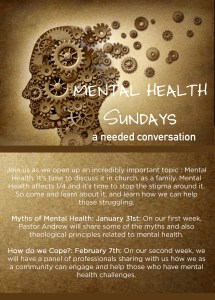 On Sunday we are going to be continuing our conversation about mental health. This is a conversation that needs to be continued if we are going to break the stigma and exclusion surrounding it.
 On Sunday we opened up a really important topic: mental health. Mental health is someone that affects huge numbers of people (estimates are around ¼ of people), yet it is one health challenge that has tremendous stigma, exclusion, and a lack of understanding surrounding it. And that’s something we want to change.
 { Andrew Mills }