Blog

What is Faith?

1264648_14417319This Sunday we are looking at the topic of faith. And we want to peel back some of the misconceptions about faith. Because the most common answer to “What is faith” is: belief.

But I don’t think that answer is helpful, healthy, or even all that biblical.

  • Because if faith is belief – what happens to it when you doubt?
  • Because if faith is belief – what happens if you believe the wrong things, or have been taught the wrong things?
  • Because if faith is belief – does it matter how you act as long as you believe?

These are some of the difficulties with “faith as belief”

So that’s what we want to explore and clear up on Sunday, by looking at Hebrews 11. Hebrews 11 is the classic chapter on faith, but it presents a different view of faith that differs from “faith as belief”

So that’s where we are going, but before we get there why not read Hebrews 11 yourself. It’s a great chapter, and it’s one that not only is about faith, but asks us to put our faith into practice. Which as it will turn out, is what faith is all about.

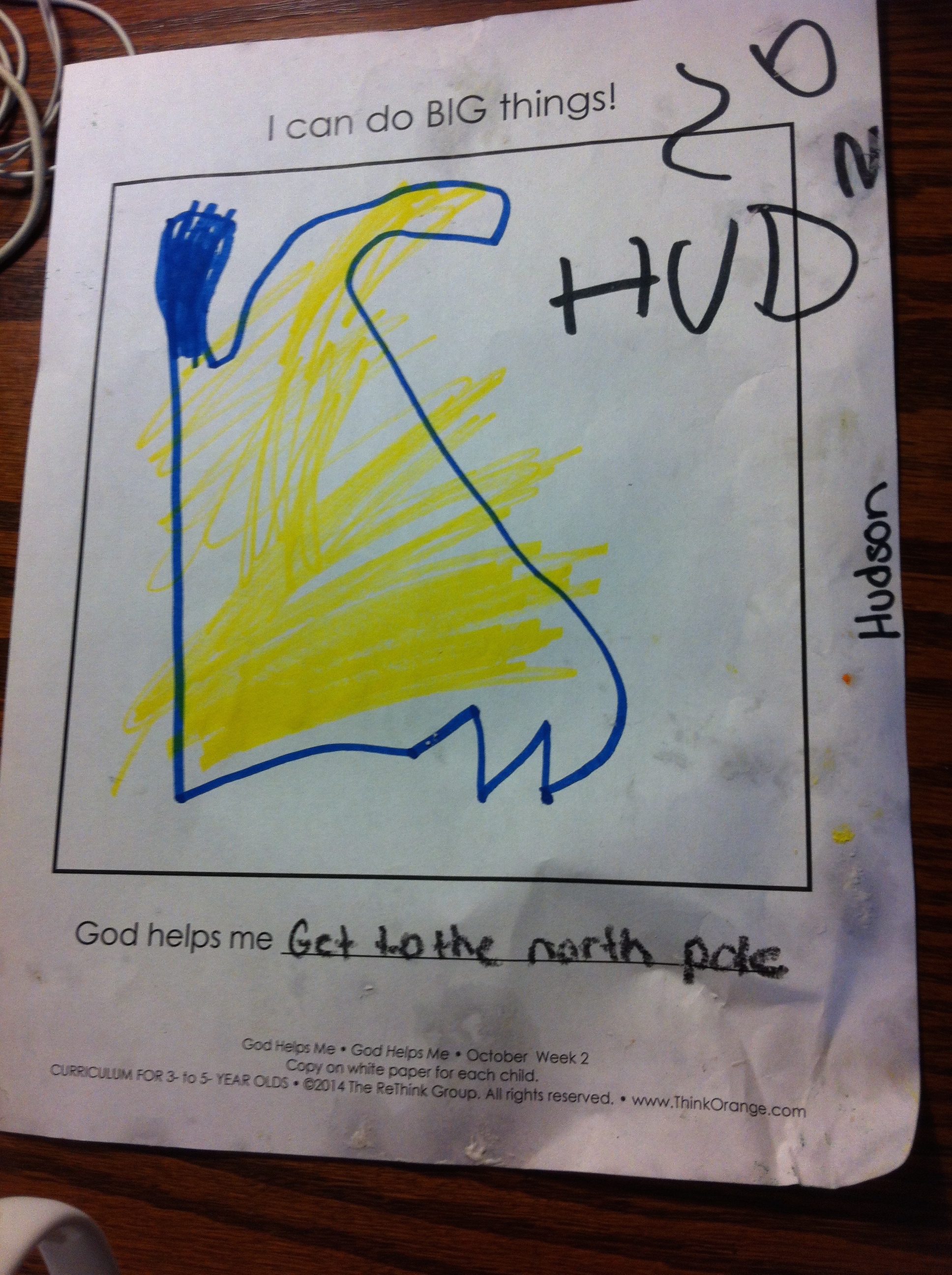
“God helps me get to the North Pole” : Theology from a 4 year Old

IMG_4512Today I’d like to share the work of my 4 year old.

Now I’m not sharing his work because he is an amazing artist, or because I want to sell his work or anything (although you’re welcome to buy it).

I share it because of something he had written at the bottom of the page.

God helps, “Get to the North Pole”

Now at first glance that is a very silly thing to say. It seems just like the type of thing a 4 year old would say. Except that this is actually a very deep theological statement, it’s just said in “Hudsonese”.

The past few weeks Hudson keeps talking about his grandpa, my dad, who died when he was just a few months old. He keeps talking about how he misses grandpa and wants to see him. So he asked where grandpa is, and I told him “Grandpa is in heaven”.

And because he’s 4 he had lots of follow up questions, “Is heaven far? Can we drive there and see Grandpa? Is it farther than Caleb’s house? Why can’t we see grandpa?”

And lastly, “How do we get there?”

We talked about this and the point he got was that God, because his love is so strong, can take us to heaven. And that heaven is far away, like the North Pole.

So when Hudson says God can help us get to the North Pole, it’s a comment on the power of God. That God is able to get us places we couldn’t get on our own. That the love of God is strong enough to draw us to heaven, and to bring heaven here. That God’s loving power is enough to do amazing things: like get us to heaven, bring reconciliation, cause resurrection, bring healing, bring hope, bring transformation, and of course, get us to the North Pole. 

While you might not see the phrase, “God helps me get to the North Pole” in any theology textbooks, it’s still a true statement. And may that statement give you hope today, just like it gives Hudson hope. That God’s love, power, and strength can change lives – and apparently get you to the North Pole.

Blood, Sacrifice, and Atonement ~ What’s it all mean?

1395375_73215192So on Sunday we began to explore this whole idea of sacrifice and what it means. The text we worked through was Hebrews 9. But before we could work through the text we needed to learn the context: how sacrifice functioned prior to Jesus, why sacrifice was needed, and what the Bible’s goal with sacrifice is.

The primary function of sacrifice in the Old Testament was to deal with the problem of sin and broken relationships. A whole system was created to ensure cleansing, forgiveness, and the assurance of peace. This was the role of sacrifice. You could offer a sacrifice, gain peace of mind, and assurance of forgiveness. That’s why it was needed and that’s why it was important. But in many ways the system didn’t fully work because the sacrifice of an animal couldn’t bring lasting peace or forgiveness. It simply wasn’t perfect or complete enough.

Fast forward to Jesus and Hebrews 9, and we have the author making an argument that Jesus is both a deeper and different sacrifice than what was used to. That while Jesus’ sacrifice brings peace and assurance of forgiveness of sins, like previous sacrifices, his is of a different kind.

Prior to Jesus we would offer a sacrifice to God to gain assurance of forgiveness. Now with Jesus, God offers a sacrifice of himself to assure us we are forgiven. This is a radical twist that actually ends sacrifice.

We can now be assured that God loves us, forgives us, and accepts us because of the death and resurrection of Jesus. We kill Jesus because of our sin (anger, vengeance, envy, fear, etc), and yet God still forgives us. Some of Jesus’ last words are “Father forgive them”, and his first words are peace. So if we can kill God’s only son, and his posture to us is still forgiveness and peace, what worse could we possibly do? 

If we kill him, and his response is to love us we no longer never need to doubt his love. We now no longer need to doubt or worry about God’s disposition towards us. We no longer need to offer sacrifices to God because Jesus has sacrificed himself to prove his love to us. Jesus’ death proves God is willing to welcome all of us because we all killed Jesus through our propensity to sin, scapegoat, and hurt.

Of course, there is so much more to unpack, but to do that just listen to the sermon.

But the main idea was this: Jesus’ death ends all sacrifice, assuring us of our forgiveness. And this is a beautiful thing. You can be accepted, you can be forgiven, you can be freed – and there is nothing you need to do. Jesus’ sacrifice does it for us.

So we ended the sermon with a simple challenge. Rest in Jesus’ sacrifice, that it covers everything, that it is enough. That means we don’t need to fear God because Jesus has given everything to prove God’s love for us. That means we can hope because we know that God’s stance towards us is open and welcoming. That means that we don’t need to be defined by sin, because we did our worst, and God did what he does best: resurrection. So we can live differently because sin and evil doesn’t get the last word.

The point is that Jesus’ sacrifice is important because it ends sacrifice, and assures us of forgiveness. And that’s a beautiful thing.


Sermon Notes:

Big Idea: Jesus’ death ends all sacrifice, assuring us of our forgiveness

Teaching Points:

  • Just because something is difficult doesn’t mean it can’t be life changing
  • Sacrifice brought peace and assurance of forgiveness.
  • The trajectory of the Bible is to limit, reduce, and abolish sacrifice.
  • The blood of Jesus is better and more complete sacrifice
  • Jesus’ sacrifice wasn’t limited, and proves God’s mercy isn’t limited
  • We killed Jesus, and he offers us forgiveness and peace.
  • Jesus’ death ends all sacrifice, assuring us of our forgiveness

Adult Discussion Questions:

What stuck out to you from the sermon? What was challenging to you? How did God speak to you through it? What was new? Were there parts that were confusing? What do you think was meant? Did you see sacrifice as beautiful, barbaric, or unnecessary before today’s sermon? What do you think of sacrifice now? Read over Hebrews 9 again and share with one another what gives you hope, assurance, of excitement in this passage. Are there portions you still don’t fully grasp? Which parts? Who can help you to understand them deeper?

Challenge for the Week: Accept and rest in Jesus’ sacrifice.

Talking about blood…

1327575_43238568On Sunday I want to talk a little about something that we think we’ve mostly grown beyond: sacrifice.

The truth is the language and theme of sacrifice pervades the Bible. It’s a part of the Old Testament with animal sacrifices, blood, and rituals and regulations. It’s also a part of the New Testament with discussions surrounding Jesus as our sacrifice.

But what isn’t as recognized is how sacrifice still functions and is a part of our world. We often think of sacrifice for back then but not for today. But sacrifices are still as much a part of our world, as it was a part of theirs; it’s just less visible.

Just look at the big movies and how they are centred on the theme of sacrifice: everything from the Hunger Games, to Lord of the Rings, to even the Avengers or Guardians of the Galaxy. There is a recurring theme of someone’s sacrifice bringing someone else peace and life. So while we might not practice animal sacrifice we still live in a world full of sacrifice.

And this is what I want to examine on Sunday specifically. What is sacrifice? How does it function? And most specifically, why is Jesus’ death and sacrifice different?

So that’s where we are headed. We’re pulling back the veil on sacrifice to talk about how it works in our lives. But while we are moving there why not just pay attention for the next few days how frequent sacrifice still lives and moves in our world.

  • Watch for how we scapegoat and sacrifice others for our good. Like when we think “If only “they” weren’t around, things would be better… “
  • Watch for how often video games, movies, or TV shows regularly use sacrifice as a driving motif.
  • Watch for how when someone gives of themselves we gain life

Sacrifice might not be well understood in our world, but it is alive and well.

Families aren’t born, but built.

10378542_10154825254920643_1753291384688482808_nIn the past two weeks, in my family we’ve had two deaths, and two funerals in a week. I lost my grandma, and my wife lost her grandfather.

I use that language in a specific way of “lost” in a specific sense. We, of course, haven’t actually “lost” them, as if we don’t know where they are. Both of them are with Jesus without a shadow of doubt. But their being with Jesus is a “loss” for us because we love and miss them.

And as I think about them both I’ve come to realize something important that they both lived out. Both my grandma, and Krista’s grandfather lived in a way that was unique. They both realized that family isn’t something you are born into, family is something you build.

Think about that for a moment, because it’s true, but it’s something we forget.

Families aren’t born, but built.

And both my grandma and Krista’s grandfather got this. They invested in their families, they welcomed new people into the family, and toiled at building a family that lasts and matters. And as I look upon their legacy, I’m reminded that they have a legacy because they built into their families. They didn’t just talk about love, or take family for granted, they invested in it, fostered in it, and created it. And I think this matters.

So I’ve been thinking a lot about my own life in relation to this. Am I building my family, or taking it for granted? Am I investing in my relationships, or coasting? Because building a family takes effort, it takes time, and it will last beyond a life-time if you do it well.

There are many things that push and pull for our attention: deadlines, obligations, and expectations. But what I’ve been reminded of these past few weeks is that what really matters is building family and friendships. Deadlines, work, and obligations will come and go, but family and friendships can last for lifetimes if we build them well.

So my challenge to all of you is simple: build family and friendships well. Because as grandpa always said, “listen to the wisdom of those older”. And some of the wisdom I’ve learned from both my grandma, and Krista’s grandpa is that family is built, not something you are just born into.

What is the New Covenant?

1354509_52789131On Sunday we looked at the language of priests and covenants in Hebrews. We began by noticing something interesting: that to be a priest in the Mosaic covenant you had to come from the line of Levi. But Jesus wasn’t born into the tribe of Levi, but the tribe of Judah. Deuteronomy 18:22 makes it clear that in that covenant priests must come from the line of Levi. So what does all this bloodline talk mean? (This is all worked out in Hebrews 7, and 8)

Well what it means is that with the shift in bloodlines is also a shift in covenant. Jesus isn’t a priest in the covenant, discussed in Deuteronomy; he has instituted a new covenant. And this shift makes all the difference.

In the Old Covenant, sin continued, and sacrifices needed to continually be offered. The cycle of sin, guilt, sacrifice didn’t ever stop. But with a new covenant a new way of living became possible. This new covenant was prophesied in the Hebrews Bible in Jeremiah 31, and is quoted in Hebrews 8, and comes to reality in the person of Jesus.

Jesus is the new high priest, in a new covenant, that functions differently.

And this “functioning differently” is key.

Because with Jesus there is one sacrifice that covers all our sin. That was offered once and for all. That means that all the failings, falterings, and sin that you and I have committed, can commit, or will commit is covered. Jesus’ sacrifice is greater than your sin, my sin, and the sin of the whole world. So we no longer need to have that cycle of sin, to carry guilt, or to carry any shame.

As Hebrews 10:1-2 says “The old system under the law of Moses was only a shadow, a dim preview of the good things to come, not the good things themselves. The sacrifices under that system were repeated again and again, year after year, but they were never able to provide perfect cleansing for those who came to worship.  If they could have provided perfect cleansing, the sacrifices would have stopped, for the worshippers would have been purified once for all time, and their feelings of guilt would have disappeared.

But now we have a perfect sacrifice that can cover all our sin and our feelings of guilt. We can live differently because we have been made different.

And this is why that matters.

Because now, “we can boldly enter heaven’s Most Holy Place because of the blood of Jesus. By his death, Jesus opened a new and life-giving way through the curtain into the Most Holy Place. And since we have a great High Priest who rules over God’s house, let us go right into the presence of God with sincere hearts fully trusting him. For our guilty consciences have been sprinkled with Christ’s blood to make us clean, and our bodies have been washed with pure water. (Hebrews 10:19-22)

So you can boldly go to God without feelings of guilt, shame, or trying to earn his approval with your behavior or sacrifices. We can go boldly to God because of what Jesus Christ has done. And this is good news.

So we ended with the challenge that if we have this high priest, this covenant, and this all-encompassing sacrifice to go boldly into God’s presence this week. Because we can, not because of what we have done, but what Jesus has done.


Sermon Notes:

Big Idea: We have a new high priest, covenant, and way to live.

Teaching Points:

  • A covenant is a binding agreement and relationship between two parties.
  • The priests were the representatives of the people and themselves with God dealing with the problem of sin.
  • Jesus isn’t a priest in the Mosaic Covenant sense.
  • For the law made nothing perfect.
  • Jesus is a new high priest, in a new covenant, in the line of Melchizedek.
  • We can go boldly into God’s presence.

Adult Discussion Questions:

What stuck out to you from the sermon? What was challenging to you? How did God speak to you through it? What was new?

Was this discussion of Old and New Covenant’s – new to you? How does this new covenant give you new hope? Read the passage from Hebrews 10:19-25. What stands out to you most? What gives you the most excitement? Are there any areas of you life where you are living under the “old covenant”? Are there any lingering feelings of guilt or shame that you should ask Jesus to free you from? How can you boldly go into God’s presence this week?

Discussion Question for Families:

Instead of talking to your kids about today’s topic – why not experience it a bit. Have your kids paint, or write some things they struggle with on a piece of paper. Then take some paint and paint over their struggles with all sorts of colors and make a beautiful picture. Talk to them about how Jesus covers over our sins, so that we can be made beautiful to God and how he loves to do that for us.

Challenge for the Week: Go boldly into God’s presence this week.

New Language: Priests, Sacrifices, and Covenants

1271462_95663567On Sunday I want to talk a little bit about something that seems kind of not relevant to our lives but really is. I want to talk about priests, sacrifices, covenants, and bloodlines.

In all honesty, many times when we come across these themes in the Bible we see them as out-of-date, old fashioned, sometimes maybe barbaric even. But the truth is when we peel back some of the language, context, and understanding they can become beautiful and freeing.

Because even though today we don’t offer animal sacrifices that were offered in the Hebrew Bible, we still are caught up in some of the same cycles. We struggle with cycles of sin and seeking atonement or forgiveness. We might not use sacrifices of animals to find peace or atonement but we do use other sacrifices: prayer, confession, trying harder, making promises, and all sorts of things. But often these sacrifices still leave us locked in a cycle we can’t break out of: fail and sin, feel shame, guilt, confess and sacrifice somehow, and repeat.

We might not regularly sacrifice animals to find forgiveness but it is something we need. We need a new way to live, not stuck in cycles of sin, self-righteousness, or shame. And that’s what we are looking at on Sunday. And it won’t come as a surprise how we find that freedom and forgiveness: it’s in Jesus.

So that’s where we’re headed but before we get there, why not do a bit of reading and prepping on your own. Read Hebrews 8, 9, and 10: that’s where we will be really focusing on Sunday. And then why not spend some time thinking if there are any cycles you need freedom from. Is there a sense of guilt that lingers, a sin that keeps creeping in, or a hurt that lasts? And if so, come Sunday we are going to find how Jesus changes all of that.

Contract Christianity

251732_4297I want to try to briefly discuss something that affects and infects our following of Jesus, especially in North America. It’s something I call “Contract Christianity”. This is where following Jesus is reduced really to a contract: we pray a prayer, and Jesus gets us into heaven.

And I think all of us know that praying a prayer to Jesus, just to go to heaven misses the heart of what following Jesus is about. It’s a truncated gospel. But what we sometimes miss is how this still infects our Christianity. We see following Jesus then in terms of a contract of what we do for him, and then what he does for us. We also then focus on what “breaks” the contract like the fine print in a legal contract. And this leads to all sorts of questions and comments that are in the wrong direction. Ones I get all the time in different ways about sin, church, and faith vs. works. Ones like this:

  • At what point will someone lose their salvation? How much can I sin and God still forgive me? I’ll still get to heaven if I don’t tithe right, or do everything?
  • It doesn’t matter if I go to church or not right? I can follow Jesus on my own, it’s a personal relationship right? Why can’t I just pray to Jesus and let that be that?
  • I prayed the prayer, isn’t that enough? why do I need to love others? Isn’t  it enough that I come to church, why do I need to change these actions?

But following Jesus is not a contract, it’s a covenant. So yes, it is not less than a contract, but a covenant is so much more than a contract. It’s a commitment for a lifetime based in relationship, not contractually binding arguments.

And if we ask the same type of questions above, in terms of a covenant relationship they quickly don’t make any sense. So let’s put those above questions in terms of the only covenant we have left really, marriage. And just see how much they miss the point.

Here are the same questions put in terms of a marriage.

  • How far can I go with another person, before it’s called cheating? Where is the line exactly? What can I do before you divorce me?
  • Why do I have to spend time with my spouse and family? We live together isn’t that enough?
  • I promised to love you and marry you, isn’t that enough? What do my actions have to do with it?

When these questions are put in the context of covenant they don’t make any sense. No one truly commits to a marriage thinking about how much they can get away with, or not wanting to spend time together, or not showing their love. But for some reason we do this with Jesus. We ask questions about what we can get away with while still following Jesus (sin questions). We ask questions about why we need to commit to Jesus’ family and gathering together (church questions). We ask questions about whether our faith really needs to change our actions or whether we are still “saved”.

This is all contract Christianity, not covenant Christianity. Because as soon as you start thinking about following Jesus in terms of a covenant none of those questions make any sense. If you are committing to follow Jesus for the rest of your life, you’re not interested in what you can get away with (sin). If you are covenanting with Jesus, spending time with him and his family (church) makes absolute sense. If you are being a disciple of his, having faith in him naturally flows out with showing it. (action / works)

So all that to say is that I think we need to regain the sense of following Jesus as a covenant and not just as a contract. We follow Jesus with our whole lives, not just what happens after our lives have ended. The point is that following Jesus is to change how we live now, which will last into eternity. And I think if there is one thing in Christianity we need to regain, it’s a sense of covenant because it matters and it’s beautiful.

What’s The Language of God?

On Sunday we started our series on Hebrews, looking at it through the lens of language. Because Hebrews has some really interesting language to it. It has the language of the Son, sacrifice, priests, and faith. And even though, for many of us, a lot of this language is far from our context, it can be life-changing to learn it.

So we began by looking at how God’s language is Son. That’s actually what the first few verses of Hebrews share. It tells us how Jesus is the perfect and exact representation of God. Jesus reveals who God is perfectly. It says this:

Long ago God spoke many times and in many ways to our ancestors through the prophets. And now in these final days, he has spoken to us through his Son…The Son radiates God’s own glory and expresses the very character of God, and he sustains everything by the mighty power of his command.

That verse where it says that now God has spoken to us through his Son, it literally reads “God has spoken Son”. Jesus doesn’t just share the words of God, but is the Word of God. And this has some huge implications for us.

First, it means that God is actually “Jesusy”. If Jesus is the perfect revelation of God, then Jesus isn’t just like God – God is like Jesus. God is Jesusy. If we want to know who God is, we now look to Jesus. Jesus is the complete, perfect, and full revelation of who God is. So if we want to know what God is like, what God cares about, and how God acts – we look to Jesus. Jesus then becomes the centrepoint of our faith, our interpretation of the Bible, and the lens we look at everything through. God is Jesusy.

The second thing is that we then know a few things about God. God then has to be at least as nice as Jesus. If Jesus reveals God, then we cannot have a divided God with the Father being  mean and Jesus being nice. Jesus reveals God perfectly, so God is at least as nice as Jesus. We also then know that God cares for us because of the actions of Jesus.

The main point is that Jesus is the language of God. Jesus is the way we know God, and the way we learn about who God is. Jesus is the reason we know that God is loving, that he isn’t vindictive or capricious. Jesus is the reason we know God is worth following!

So I ended with a simple but clear challenge. If Jesus is the language of God, we need to get to know Jesus. The only way our view of God stays true is when we focus in on Jesus Christ. So this week I said get to know Jesus deeper. Read the gospels, pray, and worship him. If Jesus is the language of God, then it’s worth learning that language.


Sermon Notes:

Big Idea: Jesus is the language of God.

Teaching Points:

  • Language can shape, direct, and expand or limit our thoughts.
  • The language of Hebrews: Son, Sacrifice, Priests, and Faith
  • Has God changed between the Old and the New?
  • Our understanding of who God is has grown with the coming of Jesus.
  • Jesus does not speak God’s words, He is God’s Word.
  • Jesus Christ not only speaks for God, He is God, and reveals God.
  • God is Jesusy.
  • The only way our view of God stays true is when we focus in on Jesus Christ
  • God has to be at least a nice as Jesus.
  • Jesus is the creative language of God.
  • We can be sure that God loves us, and knows us
  • When you get to know Jesus you get to know God

Adult Discussion Questions:

What stuck out to you from the sermon? What was challenging to you? How did God speak to you through it? What was new?

Have you ever had a bad experience with church? Have you ever had a beautiful experience with church? Why or why not do you think being a part of a community of believers matters? How might you more deeply commit, and participate in church? What next steps can you take?

Discussion Question for Families:

Talk to you kids about the importance of community. Ask them who other than you as their parents, are adults that they really respect. Ask them why, and then think about how you might have them invest more in your kids, because raising kids takes a community.

Challenge for the Week: Commit and participate in a church, to transform lives.

The Language of Hebrews

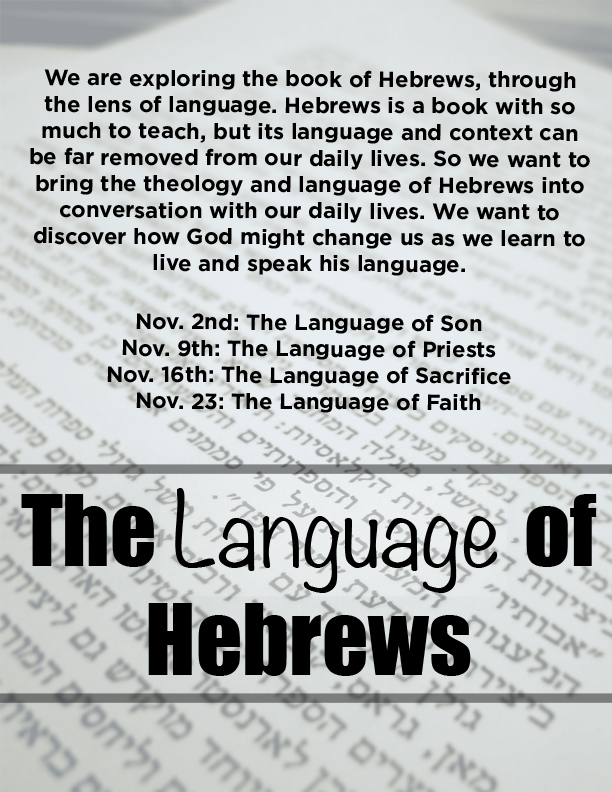
On Sunday we are starting a brand new series on the book of Hebrews. This is probably one of the most neglected books of the New Testament because a lot of its context is far from ours. We don’t know what to quite do with the language of blood, goats, sacrifice, and covenant. But we hope to change some of that through this series: that we might learn the language of Hebrews and through that grow deeper with God.

Language of Hebrews