
Rethinking Evangelism

evangelism.png

Today, I want to dive into something that is both obvious, but also crucial for sharing Jesus. And, it surrounds two facts…

1) I believe that Jesus Christ is absolutely worth sharing with others.

2) Our culture has shifted and changed, so where that sharing starts needs to change.

And, here is what I mean by this…

Decades ago, there was a lingering “Christian” consciousness in our culture. What this was often called, in more academic studies, was “Christendom.” What this meant was that purely by being born into Canada, the United States or England, etc., you were raised with, at the very least, a basic understanding of Christianity, and perhaps even shared certain Christian values. Of course, people were free to reject Christianity or to disagree, but, in general, there was a familiarity with Christianity.

If you were to graph it in terms of (a) meaning “zero understanding or readiness to accept the Gospel” to (z) meaning “deciding to follow Jesus,” people were simply closer to where the “x” is below, being ready to follow Jesus because of the cultural familiarity.

(a) ————————————————x——— (z)

My dad would often tell me that when he was growing up in high school, everyone in his grade 13 class went to Sunday School. And, this was just north of Toronto. That is no longer the case because our culture has shifted.

Today, people are far less likely to have a base knowledge, or any knowledge, of what Christianity is or why it matters. Today, on the same graph, our culture might be better represented as this…

(a) ——–x————————————————- (z)

After a sermon recently, I had a new guest share with me that they really liked my “TED Talk.” This is because they had never seen or experienced what a sermon is, since this is no longer something of which we are culturally familiar.

I bring all this up to say something radically obvious: If it’s a different culture, we need a different approach. Since people no longer have a cultural understanding of Christianity, what worked decades ago won’t work today.

In previous generations, the primary approach was to tell people about Jesus and then bring them to church. And, while there is nothing inherently wrong with this, I believe our starting place has changed, so we need to change.

We need to demonstrate the love of Jesus and bring the church to them. We need to reach out and share the love of God in tangible ways, being the people of God (the church) to those around us. And, this may take a while, because people are in a different place.

So, when it comes to sharing Jesus, I think the starting place has shifted. I think it now begins with demonstrating the love of Jesus, so that we can share about Jesus. I believe that the way we will see people be changed by Jesus isn’t to just invite them to church (although, that’s a good thing!). We also need to faithfully love those around us over the long haul. That’s the new starting place.

 

The Small Sins Matter Most

smallsins.pngHave you ever noticed that the “church” loves to pay attention to the “big sins”? Do you know what I’m talking about? How online, in the news and in the pews, people love to call out people for the “big sins”? Of course, what counts as a “big sin” changes with the times, but it’s often and usually a sexual sin of some sort.


Now, obviously “big sins” are sins that matter and need to be rooted out. And, even that classification of “big sins” and “little sins” is problematic, but I think you get what I mean.
The reasons we love to focus on “big sins” isn’t because we are “standing up for truth,” but instead we are guided by judgment, pride and sin itself. (see Paul’s exposition on this at the beginning of Romans 2)

While there is a lot to unpack in that previous paragraph, I want to look at something else. I’d like to focus in on how we shouldn’t be focusing in on the “big sins,” but rather the “little sins.”

Because, what so many deep, wise and mature Christians have shared throughout the centuries is that our temptation to look at other people’s sins obscures us from what we should be doing, which is rooting out sin in our lives.

When we are busy looking at other people, we are neglecting the myriad of ways we neglect God daily.

The truth is, if we pay attention to the “small sins” in our lives, then they won’t lead to the “big sins.” Most often, really disastrous choices are made with a bunch of small, poor choices first.

Mechthild of Magdeburg, a 13th century mystic, writes this…

“What hinders spiritual people most of all from complete perfection is that they pay so little attention to small sins. I tell you in truth: when I hold back a smile which would harm no one, or have a sourness in my heart which I tell to no one, or feel some impatience with my own pain, then my soul become so dark and my heart so cold that I must weep greatly and lament pitiably and yearn greatly and humbly confess all my lack of virtue.”

Do you see how practical that is? How everyday that is? That we need to be paying attention to our smiles, our bits of sourness and our impatience because that can turn our hearts cold and dark.

Mechthild’s point is that if we ignore those moments, we can never move toward spiritual completion, and focusing on other people’s “big sins” just misses the point. Instead, we need to reflect and act on the little ways we disengage from God and others throughout the day.

So, I write all this as a reminder that while our world loves to focus on the “big sins,” our Saviour reminds us to focus on our own planks, junk and sin that loves to hide in the everyday moments of life.

And, that’s the starting place to really walking and following with Jesus: Looking at Him and our own lives, not at others.


The Most Underrated Spiritual Gift

hospitality.png

Here is what I believe: Those who are hospitable in our world will change our world; those who aren’t will become isolated and ineffective. 

I know I’ve written on hospitality before, but I simply believe this is the single more important posture and attitude we need to have in our current world.

Our current world and culture is polarized – it is divisive, it is angry, it is full of posturing and pride. Our current culture is deficiently lacking in listening, and this is also true in the church of North America.

And, this is why I believe we need hospitality more than ever.

Because, in its core, hospitality isn’t about just opening your house to someone, but instead having a posture of openness with everyone. It’s about having an attitude that welcomes those who are different than you. It’s about having a heart that is inclusive of people across all the lines that tend to divide us: Politics, race, class, finances, geography, gender, anything really.

Henri Nouwen put it this way:

“When hostility is converted into hospitality, then fearful strangers can becomes guests… [and] guest and host can reveal their most precious gifts and bring new life to others. … The term hospitality should not be limited to its literal sense of receiving a stranger in our house, but as a fundamental attitude toward our fellow human being, which can be expressed in a great variety of ways.”

This type of attitude is needed, because this kind of attitude is Godly. This kind of attitude is Christ-like. This kind of attitude isn’t optional for Christians, because it’s practiced by our Lord and Saviour.

Jesus was radically open and inclusive to those around Him. He was hospitable to those on the margins and different from others. And, in so many places in His life, He demonstrated this. Everything from the parable of the Good Samaritan and his practicing of hospitality, to Jesus’ death and resurrection at which He welcomes in all of us who are sinful and broken.

Hospitality is a central theme and behaviour of Jesus, so, as His followers, it needs to be part of ours as well. Because, you can’t love those to whom you close yourself off, and Jesus is clear, we need to love others.

Here is the beautiful things about hospitality: When we practice it, it will shine like a city on hill, because it is so counter-cultural. Our culture is filled with hate, divisions, binaries and polarizing sides.

What if we practiced a different way? What if we had a posture and attitude of welcoming? What if we invited people who are different than us into conversation, connection and true friendship? What if we put this into practice?

While I don’t know all the specifics of what would happen, what I do know is that the world around us would be better, because it would be more Christ-like.

Getting Rid of Your “Spiritual Life” : Otherwise Known as Unifying Your Life

improve

Today, I want to write about something counter-intuitive: to improve your spiritual life, you need to stop focusing on your spiritual life.

And, here is what I mean by that…

When we talk about our “spiritual life,” we often mean things like serving, reading our Bible, going to church, having a quiet time in the morning and so on. In essence, we have a list of things that are “spiritual” and try to do them more or deeper.

But, if you’ve ever tried this, it honestly doesn’t often work all that well. It might help for a little bit, but often quickly sputters out. And, I think the reason it doesn’t work is because we’ve bought into a lie that there is something called “our spiritual life.”

But, there is no such thing as a “spiritual life” – there is just life!

Because, in the Bible, things aren’t split up into two categories: spiritual and real life. It’s all one. The Bible doesn’t split our lives up into spiritual and non-spiritual, but when we do, we run into problems.

Because here is the thing: your “spiritual life” will never improve while you ignore the rest of your life. God isn’t interested in just your prayer time and Bible reading plans; He’s interested in all of you and your entire life. How you treat your co-workers matters just as much as attending church. The things you purchase matter just as much as your Bible knowledge. Your forgiveness toward those who have hurt you matters just as much as you serving in kid’s ministry.

Are you seeing the point?

If we want to improve our “spiritual life,” we need to improve all of our lives as a whole. We need to not just focus on reading the Bible more, but living it out in each and every moment. Mondays through Saturdays matter just as much as Sundays. We can’t live divided lives and then expect to grow.

Thomas Merton puts it this way, “If you want to have a spiritual life, you must unify your life.”

You can’t have a spiritual life; you can only have a whole life.

Now, of course, reading your Bible, Sundays, church, serving and prayer all matter immensely. But, the rest of our lives matter too. When we miss that fact, we will get stuck.

So, this week, focus not just on your spiritual life, but on living and responding to God in every aspect of your life. When you start to value each aspect of your life, you might find that God is a part of it all, and that all of it is spiritual.

Celebrating the Right Decisions, not Just Disciplining the Wrong

Hudson Sweeping Driveway WORDS.pngHere is the truth about me and my parenting: I am far more likely to try to correct bad behaviour than to really praise good behaviour. And, what I mean by that is I tend to focus in on correcting poor behaviour and, while I’ll appreciate good behaviour, I can forget to really celebrate it.


Of course, it matters to correct bad choices, but what about encouraging good decisions? This is something I want to change in my life. I don’t want all my efforts going into course-correcting bad decisions, but rather I want to celebrate and really encourage my kids when they make the right decision.

The other day, we had a chance to practice this. I came home and found something totally unexpected. I drove in our driveway to find Hudson sweeping my neighbour’s driveway with her chatting away with him. Apparently, he was playing outside, saw her sweeping her driveway, got a broom and went over there on his own to help. He just took the initiative and acted.

When I went over to see him, Hudson told me why he was helping her. He said, “Dad we help our neighbours. That’s what we do, right?” Which I agreed to, and then he said, “Also Dad, she needs help. She is O-L-D.” (Hudson spelled it out loud because apparently he thinks older people can’t spell, and this, of course, was the way to share that fact sensitively. Now our neighbour is quite a bit older than we are. In fact, her kids are all retired along with her. So, different life stage).

But, here is why I mention this story: This was an opportunity to celebrate a really great decision. A chance not to just say, “I’m proud of you,” or “Great job Hudson!” but an opportunity to really show him that I was proud of him. To celebrate this, I got him his favourite donut from Tim Hortons, and we shared his donut while I shared why I was proud of him. For sure, this is a little thing, but it made a huge difference for Hudson.

I write all this to remind us all of one thing: What if you celebrated someone’s good decision, rather than just complaining or trying to correct their bad decisions? What if we put some effort into really encouraging, thanking and appreciating the surprising and unexpected good decisions that happen around us? Because, what I think might just happen is we might see more good decisions happen.

So, I’m learning to celebrate the great little decisions that happen each day. Because, I don’t want my kids to just not do bad things. I also want them to do the right things.

Creating Space for Change

hospitality blog

I think that hospitality is probably the most undervalued, but necessary gifts in the Christian world. Hospitality is to create inviting spaces where people feel safe, welcome and loved. And, there is nothing more needed in our current world than safe places for relationships to be created and cultivated.

Henri Nouwen writes: “Hospitality is not to change people, but to offer them space where change can take place.”

I think this is so true, and that’s what we can be doing in our world – creating safe spaces for conversation and connection; creating loving spaces for relationships and motivation; creating holy spaces for God to do the work of transformation.

So, do want to do something holy, beautiful and life-changing? Why not invite someone over, create a safe place and just see what happens.

What is God really Like?

whatisgodlike.png

This is a question people often ask: What is God really like?

And, often when push comes to shove, even though we hear of God’s grace and love, we often fall back on a view of God as primarily angry, wrathful and vengeful. This idea of God as full of rage and wrath lingers in our theology, and it nags at the back of our minds.

Which is why I think we need to get something crystal clear: God looks exactly like Jesus.

Or, putting it another way, Jesus fully and absolutely reveals God. And what Jesus reveals isn’t a God full or rage and anger, but a God full of love. This is what is seen pre-eminently on the cross. Here Jesus doesn’t punish and exact vengeance on others, but takes on our punishment and what we rightfully deserve.

So what Jesus reveals is that at God’s core is love, even when we are tempted to believe its something else.

And, if this sounds, well, controversial or a little worrisome to you, that itself highlights the issue. We have been so influenced by a view of God that doesn’t look like Jesus, that we need to regain the only orthodox view of God that there is: Jesus fully reveals God.

Thomas Torrance puts it this way…

“Is God really like Jesus? Questions like that gnaw at the back of people’s minds but which they suppress and which come to the surface only in moments of sharp crisis and hurt, tell us of the insidious damage done to people’s faith by dualist habits of thought which drive a wedge between Jesus and God.

“Fearful anxiety arises in the human hearts when people cannot connect Jesus up in their faith or understanding with the ultimate Being of God, for then the ultimate Being of God can be to them only a dark, inscrutable, arbitrary Deity whom they inevitably think of with terror for their guilty conscience and makes them paint harsh, angry streaks upon his face.

“It is quite different when the face of Jesus is identical with the face of God.”

And, I think that’s true. Our view of God is not only better, but truer and more whole when the face of Jesus is identical with the face of God.

So, today I write this as both a challenge and invitation: A challenge to see God as identical with Jesus, and an invitation to change your view of God so that it looks completely like Jesus. Because, the Father doesn’t have harsh, angry or rage filled streaks on his face. His face is identical to Jesus, streaked with tears and love.

The Problem Inside All of Us

probleminside.png

I was reading the other day, as I often do, and the following quote made me stop completely. I actually couldn’t read any more for the rest of the day.

“How can we Christians claim to proclaim atoning reconciliation through the cross of Christ when we contradict it by refusing to be reconciled with one another, or to allow reconciliation through the body and blood of the Saviour to be translated into our Church divisions.” – Thomas Torrance

Read it again, if it didn’t stop you the first time.

Torrance’s point is for us to examine how we can proclaim that God reconciles us to Himself when we refuse to practice that with each other. How can we hold onto our divisions, debate and disagreements when Christ died to bring us together? How can we share the good news of reconciliation when we refuse to give up our inner Church disputes and divisions?

The easy (and preachy) thing to do would be to call out all the pastors who continue to divide over silly things. The easy thing to do would be to call out all the Christians who continue to hate one another and not forgive. The easy thing to do is to get on a soapbox and slam all of you who continue to hold onto grudges and divisions, and ignore the fact that Christ brought us together.

That would be easier, but not godly.

Because, the truth is, I struggle with holding onto bitterness and grudges sometimes. The truth is, I think my theology is obvious and right, whereas others is misguided at best and stupid at worst. The reason this quote stopped me isn’t because it highlighted the problems in the Church (although it does that); it’s that it highlighted the problems in me…

  • That I would rather divide than work through things.
  • That it’s easier to be right instead of reconciled.
  • That sometimes I love my theology, my perspective and my opinions more than other’s.

Torrance’s point reminded me that I’m part of the problem. That the church’s tendency to place personal opinions, past hurts or theological preferences above people is a problem. Jesus died to reconcile us together, and we shouldn’t contradict it by refusing to reconcile with others.

So, this post isn’t meant to point out anything wrong in anyone else, rather it’s meant to remind us that often the problem isn’t with “out there,” but “inside us.” And, that’s why I stopped reading. Because I realized I had some things to work on.


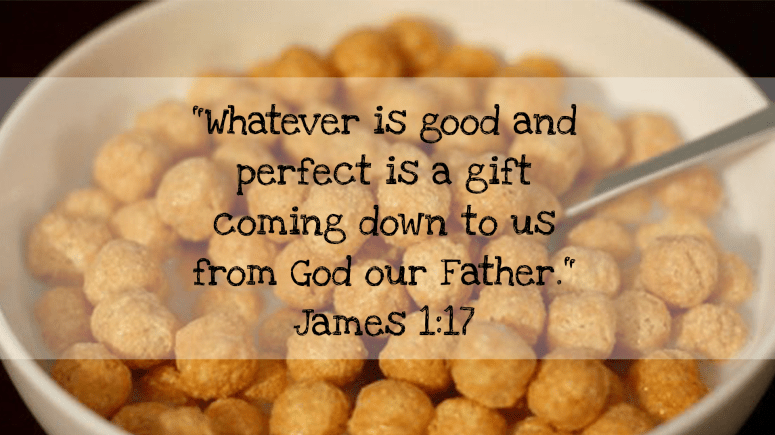
There is always more Corn Pops

cornpops.pngAsher had a meltdown the other day. And, by the other day, I mean, well, a lot of days. Asher is four and just feels everything really deeply, which makes him wonderful. But, on this particular day, he had a meltdown over the fact that we run out of Corn Pops, his current favourite cereal.

And, so he cried and was really distraught that there are “no more Corn Pops!”

As any good father would, I knelt down and held him and said, “Daddy can get you more Corn Pops. Would that make you feel so much better? Daddy can buy more.” And, instantly Asher looked up and said, “Yes daddy, please can you buy more Corn Pops.” And then, because I price match, I found another box in the pantry, and Asher started running around yelling and cheering.

I bring up this little story (one that happens in various ways with all our kids throughout the week) because of one reason: As a dad, I love to give good things to my kids. If I have the ability to give them something that they love, need and lights up there day, I’m going to do it. Especially if it’s like $3 for a box of cereal.

But, here is what struck me: If I love to give good gifts to my children, why do I ever think that God, the true Father, is any different? Have you ever noticed how sometimes we feel like we need to convince God of or can’t be really honest with Him about our desires, wants or needs? That somehow we believe that God isn’t into abundant giving of all that is good and needed.

Now, of course, I’m not saying God will give us all millions – or anything close to prosperity gospel (all health and wealth). But, on the other hand or other extreme, neither is God stingy, scarce or miserly in the gifts He wants to give.

Jesus says this, “If you, then, though you are evil, know how to give good gifts to your children, how much more will your Father in heaven give good gifts to those who ask him!” (Matthew 7:11, NIV).

Or, in James 1:17a (NLT), we read, “Whatever is good and perfect is a gift coming down to us from God our Father.”

What I realized is that just as much as I love to give good gifts to my kids (and follow with me – it gives me GREAT JOY), I believe the same is true with God – that He loves to give to us and it gives Him GREAT JOY. He isn’t up in heaven with a spreadsheet, calculating what we deserve or what He can afford to give. God is in heaven ready and willing to give good gifts to us as His children.

I write this to remind you all of something that we should already know: God is a good Father, who loves to give good gifts to His children. So, let’s live out of that reality today – not out of scarcity, but out of one in which there are lots of Corn Pops in the pantry for all of us.


You are NOT a Layperson

I want to be honest and say I’d like to get rid of the word “layperson.” And, if you’ve never heard it…well, that’s good…but here is what it means: “A person without professional or specialized knowledge in a particular subject.”

At a base level, there is nothing wrong with this idea. That in some spheres or disciplines we might be a hobbyist or an amateur at something – like being an amateur filmmaker or electronics enthusiast or racing hobbyist.

The problem happens when this terminology gets infected with consumerism and spreads into the church. Because, here is what can subtly and quickly happen: We end up with two classes of Christians – the professional and the layperson. And, what can easily happen is that we expect more from the professional than the layperson, or we encourage the layperson to live vicariously through the professional.

Eugene Peterson puts it this way: “If I can be convinced that layperson designates who I am…then I am wide open-market for experts who are ready to tell me how to live my life and, in some cases, even live it for me…And so, I end up delegating the operations of my soul to the experts. I no longer deal with God myself – I’m a layperson, after all…following Jesus gives way to following Jesus-experts.”

I couldn’t agree more. This is a problem in the North American church. We are tempted to follow Jesus-experts, rather than get out into life itself and follow Jesus for ourselves.

Now, of course, this doesn’t mean we don’t need people who give up decades to studying the Bible and God. Our theologians, scholars and pastors can help us and they matter, but they can’t follow Jesus for us. We can’t delegate the core of following Jesus to experts who are trained in evangelism, knowing the Bible, hospitality or teaching. They can point us to Jesus, help us understand Jesus,  train us in the way of Jesus, but they can’t follow Jesus for us.


I write all this to remind you to not buy into the idea that you are layperson in the church. If you are a follower of Jesus, you ARE the Church. And yes, some of us have been doing it longer than others (and we should look to these people for help!), but they can’t fill our role or our calling

So, we need our models, leaders, pastors and teachers. But, let’s never let “following Jesus give way to following Jesus-experts.” Because the world needs all of us – including you.