
|
As you may be aware, a new Scorsese film came out called Silence. It’s taken from a historical fiction book written by Shushaku Endo about two Jesuit priests.
I haven’t seen the movie yet, but there is one line in the book that I’ve often thought a lot about. Endo writes this: “Sin is for one man to walk brutally over the life of another and to be quite oblivious of the wounds he has left behind.”
Now, I’ve read a lot of definitions of sin, but this one is a good one.
Read it again: “Sin is for one man to walk brutally over the life of another and to be quite oblivious of the wounds he has left behind.”
And, isn’t that what sin is? For us to brutally walk over someone – to hurt and harm them – without acknowledgement, compassion or realization?
This is why sin is both so brutal and something to be rooted out. This is why, especially during a season of Lent, we are called to focus on rooting out our sins – on really taking seriously the harm, hurt and damage that sin can cause.
The reason that I really like Endo’s quote is because of what he gets right – that sin harms others. It always has and it always will. This is why the church speaks so strongly against sin – because sin kills. Greed will kill your career, lust will kill your marriage and lying will kill your relationships.
So, I write all this as a simple reminder that we are in the season of Lent.
Traditionally, this is a time to slow down, reflect, and honestly spend some time in introspection and rooting out of sin. And, I think that, even though it’s hard work, it’s necessary work. Because, we as Christians never want to be oblivious to the wounds we might cause. Sometimes, before we can participate in healing the wounds of others, the Spirit needs to convict us of how we are causing wounds to others.
Is that easy? No. But the promise of following Jesus isn’t that it’s easy, but that it will lead you into true life. So, today, amidst all the busyness and noise, sit and invite the Holy Spirit to reveal any area of sin in your life, and seek to live differently.
|
Tag: jesus

The Problem with Humanity
Today’s blog post might seem a bit funny at first. It’s not only completely orthodox, but also absolutely needed.
Jesus is not only the Son of God (and fully divine), He is also the Son of Man and fully human. This means that Jesus not only came to earth to demonstrate and reveal who God fully is, but also to reveal who we are to fully be as humans. Jesus demonstrates what true humanity actually looks like, feels like and, most importantly, lives like.
Marilynne Robinson writes, “It is a truism that humanity is deficient in humanity.” And, that is absolutely, unequivocally true.

When you look around the world and see evil, hurt, violence, racism, destruction and a whole host of other evils, the problem is not with “humanity” per say, but rather our lack of “humanity.” The problem is that we are not living as we actually should; that we are missing the mark (the Biblicial term for sin), and it is having disastrous consequences.
To put it positively, true humanity is seen whenever love, generosity, grace and justice flourish. Anything short of this is actually anti-human. Which brings us back to Jesus and why we need Him.
As a Christian, I fully affirm that Jesus is divine, but also that He is fully human. I believe that Jesus reveals to us the path we are to take as human beings. He reveals to us how we are called to live in this broken world. He models a life of forgiveness, grace and justice in the presence of oppressing powers. We need Jesus to not only make us more Christ-like, but also more human, not less.
So, what does this all mean practically? It means that if you want to be part of changing the world, it means embracing your humanity and especially embracing Jesus to guide you into it. Because it’s the path of Jesus that will bring healing to this world. Not just us denouncing evil, but us living differently. Us living into our full humanity. In essence, living like Jesus in and through Jesus.
“I’m Not Going to be Scared”
 If you are a young parent (or have been one), you might know this experience… Your child has a bad dream and crawls into your bed, and you get no sleep because the amount of kicking they do in their sleep is, well, unreal. We’ve had that experience with Hudson and now, as he’s grown older, we’re having it with Asher.
A few nights ago, Asher ran into our room and said, “I scared.” And, he climbed into our bed to snuggle, which usually means we let him fall asleep and then one of us gets so tired with the lack of sleep (whoever he is kneeing in the back!), we get out of bed and take him back to bed.
But, on this night, something different happened. We prayed with him about how Jesus takes away his fear, and Asher looked at us and said, “I not going be scared” and ran off to his room. By the time we got to his room to tuck him in, he was already under the covers and asleep.
It got me to thinking, what if I acted like that? What if when fear grips my heart and mind, I decide to trust so deeply in Jesus that I move forward saying, “I not going be scared.”
Because Jesus is clear that perfect love casts out fear. That fear comes from the enemy. That fear is not part of His plan for us. In fact, fear cuts down the future that God has for us.
So, I write this all as an encouragement and a challenge. The next time fear grips you, pray about it and maybe try to be a little like Asher. Say, “I not going be scared” and move forward into what Jesus has for you.
Because no matter what our fears are – monsters in the dark, bad dreams, debt, difficulty, divorce, death – Jesus’ love is greater than all our fears. So, we can trust in Him. And, these days, I’m trying to be a little more like Asher when I get scared by saying that because of Jesus, “I not going be scared.”
When Being Relevant Becomes Irrelevant
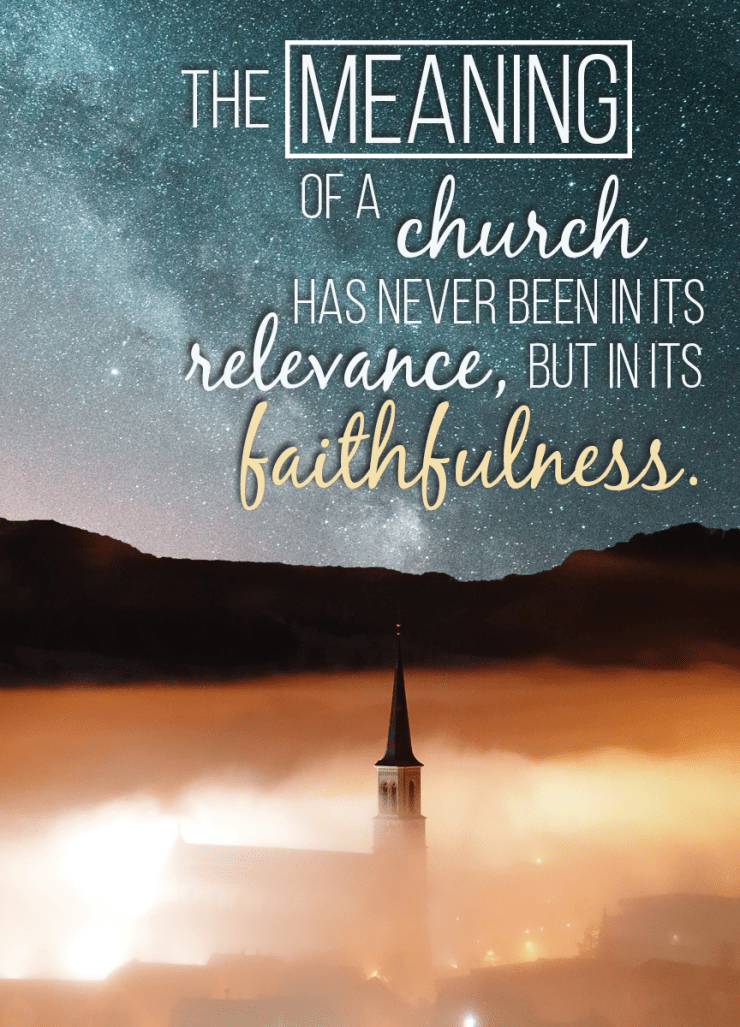 Today, I want to talk about a buzz word and what I believe is actually a curse on our current church culture: relevance.
What I often hear in and around the church world, and ministry in general, is the need to “be relevant” – that we need to ensure our message meets people where they are at and that it’s “relatable.” It’s then often tied to some new cultural trend that we need to “utilize to reach a new generation.”
Now obviously, at a certain level, this is both obvious and necessary. Jesus met us in our world, and it was certainly both relevant and pertinent to our lives. We need to continue to live and change with our world and where it is moving. So, in this sense, yes, we need to be relevant.
But, in another very specific sense, there is a problem with pursuing relevance in that “being relevant” has moved from the sidelines to the centre. And, whenever relevance becomes the marker of faithfulness or success, that becomes a problem. Because the church is first and foremost not called to be relevant, but rather to be faithful.
Please hear me clearly, this short little post isn’t calling church to be irrelevant. What I am trying to say is that the arbiter of success, the point of a church or the meaning of a church has never been in its relevance, but in its faithfulness. And, I believe that when a church is faithful to its calling, it is incredibly relevant to all of our lives. But, when a church is just trying to be relevant, it does not ensure that it will be faithful.
What I’m seeking to write and bring to our attention is a point about priorities. Relevance is a great thing when it follows faithfulness; it is a disaster when it drives faithfulness or function.
So, what does this mean for all of us today? It means, if you are older and don’t get social media, that’s okay. Be faithful. It means, if you are younger and know all the cool cultural trends and memes, that’s okay. Be faithful. It means, wherever you are at, the focus shouldn’t be on “being relevant,” hip or cool, rather it should always be on being faithful. And, that’s a hard thing, but it’s also the most relevant and life-changing thing.
Sharing Jesus
 This past November, I had an odd experience that left me, well, wanting to be a bit more courageous.
I was driving in my neighbourhood, about a block from my house, and an elderly gentleman with a walker was raking leaves. I noticed him, so I stopped, got out and asked if he needed some help. I said I had a half-hour to help clean up his yard.
While it was difficult to understand him, he made it clear that he was fine. He said he had “lots of time.” So I said, “Okay” and went to wish him well, but, before I left, he gave me a small card and spoke to me about the importance of Jesus Christ. In essence, he sought to share Jesus with me. I graciously thanked him and then continued on my way.
I bring this all up because it really got me to thinking… Do I have that kind of courage to share Jesus like that?
Now, while I obviously think that the best way to share Jesus is in the context of relationship (in which people invite that discussion), and I also probably won’t adopt or promote his personal method of sharing Jesus, the point for me lingered… Do I have that kind of courage to share Jesus with my family, friends and neighbours? What might it look like for me to be a bit more courageous in sharing my faith or a bit more bold when the Holy Spirit leads me?
I’m not talking about bulldozing or manipulating people, or trying to insert Jesus into conversations in weird places. What I’m talking about is not listening to fear when opportunities come to share Jesus and to take a step instead. Because I think we stop sharing when there are clear opportunities to. We worry what someone will think, we worry what their response will be and we listen to fear. What if we simply tried to share in humble, simple and approachable ways?
So, all of this is just meant to be a simple encouragement. When you feel moved to share Jesus, why not try it? Why not step out?
I had stopped to see if this elderly man needed help and it turns out he helped me seek to be a bit more courageous. Because Jesus is worth sharing.
Discipleship in an Instant?
Marshall McLuhan coined a pretty famous phrase that says, “the medium is the message.” This means that the medium does actually shift, alter and change the message. And, while I don’t want to spend 3,000 words unpacking that today, I want to draw our attention to something that is happening in our culture.
We now live in a world that is about speed, convenience, newness and simplicity.
Here is the tie in to McLuhan’s phrase… When everything is fast, easy, new and simple, we can then unconsciously adopt the posture that anything that is slow, difficult, older and complex is not only odd, but is also wrong.
When our TV shows, food, Amazon Prime shipping and our friendships with social media are almost instantaneous (clear, newly refreshed and right at our fingertips), it can be difficult to appreciate the reality that some things take time. Some things are incredibly hard. Some things ancient matter. Some things simply aren’t simple, but incredibly complex.
It doesn’t take a genius to notice that our current cultural expectations of speed, convenience, novelty and simplicity will have a disastrous effect on discipleship.

Because, here is the truth… Discipleship is not fast, it’s not convenient, it’s not new and it’s anything but simple. The honest truth is that following Jesus is a long journey, it requires you to give up a lot, it’s actually pretty ancient and it often places us in difficult situations in which complexities abound.
So, my point is, the current cultural trends do not fit well with the life of discipleship that Jesus calls us to follow. And, I’m not lamenting that fact actually, because this gives us a chance to truly stand out and be different than the culture around us.
Often, we want to be counter-culture morally (and we should be!), but what if we also became counter-cultural in a different way? What if we, as believers, praised and valued a long obedience in the same direction? What if we didn’t always try to be new, but focused on being faithful? What if we praised doing the next right hard thing over just the easy thing? What if we really sought to never reduce people or ideas to cultural clichés, but sought to enter fully into the complexity of life?
What I’m pondering, and even challenging us to do, is this… To counteract the instantaneous, easy, new and reductionist world around us by living like Jesus. To value slow and long-term change. To value doing the right hard things over the easy things. To value living faithfully over novelty. To value the complexity of our stories over reducing them.
In essence, I’m asking what it might look like for you and me to live differently than our culture. Because, that might just be the thing that actually changes our culture.
Finding Joy in the Midst of a Mess
On the weekend, we continued our Advent series by talking about joy. Because joy is something I think we all need and want. Joy is different than happiness, actually. While happiness is often based on our circumstances, joy can transcend our circumstances.
So, we began by looking at how we might find joy in the midst of our real lives. Because our real lives are sometimes difficult, especially around Christmas time. There can be financial strain, family drama and unmet expectations – all of which makes “the most wonderful time of the year” a little, well, not so wonderful.
What we discovered, as we examined Mary and Joseph’s life, is that their lives were full of mess, drama and difficulty when Jesus was born. First of all, Mary is with Joseph, even though they aren’t yet married. Most likely because of family drama. Then, they show up to Joseph’s ancestral hometown, but there is no room for them. No one seems to want to take in a very pregnant woman in their own hometown. So, all of this leads to some pretty obvious conclusions – Mary and Josephs’ life is not perfect, clean and put together. It’s a lot like ours – messy and occasionally hurtful.
Yet, it is into this reality that Jesus shows up. And, He brings joy to Mary and Joseph, as their first child is born. More than that, He draws in the shepherds as well. This might seem insignificant, but it’s hugely meaningful. Because when you have a child, you want to share that story and experience it with others. But, no family seems to show up, so God sends shepherds to share in the joy and celebration with Mary and Joseph.The Scriptures say that it impacts Mary deeply and she treasures it all.
So, from this, we pulled out the obvious, but necessary point – that with Jesus comes joy. One of the first things He does on earth is bring joy to His parents, and bring others together to share in this joy.

We then walked through how this applies to our lives. That, first and foremost, if we are in need of some joy, we should pray and ask for it. Jesus, Himself, says this in John 17 – that we can ask for joy. On His birth, Jesus demonstrates how He brings joy when He arrives. So, the first thing we should do is pray and wait and watch for Jesus to come with some joy.
The other thing we should be open to is that Jesus might want to send us out to bring joy to others. This is what we see when the shepherds come to meet with Jesus. So, what if that’s our calling this Christmas – to bring joy to others? To show up with cookies, a conversation or a connection? To show up and surprise others by bringing them joy?
So, we ended with a simple challenge – To pray and ask for joy, but also to listen and follow God if He sends you to bring joy to others. Because, as Christians, we are not only to experience the joy of Christmas and Jesus, but to spread it.
Teaching Notes
Passage: Luke 2:1-20
Big Idea: When Jesus shows up, He brings joy
Teaching Points:
- All families are dysfunctional at some point
- Jesus’ first act is to bring joy
- Happiness is dependent on what is going on around us; joy is dependent on what is happening within us
- Jesus brings in others to share in the joy
- Pray and invite Jesus to show up
- Giving joy spreads
- Show up so someone else receives joy
- Prayers coupled with action is always better
- Joy is on its way, and we can find it and be part of it
Adult Discussion Questions:
1. What stuck out to you from the sermon? What was challenging to you? What was new?
2. Do you agree with Andrew that all families are dysfunctional at some point? Why or why not?
3. Are you more likely to think of the story of Mary and Joseph as history or fable? Why?
4. When have you been filled with joy? Have you ever found joy amidst difficult situations?
5. How can you commit to asking Jesus to show up with joy in your life? How can you show up to bring joy into someone else’s life? What next steps do you need to take?
Challenge for the Week: Pray for Jesus to show up and show up so someone else receives joy
Asher’s Prayer
 Parents, have you ever had a moment of fear about what your child was about to do next? You know, that feeling when you realize that what is about to happen probably isn’t good…and generally that always happens in public.
Are any of you with me?
Well, last month, we were at this large family gathering. It was actually a blending of two families and we were trying to get to know one another, and it was pretty great. Then, it came time to pray for the food and, just as the prayer was about to begin, Asher yelled and screamed, “No!” and said that he wanted to pray.
I instantly had that feeling come over me as a parent – when I didn’t know what was about to happen, but I knew it wouldn’t be good.
I was ready for more yelling, silliness or for Asher, in particular, more wrestling with his brother. But, here is what happened…
Asher said, “I pray” and then he started, but stopped and told us all to close our eyes first. Then he prayed, “Dear Jesus, thank you for being here at Grandma’s with us, for the food, let’s have fun. Amen.”
I looked at my wife and my jaw dropped. Because, Asher has never done this. In fact, I don’t think he’s ever really prayed out loud before. Most of the time, he’s the one talking through my prayer. In fact, he’s more likely to yell during grace than to do anything else.
So, I share this with you, not because I have perfect kids, but for this reason…sometimes things stick and shine through, so have hope!
Read that again…sometimes things stick and shine through, so have hope!
Sometimes, after fighting through grace at meal times, fighting through bedtime prayers amidst yells from your kids that they don’t want to go to bed and fighting through reading Bible stories while your kids wrestle…sometimes things stick and shine through.
Jesus talks about it in Matthew 13 when He asks us to sow seeds. And, here is the thing…seeds take a long time to grow, but sometimes they sprout and grow, and you get to see this when you least expect it (like at a family gathering when everyone is watching).
So, I share this with you to encourage you to hold onto hope. Parenting, grandparenting and seeing change in any relationship takes a long time. Sometimes, it just feels grueling, like you’re toiling for no reason. Sometimes, in beautiful moments, you see that it’s stuck and it shines through.
So, don’t give up, because Asher sharing a deep and beautiful prayer when least expected has reminded me, we never know what’s going on underneath.
The Most Radical Spiritual Gift
 I think that in today’s day and age there is one really needed and really radical spiritual gift. It’s not seen in a lot of places and it’s certainly undervalued in most places. And, it’s just this…hospitality.
Hospitality is the gift of opening up a space so that others feel safe, loved and valued. Read that sentence again. Because, isn’t that what our world needs? Isn’t that what our family, friends, neighbours and co-workers need? A safe place to feel loved and valued.
The gift of hospitality is used when we really welcome people into our lives without any preconditions or expectations. We simply welcome. And, I think if we want to change lives with Jesus, it begins with learning this gift and this art. Opening up our lives, homes and hearts to others with no expectations other than giving them a place to feel loved and valued.
To do this, though, is really difficult because it first requires us to be centred and whole in our own identities. If not, we try to make people into what we think they should be, rather than loving who they are. And, no one likes being changed.
Henri Nouwen puts it this way: “True hospitality is welcoming the stranger on her own terms. This kind of hospitality can only be offered by those who’ve found the center of their lives in their own hearts.”
So, how do we practice this really radical gift of hospitality? Well, I think the first step is to actually welcome the hospitality that Jesus has for us. Because He welcomes us as we are, and loves us right there and then. So, for some of us, before we take the step of opening up our hearts and homes to others (which we absolutely need to do!), perhaps the step for today is to just remind yourself that you are loved by God exactly as you are. He actually likes you, loves you and wants to be with you.
And, once this starts to shape who you are, you’ll be able to share that love with others. Once you accept that you are accepted by God, you can start accepting and loving others.
Of course, we all have unhealthy areas in our lives that need to change. I’m not saying those don’t exist. I’m saying that people want to be loved firstand that love changes people, not our judgment.
So, today, practice the radical gift of hospitality by welcoming someone in as they are or by allowing Jesus to welcome you as you are. Because that’s what our world needs and what I know I need.
How to Kill Your Relationshiop
There are five ways to kill your relationship with Jesus, and they’re really simple…
1. Comparison
2. Comparison
3. Comparison
4. Comparison
5. Comparison
I mean, I’m sure that there are other ways, but this seems to be one of the fastest ways that you can harm and damage your relationship with Jesus. We so often and so easily take our eyes off Jesus and who He is calling us to be and look around at what other people are becoming and try to do that.
And, this is one of the surest ways to kill, not only your spiritual growth, but also your relationship with Jesus. Your relationship is hampered, harmed and can even be cut off when you seek to become someone other than the person Jesus is shaping you into. The really dangerous part of this is that you can feel full of guilt and shame for not being someone else, when you were never designed to be someone else – God designed you to be you. And, here is a true, but radical thought – God actually likes you and the person He is shaping you into becoming. You don’t need to be someone else, but to embrace the person and the callings that God has for you.
But, we struggle with accepting who we are. And, while so many of us “know” this, it is truly hard to live this. We see other people’s giftings, inclinations or passions and wish we could be like them. I’ve seen this all over the church, and even in pastors; pastors who wish that they could speak like “so and so” or lead like “so and so” or pray like “so and so.” But, you aren’t called to be anyone else; you are called to be you.
And this applies to not only pastors, but also apostles too.

In the book of John, Peter is having a last conversation with Jesus, and what we find Him doing right as Jesus is directing him is this – comparing. He sees the beloved disciple following and says this, “What about him, Lord?”
Jesus response, I think, is needed for all of us. He says this essentially, “What does it matter the future I have for him? What is that to you? You, follow me.”
And, I think that’s good advice for all of us. What does it matter what someone else’s gifting or calling is. You be you and follow Jesus. Because the truth is, the world needs all of us – each unique, each simply focusing on following Jesus and not focusing on anyone else.
 { Andrew Mills }