

Lent: Seven Woes of Jesus ~ Week 5: The Walking Dead, Corpses and Dead Hearts

TWD_PROLOGUE_TITLEOn Sunday we continued in our series realizing one key truth from Jesus’ encounter with the Pharisees:

You can be good, you can be moral, you can even be religious and still miss the point

Our morality, and our religiosity is no guarantee that we are actually following the will of God. And this sounds controversial and challenging because it is. The Pharisees were moral, upstanding citizens, incredibly faithful and religious and missed the point. So we then as Christians need to take a hard look at our lives to ensure that we aren’t missing the point.

And we did that on Sunday through looking at one of the “woes” of Jesus. Jesus says this in Matthew 23, “What sorrow awaits you teachers of religious law and you Pharisees. Hypocrites! For you are like whitewashed tombs—beautiful on the outside but filled on the inside with dead people’s bones and all sorts of impurity. Outwardly you look like righteous people, but inwardly your hearts are filled with hypocrisy and lawlessness.”

And while there is lots of contextual stuff going on here, here is the main point Jesus is making. Jesus is saying, you look good on the outside (like a tomb painted white) with all your good actions, but inside you are filled with death, decay, and disease. Jesus hits the Pharisees hard saying that while their outward actions are holy and good, their inner hearts are filled with impurity, hypocrisy, and lawlessness. That they may look good on the outside but inside it’s dark and diseases filled.

So rather than unpacking this theology more, I unpacked the reality of this more. I shared stories of how in my own life recently I’ve taken the right action, with the wrong heart. And how easy it is to be good, religious, and moral but miss the point. How right actions are not a guarantee of a pure heart.

And so we came to this point. We are all broken and need to acknowledge the places, areas, and parts of our hearts where we need Jesus. We cannot ever pretend we have it all so together that we don’t need Jesus. We need him, but we can use our religious activity as excuse to not allow him to challenge us, convict us, and shape us. So on Sunday we landed on this main point: we all need heart surgery. We all need Jesus to come in and cleanse our hearts, to convict us of our lack and brokenness and change us. The one thing we cannot do as Christians is to pretend we are so put together that we are no longer in need of Jesus and his cleansing.

So we closed on Sunday with a simple challenge. To sit and take a courageous moral inventory of the things that God might want to change in our lives. To sit and listen to the Spirit and what he might call out in us. Because while we might be moral and religious it’s no guarantee we aren’t missing the point. And the true point is that if we want to live like Jesus, we had better learn to listen to Jesus.

Sermon Notes:

Big IdeaWe all have junk within

Teaching Points:

  • You can be good, you can be moral, you can even be religious and still miss the point
  • Whitewashing was a signal that there was death within
  • People who look like they have it together, but deny their need of a saviour, denying that anything needs to change
  • It is so easy to hide behind religious actions.
  • We all need heart surgery

Adult Discussion Questions:

What stuck out to you from the sermon? What was challenging to you? What was new? When have you done the right thing, but inside things were off? Why do you think we can do the right things, but still miss the point? Are you willing to do a courageous moral inventory? Who can help you to ensure not only that it happens, but that changes happen.

Discussion Questions for Families:

Today do something tough – model what you want to see in your family. Sit down and share with your kids or family some of the ways that you have failed with them. Maybe times when your heart wasn’t right. And then talk to them about how it’s important that we be honest with ourselves and with God about where we failed, and that’s how God changes us. Model what you want to see – honesty, and courageously owning your own stuff.

Challenge for the Week: Take a courageous moral inventory

The Walking Dead

TWD_PROLOGUE_TITLEYes I know the title of an incredibly popular TV show, but really, Jesus should have the credit for this title. Because as far as I know he is the first person to actually talk about people being literally places of walking death.

Jesus actually goes to the Pharisees and calls them whitewashed tombs. Quite literally calling them places of walking death, disease, and decay. And that is quite similar to the AMC show, implying that they are spreading their contamination around. And while there are lots of contextual things that Jesus is saying, here is the point we are going to unpack on Sunday.

You can be good, you can be moral, you can even be religious and still miss the point.

Because the Pharisees are good, moral, and super religious and Jesus says that they still miss the point. That while their actions look good, inwardly their hearts are full of death, disease, and decay.

So we are going to unpack all that on Sunday but here is why this matters for you if you are a follower of Jesus – we can be just like the Pharisees. We can be moral, good, and religious and we can still miss the point. We can still end opposed to God and his kingdom. And if we are Christians that’s the exact opposite of what we want. So on Sunday we’ll look at how to ensure our hearts and our actions are pointed in the right way.


Lent: Seven Woes of Jesus ~ Week 4: Cleaning the Dishes and Heart Transformations

clean-1445150So on Sunday we continued our series of Lent looking at the seven woes. And the “woe” we unpacked was this one from Jesus:

What sorrow awaits you teachers of religious law and you Pharisees. Hypocrites! For you are so careful to clean the outside of the cup and the dish, but inside you are filthy—full of greed and self-indulgence! You blind Pharisee! First wash the inside of the cup and the dish and then the outside will become clean too.

And here Jesus enters into a debate on the cleaning of cups. And there are lots of cultural things going on here that we unpacked on Sunday but the main point of Jesus really is this: having stuff clean on the outside (our actions, our religious rituals, our following the rules) doesn’t matter if inside we aren’t clean (our hearts, desires, and wants).

Jesus is trying to point out something that is obvious to anyone – you can do the right thing with the wrong motives and it misses the point. That your kids can clean their room not because you want them to, but because they want to to go to a party. Your employee can go above and beyond, not because they care, but because they want the weekend off. Your spouse can be all thoughtful and caring, for you to only realize they got in a fender bender. The point is that the right actions without the right heart is deadly. That what good is it if you do the right thing – but your heart and motives are off? What good is it if you follow all the rules of the Bible – but inside you are seething with greed, excess, and sinful desires? What good is the outside of a cup looking clean, if the inside is full of junk?

Jesus’ desire to move our focus from the outward to the inward and where the work needs to be done. Because here is the truth: all of our hearts are dirty and filled with junk. Everyone has some brokenness, some greed, some hurt, some pride, some agenda, some mixed motives and desires that need to be changed.

And the truth though is that following the rules doesn’t change our hearts. I know this because my kids sometimes follow the rules, but they aren’t doing them happily and their hearts remain unchanged. For our hearts to be changed we need an encounter, and an experiences specifically with Jesus and the Holy Spirit.

So on Sunday we unpacked this main idea: that we all need a heart change, a heart transformation, and a heart cleansing.

And so to do this we took communion and took time to connect with Jesus. We took time and created space to ask for a heart cleansing, because that is what we all need. We all need some transformation from hurt to healing, from grime to grace, from hate to hope. And the way this happens isn’t by doubling down on following the rules, but doubling down on an encounter with Jesus. And that’s our challenge for the week: to have an encounter with Jesus that changes us. Because that’s where the magic is of following Jesus, not out of duty and legalism, but out of freedom with a new and changed heart.

Sermon Notes:

Big IdeaWe all need a heart change, a heart transformation, and a heart cleansing

Teaching Points:

  • “I think what Jesus is warning us about is that it’s entirely possible to be a religious, dedicated Christian, and yet totally miss the life-giving nature of a life centered squarely on his teachings. Some of us have exchanged Jesus for a Christian religion.” Benjamin Corey
  • The inner life is what matters.
  • Following the rules and the law doesn’t matter unless your heart is changed.
  • A heart change matters more than following the rules.
  • What God wants aren’t people who just follow the rulesGod wants people who have hearts like his.
  • Following the rules doesn’t change your heart.

Adult Discussion Questions:

What stuck out to you from the sermon? What was challenging to you? What was new? Have you ever had an experience of someone “following the rules” for the wrong motives? How did it make you feel? Why don’t you think following the rules changes our hearts? How can Jesus change our hearts? How can we ensure that they stay changed?

Discussion Questions for Families:

Use the example I gave from Hudson, or maybe one from your own life to talk about motives. Talk about how we as parents love when our kids do the right thing, but more than that want to see the right heart. Ask them what the difference might be in simple and easy thing like dishes, like cleaning up toys, etc.

Challenge for the Week: Have a heart change

Lent: Seven Woes of Jesus ~ Week 3: Gnats, Mercy, and Cumin

spices-1-1523661-639x950On Sunday we looked at the fourth woe of Jesus. And in the fourth woe Jesus says this,

What sorrow awaits you teachers of religious law and you Pharisees. Hypocrites! For you are careful to tithe even the tiniest income from your herb gardens, but you ignore the more important aspects of the law—justice, mercy, and faith. You should tithe, yes, but do not neglect the more important things. Blind guides! You strain your water so you won’t accidentally swallow a gnat, but you swallow a camel.

And here Jesus is confronting the religious leaders of his day for not living like God and for not prioritizing or orientating their lives in the way of God. The way they are living isn’t bringing them closer to God, or God closer to the world.

The truth is that if our religious energies go into the “minor” things rather than the “major” things of following God we can become an obstacle to God. And that is actually what Jesus is arguing that they are missing the more major, weightier, and important commandments. Apparently Jesus thinks some laws and commands matter more than others, and he’s right of course.

Jesus pulls an allusion to Micah saying what does God require mercy, justice, and faith. He says essentially what good is tithing your herb garden when you forget about the major things? What good is following the minor rules if you don’t get the major ones right?

And this is a really convicting and challenging teaching because here Jesus wants to change the metric of our holiness. Holiness isn’t about just following the rules, but which ones you actually prioritize and put the most effort into. Following Jesus is about the greatest commandments, mercy, faith, and justice.

So we ended with this main point: Some things matter more than others and we need to orient our lives around those things

The truth is we can be religious and still miss the point like the Pharisees. We need to have our lives orientated around the main things: faith, mercy, and justice like Jesus asks.

So we ended with a simple challenge. To sit and contemplate on this question:

Have I forgotten mercy, justice, or faithfulness?

Because that question matters. It matters to Jesus so it should matter to us.

So that’s what we did on Sunday, but it’s also worth doing right now, because whenever our lives major on the minors we are missing the point.

Sermon Notes:

Big IdeaSome things matter more than others and we need to orient our lives around those things

Teaching Points:

  • Their way of living will not bring them closer to God, or God closer to the world
  • Jesus believes some commands matter more than others.
  • The things we often measure our holiness and righteousness against aren’t always the things God is measuring.
  • It is so easy to neglect the most important things while keeping other religious things going.


Adult Discussion Questions:

What stuck out to you from the sermon? What was challenging to you? What was new? Have you practiced Lent before? Why or why not? Is there something you could give up this year for Lent? Have you ever considered that you might be “spiritually blind”? Can you think of other examples of “spiritual blindness”? Why is being spiritually blind so very  dangerous? Are there any areas you feel you might be blind to?

Challenge for the Week: God reveal the areas of blindness in me.

Sharing Spices and Missing the Point:


spices-1477563-640x425On Sunday we are going to be looking at something that is controversial, but well Jesus says it so we should believe it – and it’s this:

Some rules matter more than others.

And while that might strike you as odd or even untrue – the trouble is it’s biblical. Biblically speaking while there are lots of important rules, or rhythms we should have as Christians there are some that matter more than others. And that even if you do some of the minor obligations, or regulations but miss the big ones – Jesus isn’t happy.

And while it sounds funny that there is actually a hierarchy of importance in the way of following Jesus it is true. Jesus himself says that there is a “greatest commandment’ which means there are “minor commandments”. And here is the tension: sometimes we value or prioritize the minors over the majors.

So that’s where we are going on Sunday. But here is the question I have for you before we get there: what do you think the majors of faith are? Think about it, pray about it, and then on Sunday let’s see what Jesus has to say about it.

Lent: Seven Woes of Jesus ~ Week 2: Blind Guides, Hell, and Learning to See

glasses-1554870-1280x960On Sunday we looked at the second and third “woe” of Jesus. And a series examining the “woes” of Jesus isn’t something that is generally fun, but it’s so needed. We, as a culture, don’t do great with responsibility and reflection; we do blame, turning a blind eye and busyness really well. Which is why we need Lent to slow down, reflect, and listen to God’s Spirit.

So on Sunday we looked at how Jesus calls the Pharisees blind. How they believe they are helping God, but are in the way of God’s movement. How they go to great lengths to make converts but because they are blind, make them twice as bad. How rather than condemning making oaths that you intend to get out, they implicitly agree with it. How they are blind and don’t even know it.

And that’s the trouble with spiritual blindness, you don’t know you are. You think you see things clearly when you are actually on the wrong side of God’s movement.

And we only have to look back a little ways in history to see how often people in the church have been on the wrong side of the Spirit of God’s movement. When we look at how people argued slavery was ordained by God, how women are inferior to men, how it’s right to kill in Jesus’ name in the crusades, or more recently, how the church treats people with mental health challenges. I could go on and on about how we have clearly been blind in the past to the movement of God.

I brought this up because if people in the past were sure they weren’t blind, but turned out they were – then we need to acknowledge the fact that we most likely are blind in some ways to the move of God as well. That if the religious, moral, and spiritual elite (Pharisees) got it wrong, if the church has got it wrong in the past, how can we be sure we have it all right? So the challenge though is that we don’t know what we don’t know. We don’t know where we are spiritually blind.

So we landed on this main point: In our blindness we can oppose the movement of God. And the way we discover our blindness certainly doesn’t come from listening to my voice or words, but from the voice and words of the Spirit. So we challenged ourselves to pray a radical prayer daily this week: God Reveal the areas of blindness in me. 

The only way we will discover our blindness and be healed from it is if we listen and hear the Spirit speaking to us. Because I know there are areas in my life I’m spiritually blind, and I need to see clearly to follow clearly. So that’s our challenge ask Jesus to reveal areas of blindness to you, and listen for him so we can follow clearly.

Sermon Notes:

Big IdeaIn our blindness we can oppose the movement of God.

Teaching Points:

  • We, as a culture, don’t do great with responsibility and reflection; we do blame, turning a blind eye and busyness really well.
  • Holy Spirit if we are missing the point show us.
  • It’s not enough to follow God, You have to follow God in the right way.
  • If you have a false idea of God, the more religious you are, the worse it is for you – it were better for you to be an atheist.  William Temple
  • In our blindness we can oppose the movement of God.
  • We’re all blind but didn’t know it.
  • The way we will discover our own blindness is to listen to the Spirit.
  • Reveal the areas of blindness in me.

Adult Discussion Questions:

What stuck out to you from the sermon? What was challenging to you? What was new? Have you practiced Lent before? Why or why not? Is there something you could give up this year for Lent? Have you ever considered that you might be “spiritually blind”? Can you think of other examples of “spiritual blindness”? Why is being spiritually blind so very dangerous? Are there any areas you feel you might be blind to?

Challenge for the Week: God Reveal the areas of blindness in me.

Blindness and Learning to See – When you Think You Can See

Oblinds-1436458-1279x1646n Sunday we are continuing in our series “The 7 Woes” for Lent. We are looking at the condemnations that Jesus makes to the religious leaders of his day, and asking what he would say to us. I know it’s not easy, but necessary.

On Sunday we are going to look at this “woe”:

What sorrow awaits you teachers of religious law and you Pharisees. Hypocrites! For you cross land and sea to make one convert, and then you turn that person into twice the child of hell you yourselves are!  “Blind guides! What sorrow awaits you! For you say that it means nothing to swear ‘by God’s Temple,’ but that it is binding to swear ‘by the gold in the Temple.’  Blind fools! Which is more important—the gold or the Temple that makes the gold sacred?  And you say that to swear ‘by the altar’ is not binding, but to swear ‘by the gifts on the altar’ is binding.  How blind! For which is more important—the gift on the altar or the altar that makes the gift sacred?  When you swear ‘by the altar,’ you are swearing by it and by everything on it. And when you swear ‘by the Temple,’ you are swearing by it and by God, who lives in it. And when you swear ‘by heaven,’ you are swearing by the throne of God and by God, who sits on the throne.

We are going to be looking, in essence, at how we can be blind to what God is doing, and how we aren’t actually following God. This is a pretty big topic and a pretty hard topic because here is the truth: the Pharisees thought they were following God but they were in God’s way. And the same thing can happen to us. We can think we are following God with righteousness, holiness, and dedication only to have Jesus say we are blind and a blind guide.

So to prepare for this Sunday here is what I think we should all do – we should pray and ask God to reveal himself to us. We should ask him to reveal the ways in which we are blind. Because the truth is if we are moving in the wrong direction, we need to know The trouble is we need to hear God first. So my challenge before we even get to Sunday is just this: to listen to the Spirit. That’s the first step to learning to see.

Lent: Seven Woes of Jesus ~ Woe 1 – Hypocrites, Exclusion and the Kingdom

7 WoesOn Sunday we looked at the first “woe” of Jesus and opening up the series and the practice of Lent. I shared how Lent isn’t fun but necessary. Necessary because the truth is we as Christians need to challenge ourselves to live and look more like Jesus. Stanley Hauerwas writes this:
It is surely the case that many of us are kept from entering the kingdom by the lives we lead as Christians. Our problem is very simple – we simply do not know how to live as a people who believe that Jesus is the resurrected Lord.

And I believe that is true. Lent then is a time of re-centering on how to live like Jesus, appreciating his sacrifice, taking a hard look at our lives, and asking for challenge and conviction.

Lent also matters because it prepares us for Easter. We spend so much time preparing for Christmas but the true Christian holiday is Easter and I think we need to invest time and energy into that as well.

And lastly, Lent matters because it can save our faith. If you practice Lent then at least yearly you will go through a season that is slower, inward focused, repentance focused, and one that is a bit darker. And this matters because somehow we’ve bought into the illusion that the Christian faith is all light, rainbows, and sunshine. So when our lives turn dark, as can happen, we think we’ve lost of our faith. Lent reminds us that going through a dark time is actually part of faith.

So with that we kicked off our series beginning to look at the seven woes of Jesus found in Matthew 23. We focused in verse 13, and the first woe.

The first thing we realized was that the Pharisees weren’t bad people, they were people deeply desiring for God to move. And in many ways we slant the Pharisees in Christian circles so that they are different than us, but they really are very similar to us. And this is why then when Jesus condemns them we need to hear these words and apply them to ourselves. We need to make sure we are following Jesus, and not just our ideas about Jesus.

So Jesus says, “What sorrow awaits you teachers of religious law and you Pharisees. Hypocrites! For you shut the door of the Kingdom of Heaven in people’s faces. You won’t go in yourselves, and you don’t let others enter either.”

And in this Jesus starts to bring up the offensive reality of the gospel. That the gospel, or entering the Kingdom of heaven, isn’t offensive because of who it rejects but who it includes. The Pharisees were busy sharing who was in and who was out.  The difficulty is that the people they were rejecting were the people God was including. So Jesus comes to them and confronts them and says – you exclude people from God’s Kingdom (shutting the door), and then refuse to enter yourself. You not only bar other people from going in, but refuse to enter yourself.

Jesus throughout his ministry welcomed people into the Kingdom the Pharisees didn’t believe deserved to be there.  And the truth is that the people Jesus welcomed into the kingdom – tax collectors, prostitues, and sinners – didn’t deserve to be in the kingdom. And neither did the Pharisees. It was an act of grace and mercy.

So Jesus confronts the Pharisees for rejecting the people that God is including. But this isn’t about them, it’s about us. So we came to this  main point because we do the same thing the Pharisees do. The main point is this: God’s Kingdom and grace is bigger than all of us.

The question though is are we acting like the Pharisees? Are we barring people from entering? Are we excluding people God’s spirit is including? Would Jesus say to us, “Woe to you for shutting the door, on people I’m inviting in”? It’s a really important question, one that we landed and ended on.

I invited people to really reflect on that question. Are there people in our lives whom we are rejecting that God is including? Are you standing in the way of what God is doing? Do we have enemies that we believe don’t deserve God’s kingdom, or to be part of what God is doing – as they are?

So to make this personal and practical we ended with this challenge: to pray for our enemies daily. The truth is it’s hard to reject people we are daily praying for, and that is what will ensure we don’t stand in the way of God’s movement. So the challenge for all of us was simple: pray for our enemies and get out of the way for God to move. Because the Kingdom is bigger than we think, and God is inviting people in.

Sermon Notes:

Big IdeaGod’s Kingdom and grace is bigger than all of us.

Teaching Points:

  • Lent isn’t fun, but is necessary.
  • Going through a dark time doesn’t mean we’ve lost our faith, it’s actually part of our faith.
  • The gospel isn’t offensive because of who it excludes, the gospel is offensive because of who it includes.
  • Jesus welcomed in people the Pharisees didn’t believe deserved to be there.
  • The Pharisees in the name of God are denying the movement of God.
  • The kingdom is big enough for everyone.
  • The gospel is for everyone wherever they are at or it’s not the gospel.
  • No one deserves the kingdom, but we are all invited to it.
  • God’s Kingdom and grace is bigger than all of us.

Adult Discussion Questions:

What stuck out to you from the sermon? What was challenging to you? What was new? Have you practiced Lent before? Why or why not? Is there something you could give up this year for Lent? How have you seen in the past people getting in the way of what God was doing? How have you in the past excluded people God was including? Who are the people you need to pray for and work to include in God’s kingdom?

Discussion Questions / Responses for Young Families

Talk to your kids about the reality that God’s kingdom is for everyone, even the people we struggle with and really dislike. Start to teach them to pray for those who are their enemies. Start to lead them to live like Jesus through prayer.

Challenge for the Week: Pray for our enemies daily.

Welcome to Lent

Well this Sunday we are launching a new series for Lent. Lent has started and it’s an absolutely necessary Christian practice. And come Sunday we will be exploring what Lent is, why it’s needed, and also how it can change your life. Lent isn’t an easy time, but it is a necessary time.

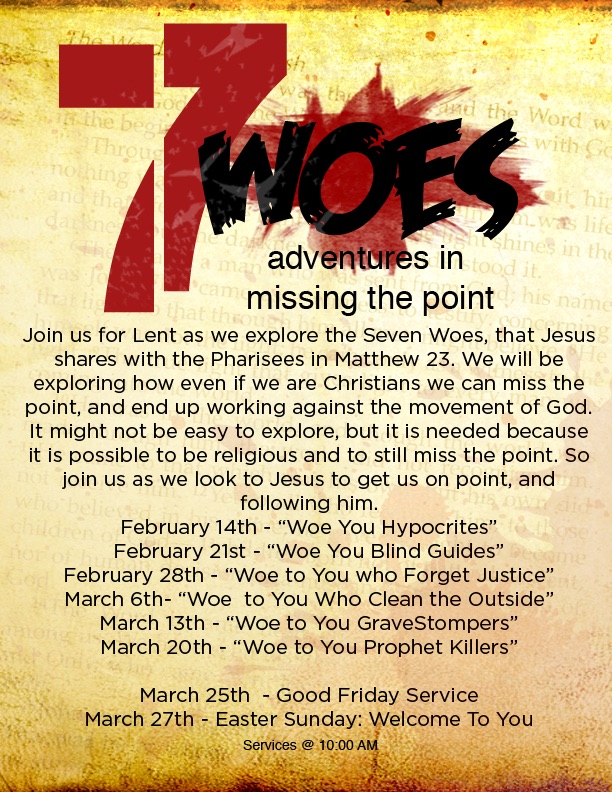
So throughout Lent we are going to be looking at the “7 Woes of Jesus”. This is where Jesus condemns the religious, moral, and spiritual elite of his day and shares with them how they are missing the point. The point for us is that if the religious, moral, and spiritual elite can miss the point – so can we as Christians. So we want to explore how we might be missing the point in our lives, and getting them back on track.

Lent is a time of reflections, repentance, and rededication and we want to do that through asking the Spirit to speak to us, challenge us, and convict us. So I know it’s not a fun time, but a necessary time.

Oh and since its Valentines Day, we’ll talk a little bit about love too 🙂 I know a bit disjointed but we’ll work it all together. Mostly because my lovely wife said “You need to talk about love on Valentines day” and since I love her, that’s what we’ll do too 🙂

7 Woes

Mental Health Sundays: What Can We Do as a Community?

On Sunday we were very blessed to have a few experts and professionals in the mental health field come and share with our church on a panel.

We believed it was important to hear from professionals in this area, who have given their lives to healing, caring, and supporting others. Receiving professional help is something that in the evangelical church receives some stigma in some circles but it is absolutely crucial.

So we are grateful to the panel for their discussion, which you can hear on our podcast.

We ended our time together with three simple challenges: welcome and include, pray, and continue the conversation.

First, as a next step we talked about welcoming and including others with mental health challenges. That this is something we can all practically do in any church you attend. We can create safe spaces for people to journey together, and to include those who often feel excluded by the church.

John Vanier and John Swinton write this,

If the church has anything to offer to people with mental illness (and indeed to anyone else), it is the provision of a space where they can truly feel that they belong.

And I believe that is so true, and absolutely needed.

Kathryn Green McCreight writes,

From a theological perspective, the most dangerous thing about mental illness is that it can lock us in ourselves, convincing us that we are indeed our own, and completely on our own, isolated in our distress.

This is why as churches, as communities of believers, as followers of Jesus we must welcome and include people who are struggling.

The second thing we reminded one another to do was to pray. That praying for others, and letting them know you are praying for them is a tangible reminder of our care and support. In some situations as we journey with people we are not always sure of everything we can do, but one thing we can always do is pray and remind them of that.

Miriam a woman who struggles with mental health writes this:

When you don’t know what to do or say, the one thing you can do is pray and let the person you are praying for know you are. It is a true expression of compassion and Christian love

And lastly, we reminded one another to continue the conversation. That this is the just the beginning and one thing we can do is to continue to learn and listen. We can learn more about mental health, and listen directly from those who are struggling. We can ask how we can help, and take action.

And through these three steps we can start to make a difference and changing the world, by changing someone’s world. As we remember to welcome and include, pray, and continue the conversation.