The Dynamics of Holding the Truth: Gritted Teeth, Judgement, or Love

201764_5120The other day I was reading through Ephesians, and one verse just jumped out at me.

It always seems weird to me how sometimes you’re reading the Bible and a verse just leaps off the page, and you wonder, “Has that always been there”. I don’t know how many times I’ve read Ephesians, but I can tell you that this for sure isn’t the first time. But here is the verse that just caught my attention:

“Instead, we will hold to the truth in love” Ephesians 4:15

And that verse just sounded so beautiful to me. Because isn’t that what we should be doing? Isn’t that what our world needs? For us as Christians to hold to the truth in love?

Because I don’t think we, as Christians, are so good at holding truth in love. We’ve got the hold the truth in self-righteousness down pat. We really know how to hold the truth in judgment over someone. We know how to hold truth in anger and aggressive verse quoting. But do we really know how to hold the truth in love?

I just think that this is something so worth striving for. Wouldn’t it be beautiful if when people talked about you or I they said, “They sure know what they believe, but they are so gracious with their beliefs” or “Even though we disagree, their love shines through.”

For me that verse just so clearly gave me a goal – for love to permeate all of my interactions. That I might hold the truth in love, share the truth in love, and live the truth in love.

I’m sure I must have read that verse before, but for today it just seemed brand-new, and needed more than ever.

What about you? What do you think of it?

Bye Bye Fear

Because God loves us, we don’t have to be afraid. Because God loves us, we are free to love others-even our enemies. And after all, once you take fear off the table, how many enemies do you really have? Brian Zahnd

So deep and so true.

Why not re-read it a few times and ask Jesus to help you take fear off the table.

Because being free of fear makes you free to love.

Why 4 Year Old’s Are the Best Theologians

I think I might be raising a theologian, or maybe better put Hudson is teaching me to be a better theologian. Hudson shared this with me about his grandpa who died, but whom he desperately wants to see.

“Daddy you know Grandpa is coming back because he loved God, just like Jesus who loved God died and came back”.

Yep that about covers it, that’s Easter, resurrection, and good theology all wrapped up in one simple sentence. Sometimes the young are the smartest.

Faith Isn’t “Believing in God” ~ Its Trusting in God

1341194_84514919On Sunday we looked at the topic of faith. And rather than seeing faith as belief, we talked about how faith is really all about trust. Faith is about trusting in God, and putting that trust in action. Those are the two aspects to faith: trusting in God, and putting trust in action.

And this is such a different, healthier, and more biblical way to look at faith. Rather than seeing faith as a set of intellectual beliefs or doctrines, see faith in a relational way. See faith as putting trust in a person, not just believing certain things about a person.

That’s what we looked at on Sunday. How Hebrews presents faith as an active thing, a trusting thing, not just a belief thing.

We ended asking a serious but important question: do you trust in Jesus? This moves the discussion beyond just debating doctrines, and positions and moves to a heart level. Do you trust Jesus? Do you trust him to guide you? Do you trust him to care for you? Do you trust that his way of living is the way of living?

Because this is really what is at the heart of faith. Living a life of trust.


Sermon Notes:

Big Idea: Faith is trust in Jesus, and putting that trust in action.

Teaching Points:

  • Culture sets our normal.
  • Faith as belief is the normal way of thinking about faith.
  • Faith is trusting in God, even in the dark.
  • Faith is trust in God, and putting that trust in action.
  • Trust without action isn’t real.
  • Placing our faith in God is never wasted.
  • Are you willing to trust Jesus?
  • Trust can begin with a decision.
  • Is there some junk in your life you need to get rid of?

Adult Discussion Questions:

What stuck out to you from the sermon? What was challenging to you? How did God speak to you through it? What was new? How amazing was that camel picture?

How have you thought of “faith” before? Why is it important to place trust in Jesus in the tough times? What helps you to do that? How is your trust in Jesus right now? Is it high or struggling? Is there any junk you need to get rid of? Who can help you do that? Can you bring them in?

Questions for Young Families:

Talk with your kids how faith isn’t just about believing but actually trusting. Why not try it out practically to show the difference and do “trust falls” with your kids to talk about how trust means stepping out.

Weekly Challenge: Trust in Jesus and live out that trust.

What is Faith?

1264648_14417319This Sunday we are looking at the topic of faith. And we want to peel back some of the misconceptions about faith. Because the most common answer to “What is faith” is: belief.

But I don’t think that answer is helpful, healthy, or even all that biblical.

  • Because if faith is belief – what happens to it when you doubt?
  • Because if faith is belief – what happens if you believe the wrong things, or have been taught the wrong things?
  • Because if faith is belief – does it matter how you act as long as you believe?

These are some of the difficulties with “faith as belief”

So that’s what we want to explore and clear up on Sunday, by looking at Hebrews 11. Hebrews 11 is the classic chapter on faith, but it presents a different view of faith that differs from “faith as belief”

So that’s where we are going, but before we get there why not read Hebrews 11 yourself. It’s a great chapter, and it’s one that not only is about faith, but asks us to put our faith into practice. Which as it will turn out, is what faith is all about.

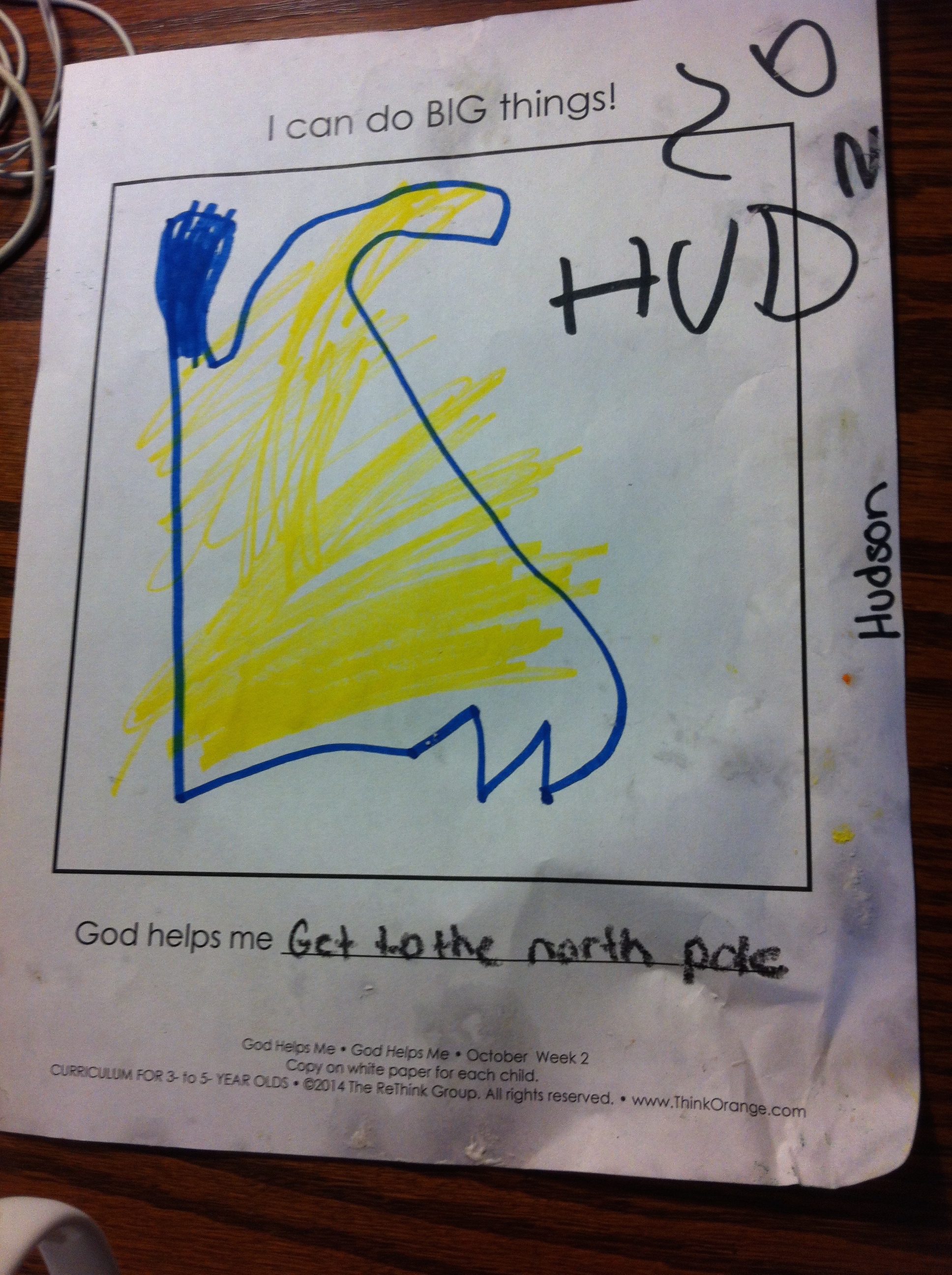
“God helps me get to the North Pole” : Theology from a 4 year Old

IMG_4512Today I’d like to share the work of my 4 year old.

Now I’m not sharing his work because he is an amazing artist, or because I want to sell his work or anything (although you’re welcome to buy it).

I share it because of something he had written at the bottom of the page.

God helps, “Get to the North Pole”

Now at first glance that is a very silly thing to say. It seems just like the type of thing a 4 year old would say. Except that this is actually a very deep theological statement, it’s just said in “Hudsonese”.

The past few weeks Hudson keeps talking about his grandpa, my dad, who died when he was just a few months old. He keeps talking about how he misses grandpa and wants to see him. So he asked where grandpa is, and I told him “Grandpa is in heaven”.

And because he’s 4 he had lots of follow up questions, “Is heaven far? Can we drive there and see Grandpa? Is it farther than Caleb’s house? Why can’t we see grandpa?”

And lastly, “How do we get there?”

We talked about this and the point he got was that God, because his love is so strong, can take us to heaven. And that heaven is far away, like the North Pole.

So when Hudson says God can help us get to the North Pole, it’s a comment on the power of God. That God is able to get us places we couldn’t get on our own. That the love of God is strong enough to draw us to heaven, and to bring heaven here. That God’s loving power is enough to do amazing things: like get us to heaven, bring reconciliation, cause resurrection, bring healing, bring hope, bring transformation, and of course, get us to the North Pole. 

While you might not see the phrase, “God helps me get to the North Pole” in any theology textbooks, it’s still a true statement. And may that statement give you hope today, just like it gives Hudson hope. That God’s love, power, and strength can change lives – and apparently get you to the North Pole.

The Problem of the Coolness and Manufacturing of Missional

Found at: http://www.ralphhoweministries.com/sancfiles/cqnov2.gif

Here is a problem I’ve noticed. It’s cool to be “missional”. You might not know the term, but trust me it’s the new “cool term”. Just look at how many books are on the topic. Just look at how many Christian workshops there are about it. Just look at how often people talk about it…or blog about it (yes I know I’m blogging about it and have many times before).

Now I’m not against the missional movement at all. I’ve led workshops on it, I’ve created resources for it, and I wrote my thesis on it. What I’m worried is that we tend to “consume missional-ness” rather than practicing being missional. So we go to trainings, read books, buy more books, go to another training, and leave our “old churches” to do something cool and new. And in the end rather than being missional, we end up being consumeristic and “consuming mission”.

Jason Clark puts it this way:

“This is how we consume church. We read book on missional church, attend missional events, leave existing churches to be revolutionary, and at the end of the day we end up ‘consuming’ mission rather than doing the dirty work of bringing about a concrete church and mission”.

And the truth is it’s easier to consume church, rather than truly being missional and committing to a location for a long-term. It’s easier to read a book, go to a training, and start something new rather than investing, planting yourself, and saying, “God use me here.”

I am in no way against new things, or the church moving into the community. This needs to happen. I just want to make sure the motives are right for why it’s happening. Because the truth is this: it’s too easy to jump to the new cool thing, it’s hard to do the faithful thing. And I believe being faithful to God means being missional. It’s just that it’s so easy to try to “be missional” not from a desire of faithfulness, but a desire of rejection and consumerism.

I think Jason Clark’s question is a good one for all of us to think about, “are we ‘consuming mission’ rather than doing the dirty work of bringing about a concrete church and mission”

  • Are we responding faithfully to God’s call to move out into the neighborhood, or just tired of the neighborhood we find ourselves in?
  • Are we launching something new because God is calling us to, or because we’re just bored and frustrated with our current place?
  • Are we learning about being missional to practice it, or to critique others who aren’t doing it?

I just think Jason Clarke’s point is wise. Are we consuming mission, or living out God’s mission? Because especially in being missional, motives matter.

Beautiful Quote on Love

1438016_46366975

I read this in a book a few weeks ago and its really lingered with me:

Love is the great equalizer. One cannot love from a higher position. Love requires personal abandonment, a divesture of the social, economic, political, or hierarchical artifices we think make us somebody of worth. Only love does that, and the loving requires the divestiture, the humility. It descends, never condescends. This is what God is teaching us in Jesus. Phil Needham

Yeah I don’t have anything to add to that, other than that this is true and worth reflecting on. To help try reading Philippians 2:5-11 a few times, I think it will resonate really well with what Phil Needham wrote.

What is the Father Like?

FarSideGodComputerSmallOn Sunday we looked at who the Father is. Many of us have this idea that like this comic shows that the Father is in heaven ready to smite. That if it weren’t for Jesus, the Father would be angry with us. That the Father’s natural disposition is not being nice like Jesus, but anger, wrath, and punishment. But this is not the picture Jesus paints of his Father

We began exploring how the Father is one who goes looking for the lost, and hurting in Matthew 18:12-14. In this passage Jesus is clear that the Father’s desire isn’t for anyone to be lost. That he notices you, and comes to seek and find you when you wander off. The posture of the Father is one of yearning, inclusion, and finding, not vengeance and “smiting”.

The second passage we looked at is Matthew 7:7-11. In this passage we see a Father who loves to give good gifts. And this matters because so often we have this feeling that God is stingy, uninterested, or that we need to “work harder” (more prayer, fasting, or faith) for God to answer our prayers. But Jesus reveals a Father who is generous, active, and approachable. Jesus reveals a Father in heaven who is filled with abundant generosity not scarcity. And this is a picture we need to get straight and hold onto.

The third passage we looked at was Luke 6:35-36. Here we see something that we often forget. The Father is merciful. Jesus is so clear, and succient reminding us the Father is merciful. The Father is not full of wrath, and anger but full of mercy. Jesus isn’t the nice one, while the Father is the angry one. Jesus reveals who the Father is, and he is clear that he is merciful. So whatever else we do with some of the other complex passages in Scripture we need to be clear on this: the Father is full of mercy.

And finally, the last passage we looked at was the story of the Prodigal Son in Luke 15. This really summarizes all the other passages. That when the son demands his inheritance the Father’s generosity is so deep, he is even willing to give when it hurts and will be taken advantage of. We see also that the Father searches and looks for his son, like a lost sheep. We also see the Father welcome home the son with compassion and love and mercy, not judgment and wrath. We lastly see the Father being full of forgiveness.

So the main point on Sunday was to centre on the picture of the Father as revealed by Jesus. One who is loving, generous, merciful, and forgiving. This is our Father in heaven and this should change how we live.

Dads, we need to be Fathers like the Father in heaven.

Parents we need to parent like the Father in heaven.

Christians we need to live and follow the “house rules” and “house values” of our Father in heaven. We need to be about mercy, forgiveness, compassion, and love as well

So on Sunday we gave the challenge to get closer to the Father, and live like the Father. This is a good reminder to us because we need to get rid of the idea that God is sitting by a computer ready to smite. We need to get centred on the Father that Jesus reveals.


Sermon Notes

Big Idea: The Father is loving, generous, merciful, and forgiving

Take Aways…

  • We have a wrong picture of God the Father
  • Our picture of God the Father needs to be based in the revelation of Jesus Christ
  • If our picture of God the Father is off, so will our lives.
  • The Father’s reaction isn’t to smite but to find
  • Heaven is not about scarcity, but abundance, and gift, and generosity
  • The Father is merciful
  • Jesus didn’t die because the Father was angry, Jesus died as an expression of God’s love not anger
  • The Father Jesus reveals is loving, merciful, generous, and forgiving.
  • Next Steps: Go to the Father. Thank our fathers. Live like the Father
  • The greatest tragedy of our lives, is that we forget who we are. Henri Nouwen

Adult / Group Discussion Questions: What stuck out to you from the sermon? What was challenging to you? How did God speak to you through it? What was new? What picture did you have of the Father in your mind before today’s sermon? Was he generous or stingy? Kind of angry? Forgiving or judgy? What has shaped your image of the Father? What image / passage most resonated with you today? What has changed in your view of the Father after today? What questions do you have? How can you live more like him?

Discussion Questions / Actions for Young Families: Today talk to your kids about what God the Father is like. How he is loving, generous, forgiving and merciful. Tell them this is who he is, and who you want to be like. Make a promise to them to try to live like their Father in heaven.

Challenge for this Week: Get close to the Father, and live like the Father

A Reminder I’d Rather Not Have…The Anniversary of My Dad’s Death

My dad died 4 years ago today. This is a day that I mark in my life but I wish this is a day that would never have happened. It reminds me and brings me back to a very difficult time in my life.

This is a day that comes around once a year that reminds me of something I know each and everyday – that someone is missing.

Someone is missing at my son’s soccer games. Someone is missing after I preach a good sermon to talk it through with. Someone is missing to give me advice and counsel when I desperately need it. Someone is missing in my life.

Some days its felt more than others, but its always felt. And today is one of those days.

So what do you do on days like today? Where things are hard, loss seems so present, and hurt so close by?

Well here is my answer – but I promise you it’s not a good one, or really one you’d expect a pastor to say. But it is an honest answer. You give in for a day. You give in for a day.

I know people say be strong, say get through it, say don’t ever give up. I know people say that, but sometimes I just think people are wrong or maybe others are just stronger than me. But I know when days like today come around once a year, the answer isn’t to try to tough it out, the answer isn’t to try to forget the hurt, the answer isn’t to busy yourself past it, but to enter into it.

So that’s what I’m doing today. I’m giving in for a day.

There is a line in a song I love by Florence and the Machine that says this, “I’m not giving up, I’m just giving in” And that’s how I feel today. I’m not giving up. Tomorrow I will get up and go to work. Tomorrow I will wake up and cook breakfast for my boys like I do every day. Tomorrow I will check emails, read Facebook, and check soccer scores. Tomorrow I will get back to my regular rhythm of life. But that’s tomorrow, today I won’t. Today I’ll give in, and remember that the rhythm of my life has forever been changed because someone is missing. So I will give in, I will be sad, I will sit, I will think, I will pray, and then decide I don’t want to pray, and I’ll talk about my dad. And I’ll repeat those actions a hundred times today.

You might disagree that this is healthy. That’s fine, do whatever is healthy for you. Tough it out if you can. But I know I’ve just never been that tough. So today “I’m not giving up. I’m just giving in.” And if you’ve ever been through loss, difficulty, or death it’s okay to give in for a day.